
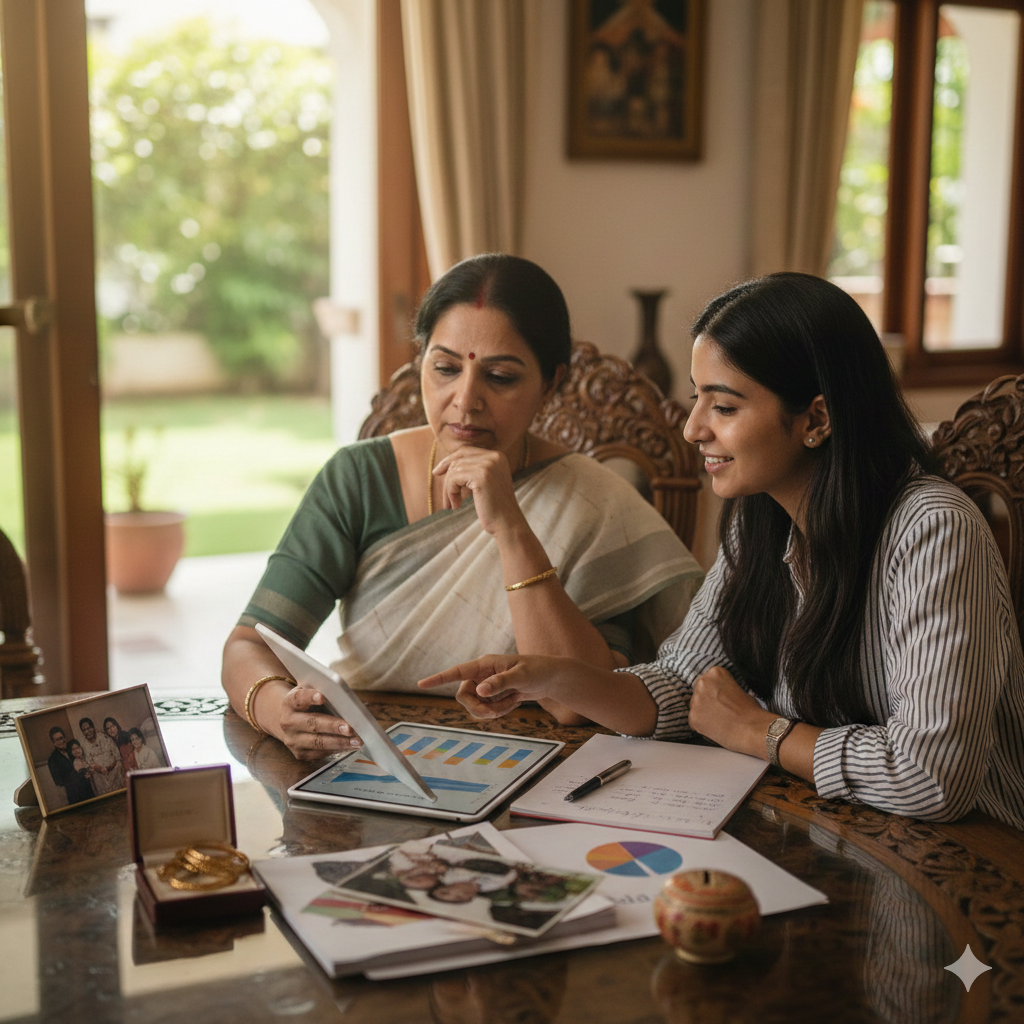
Bridging the gap: Sunita and her daughter discuss the importance of independent retirement planning for Indian women.
Retirement planning for women is often overshadowed by a “longevity-savings paradox”: while women typically outlive men, they often enter their golden years with significantly smaller financial corpuses. This gap is fueled by systemic hurdles, including the gender pay gap, with women in India earning roughly 27–34% less than men and frequent career interruptions for caregiving roles, which limit their ability to benefit from the power of compounding. Culturally, many Indian women have traditionally prioritized family milestones, such as children’s education and marriage, over their own long-term security, often relying on a spouse’s pension or family support. However, with the shift toward nuclear families and rising healthcare inflation, this dependence is becoming a major risk.
This article explores the unique financial trajectory of Indian women, through the lens of Sunita, a 52-year-old schoolteacher who realized that “saving” and “planning” are two very different things.
- Social Norms and Fragmented Incomes
- The Hidden Gaps: Caregiving and PF Accumulation
- Survivor Benefits and Targeted Products
- A Path to Success: Sunita’s Turnaround
The Retirement Talk: A Reality Check
When Sunita sat down with her family last Diwali, the conversation shifted to her brother’s sprawling retirement villa. It hit her then: despite working for 25 years, her own corpus looked significantly smaller. “I always prioritized the children’s education and gold for my daughter,” she shared. “I assumed the family pool would cover me, but I never calculated “My Own” specific needs for a life that might last 30 years past retirement.”
Social Norms and Fragmented Incomes
In the Indian context, social norms often dictate that men manage the “growth” investments while women handle “household” savings. This creates a **fragmented income cycle**. Women frequently move in and out of the workforce, leading to inconsistent contributions toward long-term goals. Because many women view their income as “supplemental” to the husband’s, they often miss the power of compounding on their own accounts.
The Hidden Gaps: Caregiving and PF Accumulation
Two major factors hit the Indian woman’s retirement fund the hardest:
- The Caregiving Penalty Sunita took a five-year break to care for her aging in-laws and later her newborn. During these peak earning years, her Provident Fund (PF) and National Pension System (NPS) contributions stopped entirely.
- Lower Accumulation: Even after returning to work, women often settle for roles with more “flexibility” but lower pay, leading to a smaller terminal corpus compared to male peers who stayed on a linear career path.
Survivor Benefits and Targeted Products
Statistically, Indian women outlive men. This makes survivor benefits a critical, yet often ignored, part of the conversation.
1. Life Insurance & Joint Holdings: Women must ensure they are not just nominees but active joint holders in annuities.
2. Targeted Products: Financial institutions now offer women-specific ULIPs and pension plans with lower premium rates or loyalty additions for milestones.
3. Health-Specific Riders:Given the rising cost of critical illness care in India, a standalone retirement plan must include a health buffer that doesn’t eat into the monthly pension.
A Path to Success: Sunita’s Turnaround
Sunita didn’t let the gap discourage her. She took three decisive steps:
SIP Acceleration: She diverted her year-end bonuses into equity-mutual funds to compensate for the “lost” five years.
NPS Tier II: She opened an NPS account to take advantage of the low fund management costs and the additional tax benefit.
The ‘Self-First’ Rule: She automated her retirement contribution to go out *before* the household budget was set.
Today, Sunita speaks openly with her daughter about financial independence. “Retirement isn’t a family project,” she says. “It’s a personal safety net.”




Start the conversation
Share a helpful experience, ask a thoughtful question, or add another perspective for fellow readers.