
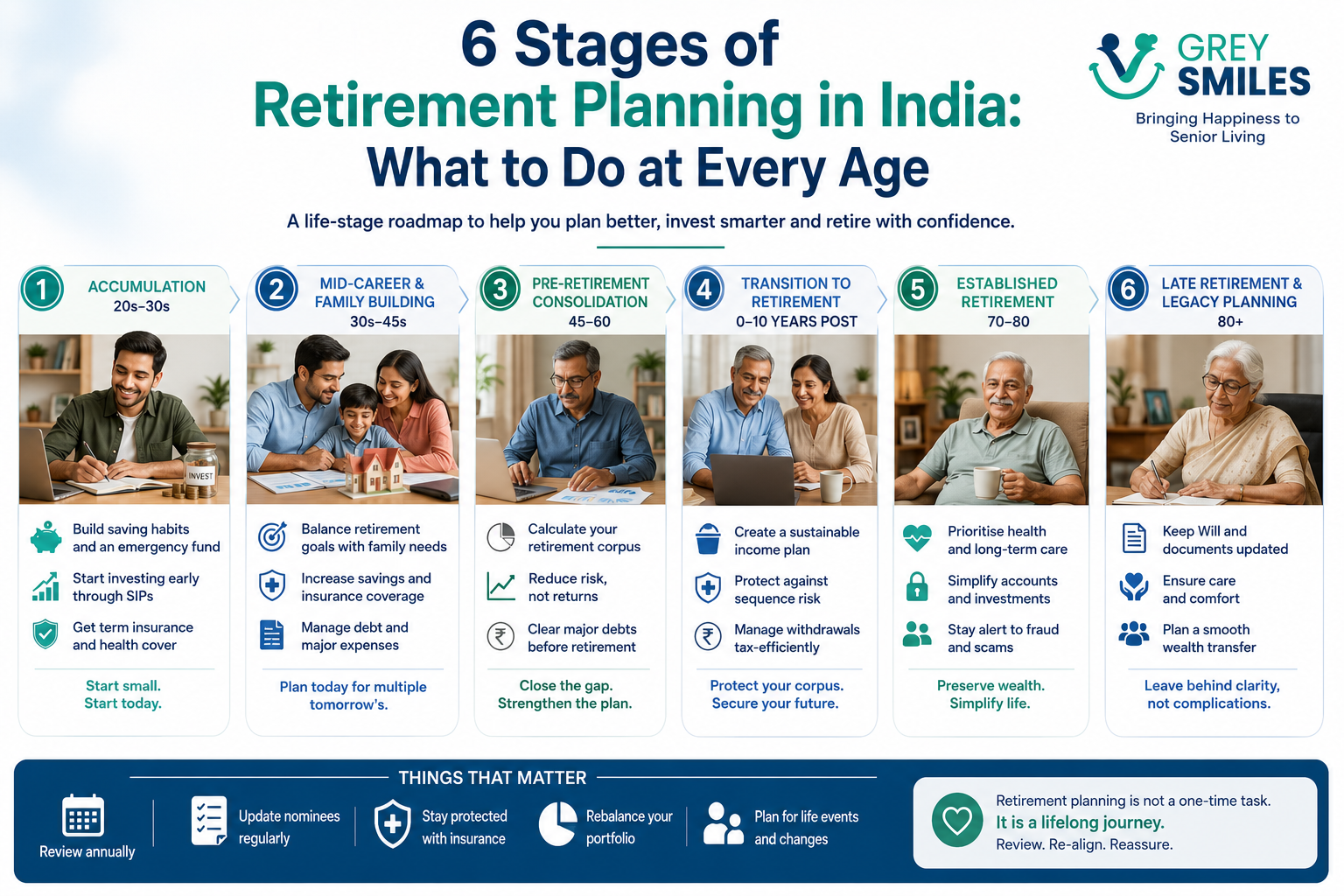
Six stages of retirement planning—from building wealth in your early years to protecting income, healthcare and legacy in later life
At a Glance: The Six Stages of Retirement Planning
- 20s–30s: Build the foundation. Start investing, create an emergency reserve, protect your income and give compounding time to work.
- 30s–45s: Balance competing goals. Build retirement wealth while managing children, housing, education and lifestyle expenses.
- 45–60: Close the retirement gap. Calculate what you actually need, reduce avoidable debt and gradually prepare the portfolio for retirement.
- First 10 years after retirement: Protect the transition. Build dependable cash flow and protect against early-market losses while you adjust to life after work.
- 70s: Simplify and preserve. Give greater attention to healthcare, liquidity, fraud protection and ease of financial administration.
- 80+: Prioritise dignity and legacy. Simplify finances, organise estate documents and ensure money is available for care when it is needed.
The most important point: retirement planning is not something you finish at 60. Your priorities change as your life changes, and your financial plan should change with them.
Retirement planning is often presented as a single number: “How much money will I need when I retire?”
That question matters, but it is only part of the story.
Your financial priorities at 25 are very different from those at 45. At 55, the question becomes less about accumulating as much as possible and more about whether your money can support the life you want after work. At 70, healthcare, liquidity and financial simplicity may matter more than maximising returns. Later still, estate planning and ease of access can become as important as investment performance.
That is why GreySmiles looks at retirement as a life-cycle journey rather than a retirement-date event.
The six stages below are a practical framework for thinking about what deserves the most attention at different points in life. The ages are illustrative rather than rigid; your career, family circumstances, health, finances and intended retirement age may move you from one stage to another earlier or later.
In This Article
- Stage 1 — Accumulation: Your 20s and 30s
- Stage 2 — Mid-Career and Family Building: 30s–45s
- Stage 3 — Pre-Retirement Consolidation: 45–60
- Stage 4 — Transition to Retirement: The First 10 Years
- Stage 5 — Established Retirement: Around 70–80
- Stage 6 — Late Retirement and Legacy: 80+
- How Your Portfolio May Change Over Time
- Common Retirement Planning Mistakes
- Your Annual Retirement Planning Checklist
- Frequently Asked Questions
Stage 1 — Accumulation: Your 20s and 30s
Main objective: Build the financial habits and protection that give your future self the greatest advantage—time.
When retirement is several decades away, the biggest asset you have is not your salary or even your investment portfolio. It is the number of years available for your savings to compound.
What can go wrong at this stage?
- Putting off investing because retirement feels too far away.
- Allowing lifestyle upgrades to consume every salary increase.
- Taking on expensive consumer debt.
- Depending entirely on employer-provided health insurance.
- Ignoring income protection because you are young and healthy.
What deserves your attention?
- Build an emergency fund: Aim for around 3–6 months of essential expenses. People with unstable or freelance income may need a larger cushion.
- Start long-term investing: Use diversified investments appropriate to your risk tolerance and time horizon. SIPs can make disciplined investing easier.
- Use available retirement vehicles: Understand the role of EPF, PPF and NPS within your overall plan rather than treating any one product as a complete retirement solution.
- Protect your income: If people depend on your earnings, consider appropriate term insurance and personal health insurance.
If You Are Here — Do This Now
Automate your first investment, build an emergency reserve and make sure high-interest debt does not become a permanent part of your lifestyle. You don’t need to start big. You need to start consistently.
For a deeper look at retirement investing, see GreySmiles’ guide to mutual funds for retirement planning.
Stage 2 — Mid-Career and Family Building: 30s–45s
Main objective: Build retirement wealth while managing the many competing financial demands that arrive during mid-life.
This is often the most financially crowded stage of life. There may be a home loan, children, education expenses, parents who need support, lifestyle upgrades and a career that is becoming more demanding.
The danger is allowing retirement to become the goal that gets whatever money is left over.
What can go wrong at this stage?
- Putting too much of your net worth into a single property.
- Using retirement savings for children’s education or lifestyle spending without rebuilding the corpus.
- Taking on increasingly large EMIs as income rises.
- Providing informal financial assistance without considering its impact on your own retirement.
What deserves your attention?
- Separate your goals: Retirement, children’s education, home ownership and short-term spending should not all compete for the same pool of money.
- Increase savings as income rises: Every promotion does not need to translate into a proportional lifestyle upgrade.
- Review insurance: Revisit health insurance and income protection as your responsibilities increase.
- Keep retirement contributions growing: EPF, VPF, PPF, NPS and long-term investments can work alongside one another depending on your circumstances and tax position.
If You Are Here — Do This Now
Calculate what your major goals could cost in the future rather than relying on today’s numbers. Then decide how much must be invested specifically for retirement. Don’t let retirement become whatever happens to be left at the end of the month.
Stage 3 — Pre-Retirement Consolidation: 45–60
Main objective: Find the retirement gap, reduce unnecessary risk and turn accumulation into a plan for future income.
This is the stage where retirement stops being a distant idea and starts becoming a real financial deadline.
You now have a much better idea of your likely retirement age, family responsibilities, assets and liabilities. That makes it possible to move from general saving to a much more meaningful retirement calculation.
What can go wrong at this stage?
- Taking excessive investment risk to compensate for inadequate savings.
- Assuming the current lifestyle will cost the same after retirement.
- Underestimating healthcare and long-term care expenses.
- Entering retirement with large personal loans or housing liabilities.
What deserves your attention?
- Calculate the retirement gap: Estimate future expenses, expected income and the corpus required to bridge the difference.
- Stress-test your plan: Consider inflation, longer life expectancy, healthcare costs and poor market returns.
- Gradually manage risk: Your portfolio does not necessarily need to become extremely conservative, but the money you will need soon should not depend entirely on equity-market performance.
- Reduce avoidable debt: Aim to enter retirement with your major liabilities under control.
If You Are Here — Do This Now
Run a proper retirement gap analysis. Work backwards from the lifestyle you want rather than forwards from the corpus you currently have. The difference tells you what needs fixing while you still have earning years left.
If you’re unsure where you stand, GreySmiles’ Retirement Readiness Test can help you identify what needs attention first.
Stage 4 — Transition to Retirement: The First 10 Years
Main objective: Turn accumulated wealth into dependable income without putting the entire retirement corpus under pressure.
Retirement changes the financial equation. For decades, your salary may have been the main source of cash flow. Now your investments, pension, annuity income and other sources need to work together.
The early years deserve particular care because withdrawing from a portfolio during a major market decline can have a disproportionate effect on how long the money lasts.
What can go wrong at this stage?
- Withdrawing too aggressively during the first few years.
- Keeping too little liquid money for near-term expenses.
- Taking excessive investment risk because the corpus feels insufficient.
- Spending heavily on travel, gifts or family commitments without a sustainable withdrawal plan.
What deserves your attention?
- Create a cash-flow plan: Separate essential expenses from discretionary spending.
- Build a near-term reserve: Keep money required for the next couple of years in appropriately liquid, lower-volatility instruments.
- Use a bucket approach if it suits you: Near-term spending, medium-term stability and longer-term growth can be managed separately.
- Review taxes: Understand how withdrawals, interest, pensions and capital gains interact with your tax position.
If You Are Here — Do This Now
Write down your essential monthly retirement expenses first. Then identify which income sources cover them and how the rest of your portfolio will support discretionary spending and future needs.
See GreySmiles’ practical guide to the 3-bucket retirement strategy for a deeper explanation of this approach.
Stage 5 — Established Retirement: Around 70–80
Main objective: Protect purchasing power while making your financial life simpler, safer and easier to manage.
At this stage, the retirement conversation changes again. Maximising returns may no longer be the only priority. Healthcare, liquidity, predictable income, financial safety and ease of administration become increasingly important.
What can go wrong at this stage?
- Underestimating medical and long-term care expenses.
- Maintaining too many bank accounts, investments and financial products.
- Allowing financial administration to become unnecessarily complicated.
- Becoming vulnerable to digital scams or inappropriate financial decisions.
What deserves your attention?
- Review your healthcare protection: Check health insurance, super top-ups and exclusions rather than assuming an old policy is sufficient.
- Keep sufficient liquidity: Avoid locking every rupee into products that are difficult to access when money is needed.
- Review your portfolio: Ensure your investments still match your actual needs, time horizon and risk tolerance.
- Simplify: Consolidate unnecessary accounts and keep a clear record of what you own and where it is held.
If You Are Here — Do This Now
Make your financial life easier to understand. Review nominations, account mandates, insurance policies, investments and important documents. The objective is not simply to earn more—it is to make sure your money remains useful and accessible when you need it.
Our guide to fixed-income laddering in India can help you think through how to organise predictable income and liquidity.
Stage 6 — Late Retirement and Legacy Planning: 80+
Main objective: Protect dignity, fund care and make the eventual transfer of wealth as simple as possible.
At this stage, the most successful financial plan may be the one that requires the least effort to operate.
That means fewer unnecessary accounts, clear documentation, accessible information and enough liquidity for healthcare and care-related expenses.
What can go wrong at this stage?
- Important documents becoming difficult to locate.
- Unclear estate instructions creating avoidable confusion.
- Insufficient funds set aside for assisted or long-term care.
- Property and financial arrangements becoming unnecessarily complicated.
What deserves your attention?
- Review your Will: Ensure it reflects your current wishes and circumstances and obtain appropriate legal advice.
- Organise an emergency folder: Keep important financial, property, insurance and medical information together in a secure and accessible manner.
- Plan for care: Think about how future home care, nursing or assisted living costs could be funded.
- Simplify assets: Consider whether every property, account or investment still serves a useful purpose.
If You Are Here — Do This Now
Make it easy for the right people to understand your financial life if you ever cannot manage it yourself. Organise documents, review your Will and clearly communicate your wishes where appropriate.
For the broader question of financial and legal protection later in life, see GreySmiles’ guide to ageing with authority, rights and dignity.
How Your Portfolio May Change Across the Six Stages
Your asset allocation will usually evolve as your time horizon changes. Someone with 30 years until retirement can generally tolerate more short-term market volatility than someone who needs the money next year.
The following is an illustrative framework, not a universal recommendation. Your allocation should reflect your goals, income sources, health, liabilities, risk tolerance and retirement horizon.
| Stage | Illustrative Equity | Illustrative Debt / Fixed Income | Illustrative Cash / Liquid |
|---|---|---|---|
| 20s–30s | 75–85% | 10–15% | 5–10% |
| 30s–45s | 60–75% | 20–30% | 5–10% |
| 45–60 | 40–50% | 40–50% | 10–15% |
| First 10 years after retirement | 20–35% | 50–65% | 15–20% |
| 70+ | 10–20% | 60–75% | 15–25% |
Remember: there is no magic equity percentage for a 60-year-old or a 75-year-old. A retiree with a substantial guaranteed pension and modest expenses may have very different needs from someone who relies almost entirely on investments for income.
5 Retirement Planning Mistakes That Can Follow You Across Every Stage
1. Treating retirement as a number rather than a lifestyle
A corpus target means little without knowing what it is expected to fund. Estimate the lifestyle, healthcare, housing and family commitments that your money will actually have to support.
2. Ignoring inflation
Today’s monthly household expense will not necessarily be tomorrow’s. Healthcare deserves particular attention because medical costs can become a significant part of later-life spending.
3. Confusing property wealth with retirement income
A valuable house can strengthen your net worth while producing little regular cash flow. Think separately about wealth and income.
4. Leaving healthcare planning until retirement
Health insurance, emergency reserves and a plan for potentially large medical expenses should be part of retirement planning well before retirement begins.
5. Never revisiting the plan
Salary, family circumstances, markets, health, tax rules and retirement expectations all change. A retirement plan that was sensible at 40 may need significant adjustment at 55.
Your Annual Retirement Planning Checklist
You don’t need to rebuild your entire financial plan every year. A focused annual review can catch many problems early.
- Review your current net worth and outstanding liabilities.
- Check whether your retirement savings rate is still on track.
- Review emergency funds and liquidity.
- Check health and life insurance coverage where relevant.
- Review nominations across bank accounts, investments and insurance policies.
- Check whether your investment allocation has drifted materially from your intended strategy.
- Review your expected retirement age and retirement income requirement.
- Update your Will and important estate documents when circumstances change.
- Keep a clear record of important financial accounts and documents.
The GreySmiles Rule of Retirement Planning
Don’t wait for the “right age” to start planning. At every stage, ask one simple question: What is the most important financial risk I can fix now? The answer will change over time. That is exactly why retirement planning needs to be a life-cycle process.
Frequently Asked Questions
What are the six stages of retirement planning?
The six stages are broadly: accumulation in your 20s and 30s; mid-career and family building in the 30s to 45s; pre-retirement consolidation around 45–60; the transition and first years of retirement; established retirement around the 70s; and late retirement and legacy planning from around 80 onwards. These are illustrative stages rather than fixed age rules.
When should I start retirement planning in India?
The earlier you start, the more time you have to build savings and allow long-term investments to compound. But starting late is not a reason to give up. If you are already in your 40s or 50s, the priority is to understand your retirement gap and identify what needs to change while you still have earning years.
How much should I save for retirement?
There is no single number that applies to everyone. Your retirement corpus depends on your desired lifestyle, current expenses, inflation, retirement age, expected longevity, healthcare costs, guaranteed income and investment returns. A proper retirement calculation should bring these factors together.
Should my investment portfolio become more conservative as I approach retirement?
Often, the money you need in the near term should be exposed to less volatility than money that will not be needed for many years. However, moving everything out of growth assets can create another risk—your money may not keep pace with inflation. The right balance depends on your income needs, time horizon and risk tolerance.
Is retirement planning only about investments?
No. A good retirement plan also includes health insurance, emergency reserves, debt management, tax planning, income generation, estate planning and decisions about where and how you want to live. Investments are only one part of the picture.
How often should I review my retirement plan?
An annual review is a sensible starting point, with additional reviews after major life events such as marriage, the birth of a child, a career change, a major property transaction, significant health changes or a change in your expected retirement date.
Conclusion: Retirement Planning Changes Because Life Changes
The mistake is to think that retirement planning ends when you reach your retirement date.
In reality, your financial priorities keep changing. In your 20s, the biggest advantage is time. In your 40s, it is the ability to correct course while you are still earning. In your 50s, clarity becomes critical. Once you retire, the challenge shifts towards turning wealth into dependable income while protecting against inflation, market volatility and healthcare costs.
Later in life, simplicity, dignity and legacy become increasingly important.
There is therefore no single “retirement plan”. There is a retirement plan for where you are today—and another one for the person you will become ten, twenty or thirty years from now.
Start with your current stage. Identify the biggest risk. Fix what you can. Review it again next year.
That is how retirement planning becomes a lifelong process rather than a last-minute financial exercise.
Related GreySmiles Guides
- Can I Retire? GreySmiles Retirement Readiness Test
- Mutual Funds for Retirement: A Strategic Guide
- The 3-Bucket Strategy for Retirement Drawdown
- Fixed-Income Laddering in India
- Age With Authority: Your Home, Your Rights, Your Dignity
Disclaimer: This article is intended for general education and information. Asset allocation, insurance, tax and investment decisions should be based on your individual circumstances. Tax rules, investment products and government schemes can change, so verify current rules and seek qualified professional advice before making significant financial decisions.




Start the conversation
Share a helpful experience, ask a thoughtful question, or add another perspective for fellow readers.