
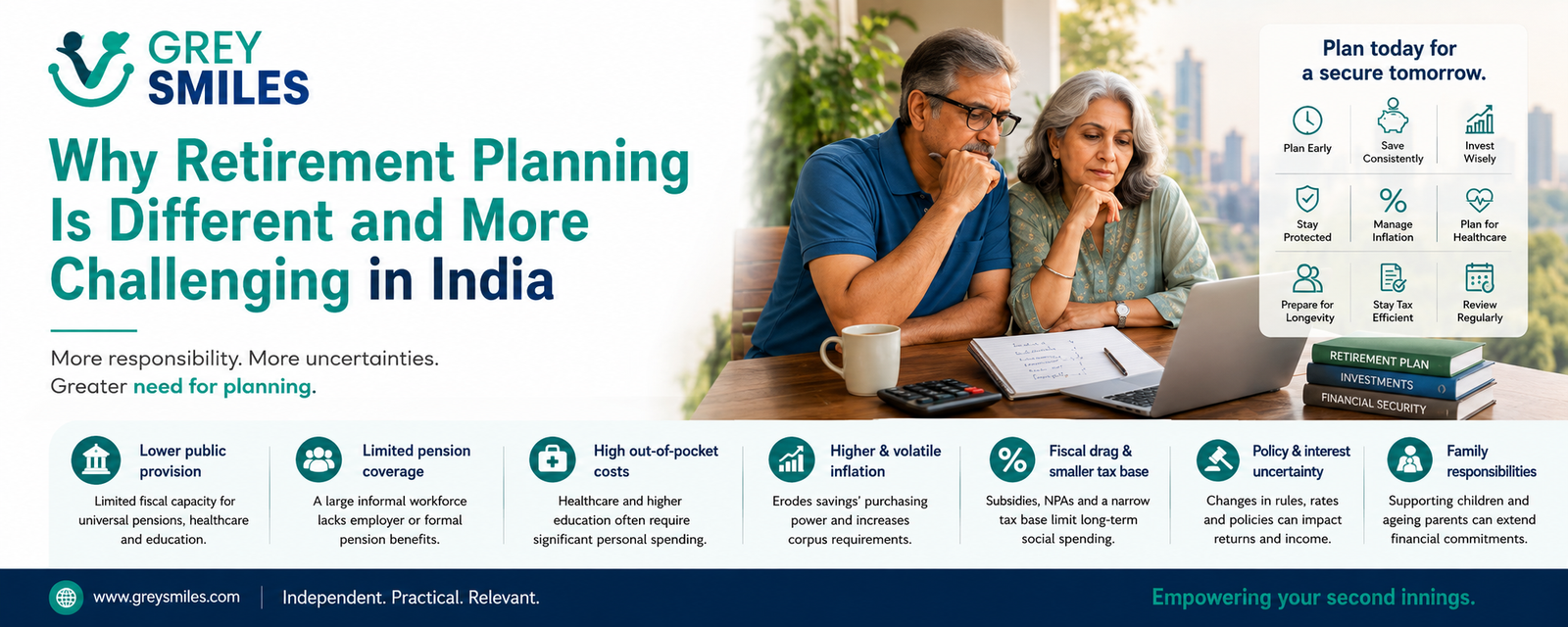
Retirement planning in India is different because a larger share of your future financial security has to be planned and funded by you. Pension coverage is uneven, healthcare can involve significant out-of-pocket spending, inflation can erode the purchasing power of savings, and retirement may last for two or three decades. These factors make early planning, adequate diversification and a realistic retirement corpus particularly important.
At a Glance
- Retirement planning in India often requires greater individual preparation for healthcare, longevity and income after work.
- Formal pension and employer-sponsored retirement benefits do not cover everyone, particularly across India’s large informal workforce.
- Inflation can substantially increase the amount you need by the time you retire.
- Healthcare and family-related expenses can continue well into retirement and should not be treated as afterthoughts.
- Your retirement plan should combine corpus building, protection, diversification and an income strategy.
- The earlier you start, the more time you have to build the corpus and adjust if you fall behind.
Why Is Retirement Planning Different and More Challenging in India?
India has made significant progress in financial inclusion, pensions, healthcare and social protection. But the level and reach of these systems are not uniform across the population. For many households, retirement security still depends heavily on personal savings, investments, property, family resources and insurance.
That changes the retirement-planning question. It is not simply:
“How much will I need to retire?”
It is also:
“Which expenses and risks will I have to fund myself, and how long might I need the money to last?”
1. Retirement Income Is Not Automatically Guaranteed
Government pensions and employer-sponsored retirement schemes provide important support for some sections of the workforce, while schemes such as EPF and NPS have expanded formal retirement saving. But India also has a very large informal workforce, for whom employer-sponsored retirement benefits may not be available in the same way.
This makes personal retirement savings particularly important for self-employed people, entrepreneurs, professionals and workers outside formal employment structures.
For information on EPF and related services, the Employees’ Provident Fund Organisation (EPFO) is the primary official source. For NPS information, use the Pension Fund Regulatory and Development Authority (PFRDA).
GreySmiles Thumb Rule: Treat EPF, NPS, pension income and other guaranteed or relatively predictable income as parts of your retirement plan, not automatically as a complete retirement plan.
2. Healthcare Can Become a Major Retirement Expense
Healthcare is one of the biggest uncertainties in retirement because expenses can rise precisely when employment income has stopped.
India’s National Health Accounts show that out-of-pocket expenditure remains a significant component of health spending. The latest available National Health Accounts estimates also show that households continue to finance a substantial share of healthcare directly.
This does not mean every retiree will face large medical bills. It means your retirement plan should allow for the possibility of healthcare costs that are higher than your normal household spending.
Consider three layers:
- Health insurance for eligible medical expenses.
- An emergency medical reserve for costs that insurance may not fully cover.
- A retirement corpus large enough to absorb healthcare spending without destroying your regular income plan.
For broader retirement healthcare planning, see the GreySmiles guide on healthcare costs in retirement if that is the current published destination.
3. Inflation Changes the Retirement Number
One of the most common retirement-planning mistakes is to think in today’s rupees.
If you spend ₹8 lakh a year today, you should not assume that ₹8 lakh will be sufficient twenty years from now. Food, housing, healthcare, travel, domestic help and other expenses may all cost considerably more.
Inflation therefore affects both sides of the retirement equation:
- the amount you need to accumulate before retirement; and
- the amount you may need to withdraw every year after retirement.
This is why a retirement corpus calculation should use a realistic inflation assumption rather than simply multiplying today’s expenses by the number of retirement years.
Use our retirement corpus calculation guide to work through the numbers.
4. Retirement May Last Much Longer Than You Expect
Retirement is no longer necessarily a ten-year period at the end of life. Someone retiring at 60 may need their retirement savings to support them for 25 or 30 years, sometimes longer.
That creates a difficult combination:
- your employment income stops;
- your investments still need to support you;
- inflation continues;
- healthcare needs can increase with age; and
- markets may be volatile during the period in which you are withdrawing money.
Longevity therefore needs to be treated as a financial risk, not simply a demographic statistic.
5. Family Responsibilities Can Extend Into Retirement
Indian retirement planning can also involve financial responsibilities towards children, ageing parents or other family members.
Education costs, support for adult children, weddings, parental healthcare or assistance to a family member can sometimes continue well beyond the point at which someone expected to become financially independent.
The answer is not to assume that every family responsibility must be funded from the retirement corpus. Instead, separate goals wherever possible.
GreySmiles Advice: Your retirement corpus should not quietly become the family’s emergency fund for every future expense. Separate retirement money from children’s education, major family commitments and other identifiable goals wherever you can.
6. Traditional “Safe” Investments May Not Be Enough on Their Own
Indian savers have traditionally relied heavily on bank deposits, fixed deposits, provident-fund savings and other fixed-income instruments. These can play an important role in a retirement portfolio.
But safety of principal and protection of purchasing power are not exactly the same thing.
If your investment return after tax is below inflation over a long period, the real purchasing power of your money can decline even though the nominal balance appears to be increasing.
This is why retirement planning usually requires a balance between:
- growth assets for long-term purchasing-power protection;
- stable or lower-volatility assets for capital protection and near-term needs; and
- liquid reserves for emergencies and short-term spending.
7. Policy, Interest Rates and Tax Rules Can Change
Retirement planning often spans several decades. The interest rates, tax rules, investment products and government policies that exist when you start saving may not be the same when you retire.
That is another reason not to build a retirement strategy around a single product or a single assumption.
A robust plan should be capable of being reviewed and adjusted as your circumstances and the financial environment change.
What Does This Mean for You?
The practical implication is simple:
You need to take active ownership of your retirement plan.
That does not mean you need to manage every investment yourself. It means you should know:
- how much you are likely to spend in retirement;
- when you expect to retire;
- how much retirement income you can expect from EPF, NPS, pensions, annuities or other sources;
- how large a corpus you are likely to need;
- how healthcare and family responsibilities could affect that number;
- how your investments are allocated; and
- how you will convert your accumulated wealth into sustainable retirement income.
A Practical Retirement Planning Roadmap for India
1. Start Early
Starting early gives your savings more time to compound and gives you more opportunities to correct mistakes.
You do not need a large starting amount. Consistency and increasing your contribution as your income grows can be more important than waiting until you can make a large investment.
2. Calculate Your Retirement Corpus
Begin with today’s annual expenses and then account for inflation, years to retirement, retirement duration, other income and healthcare requirements.
A simple rule of thumb can be a useful starting point, but it should not become a substitute for a proper calculation.
For example, a 25–30 times multiple of annual retirement expenses can provide a rough first estimate in some situations, but the appropriate corpus can vary significantly depending on inflation, expected returns, retirement duration, asset allocation and other income.
3. Build Protection Before Chasing Returns
Your retirement strategy should not depend entirely on investment returns.
Consider:
- adequate health insurance;
- an emergency fund;
- appropriate life insurance while dependants rely on your income;
- manageable debt levels; and
- adequate liquidity for near-term needs.
4. Build a Diversified Investment Strategy
Long-term retirement investing may require exposure to different asset classes. Equity can provide long-term growth potential, while debt and other relatively stable assets can help manage volatility and provide liquidity.
The right mix depends on your age, retirement horizon, risk capacity and existing assets. There is no universal equity-versus-debt allocation that works for everyone.
5. Use EPF, NPS, PPF and Other Instruments as Parts of the Plan
Tax treatment, liquidity, risk and investment structure differ across products. Tax benefits should therefore be considered alongside — not instead of — your overall asset allocation.
For current rules and product features, always check the relevant official source rather than relying on an old article or social-media explanation.
6. Keep Debt Under Control
Entering retirement with expensive consumer debt or a large loan can dramatically increase the amount of investment income you need.
Where practical, reduce high-cost debt before retirement and plan carefully for any housing loan or other long-term borrowing that will continue after you stop working.
7. Consider a Phased Retirement
Retirement does not have to be an on-off switch.
Consulting, freelancing, teaching, mentoring or part-time work can provide income while also reducing the amount you need to withdraw from your portfolio during the early years of retirement.
For some people, a phased retirement can materially improve financial resilience.
8. Review the Plan Regularly
A retirement plan created at 40 should not be expected to remain unchanged until 60.
Review your expenses, savings rate, investment allocation, retirement date, expected income and major family responsibilities periodically.
The purpose of a review is not to constantly change investments. It is to make sure the plan is still on track.
India vs Developed Economies: What Should You Actually Take Away?
It is tempting to compare India with developed economies and conclude that one system is simply better than the other. That is too simplistic.
Countries differ in their pension systems, taxation, healthcare financing, social security, employment structures and household responsibilities. The more useful question for an Indian household is:
Which costs and risks are likely to fall on me?
| Retirement risk | What to plan for |
|---|---|
| Longevity | A corpus that can potentially support a long retirement |
| Inflation | Investments and income that retain purchasing power |
| Healthcare | Insurance, emergency reserves and additional healthcare provision |
| Income gap | A combination of pension, investments and other reliable income |
| Family responsibilities | Separate funding for major family goals wherever possible |
| Market risk | Diversification and a withdrawal strategy appropriate to retirement |
FAQs
Why is retirement planning important in India?
Because many households cannot assume that a pension or other guaranteed income will cover all retirement expenses. Healthcare, inflation, longevity and family responsibilities can create substantial financial requirements after employment income stops.
Is retirement planning more difficult in India than in developed countries?
It depends on the country and the individual. India has expanded pension, healthcare and social-protection programmes, but coverage and household circumstances vary widely. For many Indians, personal savings and investments remain an important part of retirement security.
How much retirement corpus do I need in India?
There is no single number. Your required corpus depends on current spending, inflation, retirement age, retirement duration, expected investment returns, other income and healthcare or family obligations. A corpus calculator is more useful than applying a single universal number.
Should I start retirement planning in my 30s?
Yes. Starting in your 30s gives you a longer investment horizon and more time to benefit from compounding. It also gives you more time to adjust your savings rate if your retirement target changes.
Read: Retirement Planning in Your 30s: Follow These 10 Principles
What if I have started retirement planning late?
A late start does not mean retirement planning is pointless. It means the plan may need a higher savings rate, a later retirement date, lower future spending, additional income or a combination of these. The first step is to calculate the gap rather than assume it is too late.
This is an important area for GreySmiles’ developing Late Start retirement-planning content.
Is EPF enough for retirement?
EPF can be an important part of retirement savings, particularly for eligible employees, but whether it is enough depends on your eventual expenses, retirement age, other assets and expected retirement income. It should be evaluated as one component of the overall plan.
Should I invest aggressively for retirement?
Not simply because retirement is important. The appropriate level of investment risk depends on your time horizon, financial capacity to absorb losses and how soon you will need the money. A retirement portfolio should balance growth with the need to protect money as retirement approaches.
The GreySmiles Take
GreySmiles Thumb Rule
Don’t build your retirement plan around what you hope the system will provide. Build it around what you know you will need.
India’s retirement landscape is changing. Pension coverage is expanding, financial products are becoming easier to access and households have more ways to save and invest than previous generations.
But the fundamental responsibility remains personal: understand your future expenses, build adequate assets, protect yourself against major financial shocks and create a plan for income after work.
You do not have to solve everything today.
Start early if you can. Start now if you haven’t.
And remember that retirement planning is not a one-time calculation. It is a plan that should evolve as your income, family, health, investments and retirement date change.
Also Read: Retirement Planning in Your 30s: Follow These 10 Principles
Also Read: Are Women Well Prepared for Retirement in India?
Important: This article is for educational purposes and is not personalised financial, investment, tax, insurance or legal advice. Retirement needs vary significantly by individual. Verify current rules, tax treatment, product features and government schemes through official sources before making financial decisions.



Start the conversation
Share a helpful experience, ask a thoughtful question, or add another perspective for fellow readers.