
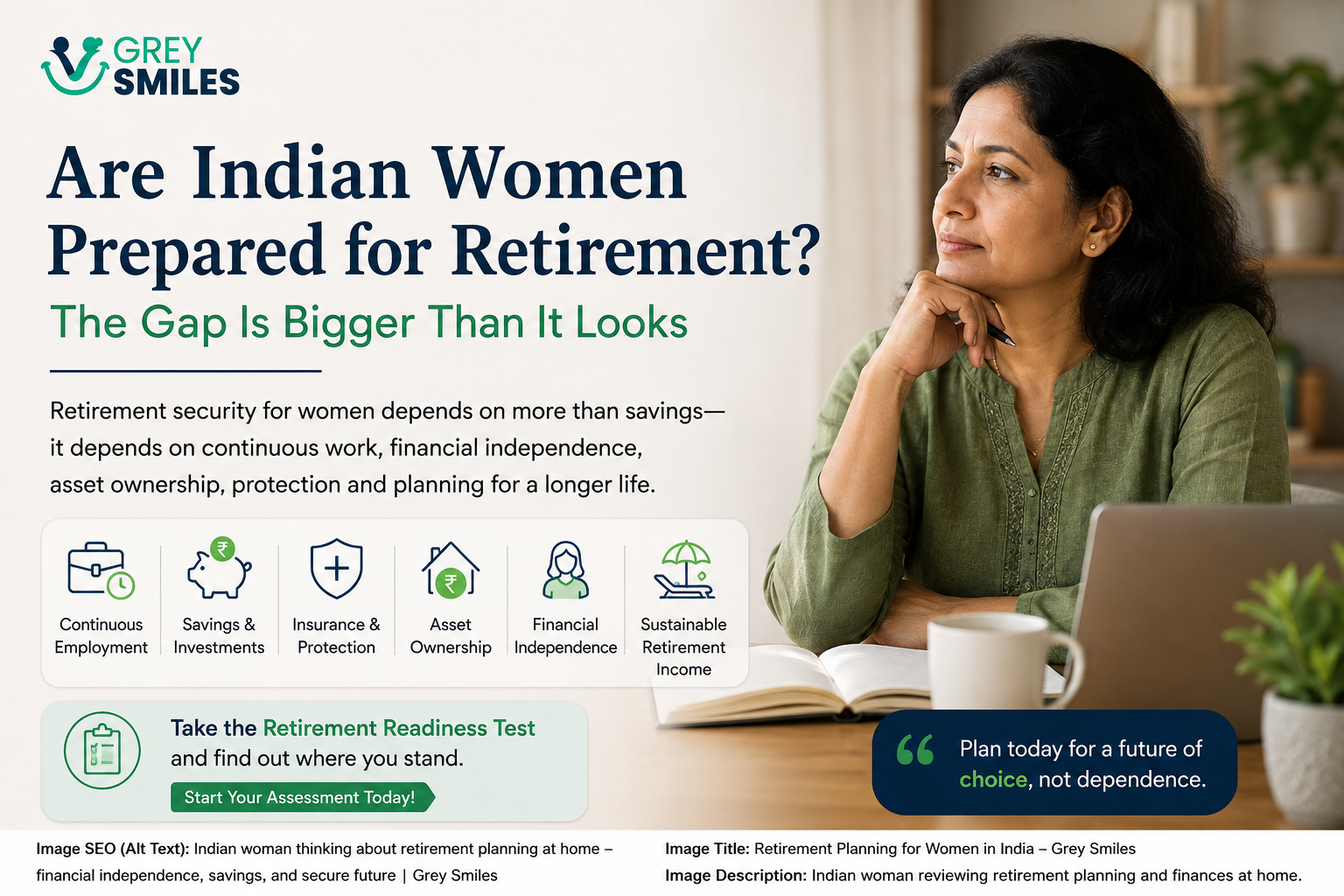
The question is not simply whether women save. It is whether they have had enough continuous years of paid work, adequate income, access to formal retirement benefits and control over assets to build financial security of their own.
Despite progress in education, employment and financial access, many Indian women still enter later life with less independent financial security than they need. The reasons run deeper than investment knowledge. Grey Smiles’ analysis of what happens to an Indian woman when she retires explores the deeper issue of financial independence within the family. For a broader assessment of retirement preparedness, the Grey Smiles Retirement Readiness Test looks beyond savings to the wider picture.
At a Glance
- Women often have fewer continuous years of paid employment because of caregiving and family responsibilities.
- Many women work outside formal employer-based retirement systems, limiting access to benefits such as EPF.
- A household can be financially comfortable while the woman has little money or property she can independently access or control.
- Longer life expectancy can mean retirement savings have to last for more years.
- Widowhood can expose weaknesses in a retirement plan that looked adequate while both spouses were alive.
- Retirement security depends on employment, ownership, insurance, financial knowledge and social protection — not simply on saving more.
The Retirement Gap Starts During Working Life
Retirement savings are ultimately built from income, years of earning and time invested. This is where many women start at a disadvantage.
India’s Time Use Survey 2024 shows the continuing imbalance in paid and unpaid work. Among people aged 15–59, women were much less likely than men to participate in employment and related activities. The survey also found that women who performed unpaid caregiving spent about 137 minutes a day on it, compared with 75 minutes for men, while women spent substantially more time on unpaid domestic services. The full Time Use Survey report provides the broader picture.
That matters for retirement because a career break is not only a loss of current salary. It can mean fewer EPF contributions, fewer years of investment, slower career progression and less time for savings to compound. It is one reason the six stages of retirement planning cannot be treated as a one-size-fits-all journey. It also explains why retirement planning needs to start well before the final few years of employment.
The same issue applies to women who work predominantly in informal or irregular employment. Being economically active does not automatically mean having a pension, provident fund or employer-supported retirement benefit.
Income Is Only Part of the Problem
There is another distinction that matters in India: family wealth is not necessarily the same as individual financial security.
A family may own a home, land, gold, investments or a business, while the woman herself has limited control over those assets. This becomes particularly important after widowhood, when the surviving spouse may suddenly need to manage investments, bank accounts, insurance, property and household expenses that she did not previously handle. Grey Smiles’ article on women and retirement examines this distinction between family money and a woman’s own financial security in greater depth.
That is why retirement planning for women should include a simple test: Could I manage my finances independently if I had to?
For a homemaker, the question is equally relevant. Unpaid household and caregiving work has economic value, but it does not automatically create an individual retirement corpus. A couple’s retirement plan should therefore consider whether both partners have adequate access to assets, insurance and income — not simply whether the household has a large net worth.
Longer Lives Make the Problem More Important
Women generally live longer than men, which can mean a longer period of retirement to finance. The objective is therefore not just to accumulate a corpus by age 60. It is to create income that can withstand inflation, healthcare costs and a potentially long retirement.
This is especially important for women who become widows. A plan based largely on a husband’s income, pension or investments can change overnight. Retirement preparedness should therefore include knowing what income will remain, what assets are jointly or individually owned, how nominations are arranged and where key documents are kept.
What Can Women Do?
The first step is not choosing an investment product. It is getting a clear picture of the financial position: income, expenses, assets, liabilities, insurance and expected retirement income. That is also the starting point for the broader Grey Smiles Retirement Readiness Test.
Women in formal employment should understand their EPF and other employer retirement benefits. The Employees’ Provident Fund Organisation (EPFO) provides information and services relating to EPF and other social-security schemes. NPS can also be used voluntarily by eligible Indian citizens aged 18–85 under current rules. PFRDA’s current NPS information should be checked before making decisions because rules can change.
Women outside formal employment also have options, depending on eligibility and circumstances, including PPF, NPS and suitable investments. Atal Pension Yojana is available to eligible Indian citizens aged 18–40 with a savings account, subject to the restriction on new subscribers who are or have been income-tax payers since October 2022. PFRDA’s current APY rules should be checked before enrolling.
The larger point is more important than any individual product: build retirement assets that you understand and can access, rather than relying entirely on a spouse, children or property. For homeowners, property can form part of a retirement strategy, but it should not automatically be treated as retirement income. Grey Smiles’ guide to reverse mortgage explains one option for converting home equity into income without selling the home.
Alongside retirement savings, maintain an emergency fund, review health insurance, consider inflation when estimating future expenses, and keep nominations and important documents current. A will may also be appropriate depending on the family’s circumstances.
If You Are Already 45, 50 or 55
Starting late is not the same as starting too late.
At this stage, the priority should be to calculate the actual retirement income gap, reduce expensive debt, protect against major healthcare costs, increase savings where possible and consider whether working for a few additional years could materially improve the outcome. The Retirement Readiness Test can help identify which gaps deserve attention first.
Retirement does not necessarily have to mean stopping work completely. Part-time work, consulting or a second career can provide income and reduce the number of years that savings need to support you — provided the work remains a choice rather than a financial necessity.
What Needs to Change Beyond Individual Saving?
Women cannot solve the entire retirement gap through better investing. Greater participation in formal employment, easier career re-entry after caregiving, affordable childcare, safer workplaces and stronger social-security coverage for informal workers all affect how much retirement security women can build.
Employers can help by making retirement benefits easier to understand and supporting women returning after career breaks. Policymakers can strengthen portable social protection and financial-literacy initiatives for women outside formal employment.
A Simple Retirement Check
- Do I know what I own, what I owe and what I spend?
- Do I have retirement savings or assets in my own name?
- Do I know what monthly income I am likely to have after retirement?
- Could I manage the household finances if my spouse were no longer able to do so?
- Are my health insurance, nominations and important documents in order?
- If I am approaching retirement, do I know the size of my retirement income gap?
If several answers are “no”, that is where the planning needs to begin. The Grey Smiles Retirement Readiness Test can help turn that broad concern into a more structured assessment, while the women and retirement guide goes deeper into the specific financial vulnerabilities women can face.
The Bottom Line
Too many Indian women still enter later life with less financial security than they need. The reasons go well beyond investment knowledge: interrupted careers, unpaid caregiving, informal employment, lower lifetime earnings, limited individual asset ownership and longer lives all play a part.
The encouraging part is that retirement preparedness can improve at almost any age. The aim is not to accumulate products or depend on a single source of income. It is to build enough income, assets, protection and financial control that retirement remains a period of choice rather than dependence.
FAQs
Why are women more exposed to retirement insecurity?
Career interruptions, unpaid caregiving, lower lifetime earnings, informal employment and longer lives can all reduce retirement security. The extent of the risk varies considerably by income, employment and family circumstances.
Should homemakers have retirement savings in their own name?
Ideally, yes. A household may have adequate wealth while a homemaker has little independent access to money. Retirement planning should consider the financial security of both partners.
Is NPS suitable for women?
NPS can be one component of retirement planning for eligible individuals. Whether it is suitable depends on the person’s goals, time horizon, risk tolerance and overall finances; current PFRDA rules should be checked before investing.
What if I am nearing retirement with inadequate savings?
Start with the gap rather than trying to make up for lost time through high-risk investments. Review expected income and expenses, reduce expensive debt, protect against healthcare costs, increase savings where possible and consider whether a longer working life can improve the position. The Grey Smiles Retirement Readiness Test is a useful next step if you want to identify what needs attention first.




Start the conversation
Share a helpful experience, ask a thoughtful question, or add another perspective for fellow readers.