
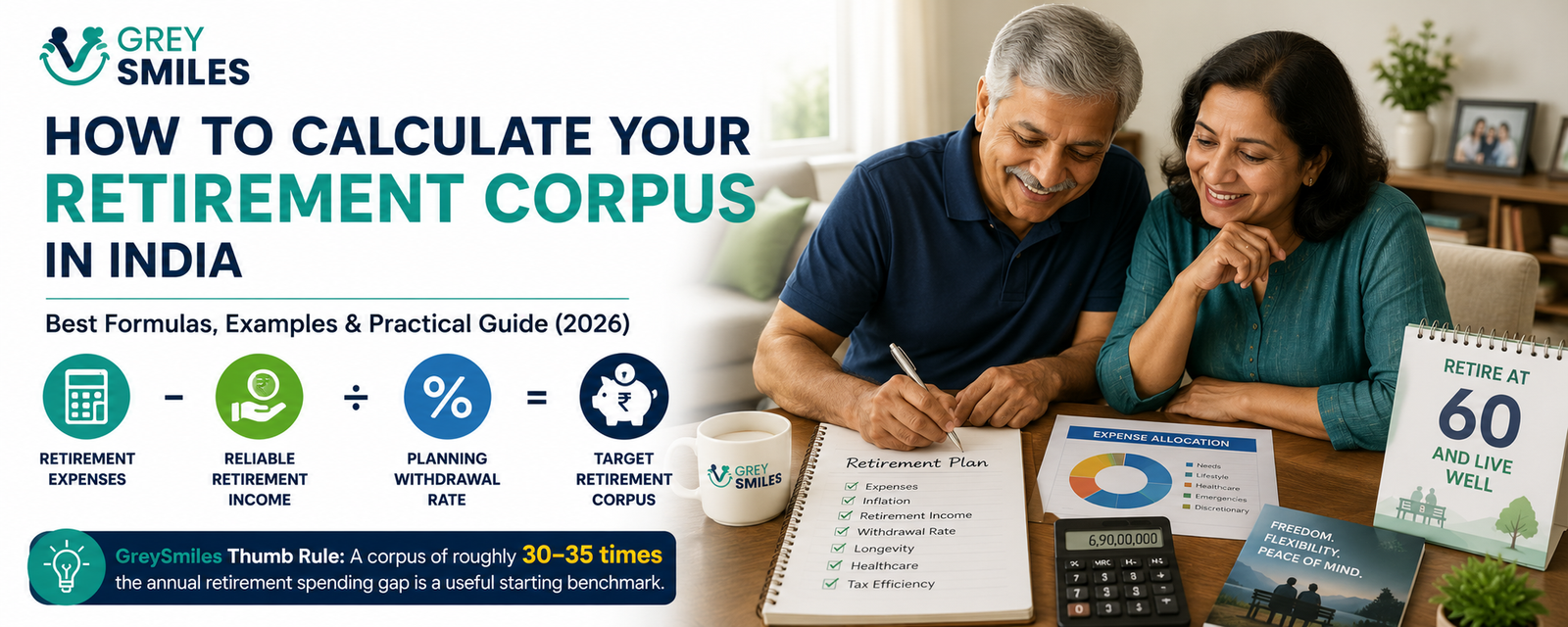
How much do you need for retirement? There is no single number that works for everyone. Your retirement corpus depends on what you expect to spend, when you retire, how long the money may need to last, what income you can depend on, and how much risk your retirement plan can absorb.
A person spending ₹80,000 a month today may need a very different retirement corpus from someone spending the same amount but retiring ten years earlier, supporting parents or children, living in a high-cost city, or expecting substantial healthcare expenses.
That is why retirement corpus calculation should not begin with a target such as ₹3 crore, ₹5 crore or ₹10 crore. It should begin with a more useful question: What will my retirement actually cost, and what part of that cost will my investments need to fund?
At a Glance
- Your retirement corpus is not a universal number. It depends primarily on how much you expect to spend, when you retire and how long the money may need to last.
- Start with expected retirement spending, then account for inflation, dependable income, healthcare, taxes, longevity and irregular expenses.
- A simple 25X, 30X or 35X rule can be a useful starting benchmark, but it should not be treated as a guarantee.
- A better approach is to stress-test your corpus under different assumptions rather than relying on one magic number.
- Once you have an indicative corpus requirement, the next question is whether your withdrawal strategy can sustain it through retirement.
What Is a Retirement Corpus?
Your retirement corpus is the pool of financial assets available to support you after regular employment income stops or reduces significantly.
It may include investments and retirement savings such as mutual funds, EPF, PPF, NPS, deposits and other financial assets, depending on your circumstances. The important question is not simply how large the corpus is, but what job that corpus has to perform.
For example, a retiree with a dependable pension may need a smaller investment corpus than someone with no regular retirement income, even if both have identical monthly expenses.
So the calculation is really about the funding gap between what retirement costs and what dependable income can reasonably cover.
Why There Is No Single “Right” Retirement Corpus
You will often see retirement targets expressed as a fixed multiple of annual expenses — 25X, 30X, 35X or even 40X. These can be useful as rough benchmarks because they help you understand the scale of the problem and start a retirement-planning conversation.
But they are not personalised retirement plans.
The same ₹5 crore corpus can look comfortable in one situation and inadequate in another. The difference may come from retirement age, spending, inflation, guaranteed income, investment mix, healthcare needs, taxes, longevity and how flexible the retiree can be about spending.
GreySmiles Take: Don’t ask, “Is ₹5 crore enough?” in isolation. Ask, “Enough for what retirement, for how long, and after accounting for which other sources of income?”
Step 1: Start With Your Retirement Spending
The most useful starting point is your expected retirement spending — not your current salary.
Your current expenses provide the baseline, but retirement can change the shape of your spending. Some costs may disappear, some may reduce and others, particularly healthcare and leisure, may increase.
| Expense | What to consider |
|---|---|
| Housing | Rent, maintenance, repairs, property costs and society charges. |
| Food & household | Groceries, domestic help and household services. |
| Healthcare | Insurance, medicines, consultations, diagnostics and potential long-term care. |
| Transport | Car ownership, public transport, fuel, cabs and mobility needs. |
| Travel & leisure | Holidays, hobbies, dining out and experiences. |
| Family support | Support for children, parents or other family members if you expect it to continue. |
| Insurance & taxes | Premiums and taxes that may continue after employment. |
| Irregular expenses | Home repairs, appliances, vehicles, family events and other occasional costs. |
A useful way to begin is to look at your actual spending over the last 12 months rather than trying to invent a retirement budget from scratch. Then ask which expenses will disappear, which will reduce, and which may actually increase.
Step 2: Adjust Today’s Spending for Inflation
₹1 lakh a month today will not buy what ₹1 lakh buys ten or fifteen years from now. That makes inflation one of the most important assumptions in retirement corpus calculation.
A basic future-value calculation is:
Future annual spending = Current annual spending × (1 + inflation rate)number of years
For example, if your current annual spending is ₹12 lakh and you expect retirement to begin 15 years from now, even a moderate inflation assumption can materially change the amount you will need to fund.
The important point is not to choose an inflation number simply because it produces a convenient corpus target. Your assumptions should be reasonable, explicit and revisited as circumstances change.
Healthcare deserves particular attention because medical expenses may behave differently from many ordinary household expenses. It is often better to examine healthcare separately rather than assume that every retirement expense will rise at exactly the same rate.
Step 3: Identify Income You Can Actually Depend On
Not every future income stream should automatically be treated as guaranteed retirement income.
Depending on your situation, you may have income from:
- Pension or family pension
- NPS or other retirement income arrangements
- EPF-related retirement savings
- Rental income
- Interest or other relatively dependable income
- Annuity income
- Part-time or consulting income you genuinely expect to continue
The key word is dependable.
If an income stream depends on a property remaining occupied, a business continuing to perform, or you continuing to work, it may be more appropriate to treat it cautiously rather than as a guaranteed offset.
Annual retirement spending − dependable annual income = amount the portfolio may need to fund
Step 4: Calculate the Corpus Requirement
Once you have an estimate of future spending and dependable income, you can begin thinking about the corpus required to fund the remaining gap.
A simplified framework is:
Corpus requirement ≈ Annual portfolio-funded spending ÷ sustainable withdrawal rate
This is useful as a planning framework, but the withdrawal rate is an assumption — not a law of nature.
A sustainable withdrawal rate depends on factors such as:
- How long the retirement may last
- Asset allocation
- Market returns and sequence of returns
- Inflation
- How flexible spending can be
- Healthcare and other large irregular expenses
- Taxes and investment costs
- Whether dependable income covers part of essential spending
That is why a corpus calculation should produce a range and a decision framework, rather than false precision.
🧮
Calculate Your Retirement Corpus
Put your own retirement spending, timeline and assumptions into the calculation to get a more useful starting point for your retirement plan.
Calculate Your Retirement Corpus →
Illustrative planning tool. Your actual requirement will depend on your assumptions, circumstances and investment outcomes.
What About the 25X, 30X or 35X Rules?
These rules are easy to understand. If your annual retirement spending is ₹12 lakh:
| Rule | Illustrative corpus |
|---|---|
| 25X | ₹3 crore |
| 30X | ₹3.6 crore |
| 35X | ₹4.2 crore |
They can provide useful reference points, but they should not be mistaken for a personalised answer.
Someone retiring relatively early with uncertain income and limited flexibility may need a larger margin of safety. Someone retiring later with substantial dependable income and flexible discretionary spending may face a different requirement.
The problem is not using these multiples. The problem is stopping the analysis there.
Why Retirement Age Changes the Calculation
Retiring at 55 and retiring at 65 are not financially equivalent. The earlier retirement may require the corpus to support spending for considerably longer, while also meaning fewer years of salary income and investment accumulation before withdrawals begin.
At the same time, retirement is not necessarily a single straight line. Spending patterns can change over the decades.
| Retirement phase | Possible financial characteristics |
|---|---|
| Early retirement | More travel, activities, discretionary spending and potentially higher mobility costs. |
| Later retirement | Healthcare, support and care-related expenses may become more important. |
| Long retirement | Longevity risk becomes increasingly important. |
Your corpus should therefore be tested against the possibility that retirement lasts longer than you initially expect.
Healthcare Can Change the Answer
One of the easiest mistakes in retirement planning is assuming that healthcare will behave like an ordinary monthly household expense.
Healthcare can include insurance premiums, medicines, diagnostics, consultations, hospitalisation, procedures, home care and potentially long-term support. Some of these costs may be predictable. Others may arrive as large, irregular expenses.
This is one reason a retirement plan should not simply say, “My monthly expenses are ₹1 lakh, so I need 30 times ₹12 lakh.” The more useful question is whether your plan has enough capacity to absorb expenses that do not fit neatly into a monthly budget.
What Can Make Your Required Corpus Larger?
- Retiring earlier
- Higher expected retirement spending
- Little or no dependable retirement income
- Longer expected retirement duration
- Significant healthcare or long-term care requirements
- Supporting children or other family members after retirement
- Large discretionary spending plans such as frequent travel
- High fixed expenses that cannot easily be reduced
- Low tolerance for reducing withdrawals during poor market periods
- Leaving a substantial legacy as a priority
What Can Reduce Pressure on the Corpus?
A larger corpus is not the only way to make retirement more secure.
You may also reduce pressure on investments by having dependable income, reducing fixed expenses, working for longer, adjusting discretionary spending during difficult market periods, or using other assets appropriately.
A debt-free home, for example, can materially reduce monthly housing pressure. But it should not automatically be treated as retirement income unless you actually intend to monetise it.
Similarly, continuing some form of work after formal retirement can change the timing and size of withdrawals — but only if that income is realistic rather than simply assumed.
Think in Scenarios, Not One Magic Number
Instead of calculating one corpus and declaring yourself “ready”, consider testing three broad scenarios.
| Scenario | Question to test |
|---|---|
| Base case | What happens if spending, inflation and returns broadly follow your planning assumptions? |
| Cautious case | What happens if inflation or healthcare costs are higher and returns are less favourable? |
| Stress case | What happens if markets fall early in retirement, you live longer than expected, or a major healthcare expense occurs? |
This approach produces something more useful than a single target: an understanding of how resilient your retirement plan is.
What We Found Important: The corpus number itself is only half the question. A ₹4 crore corpus is not automatically safer than a ₹3 crore corpus if the first plan has unrealistic spending assumptions, no healthcare margin or an unsuitable withdrawal strategy.
Corpus Needed to Retire vs Corpus Needed to Sustain Retirement
There are actually two different questions here.
Question 1: How much should I have when I retire?
That is the corpus calculation discussed in this article.
Question 2: How should I withdraw from that corpus so that it lasts?
That is a separate problem involving asset allocation, withdrawal rates, market conditions, spending flexibility and the sequencing of withdrawals.
You can explore that next in How Should You Withdraw From Your Retirement Corpus?
↗
Can Your Corpus Sustain Your Withdrawals?
Once you have an indicative retirement corpus, test how regular withdrawals could affect the money you may need throughout retirement.
Test Your SWP Sustainability →
Illustrative planning tool. Actual outcomes depend on returns, withdrawals, inflation, taxes and market conditions.
Don’t Forget Asset Allocation
Two people can have the same corpus and very different retirement risks because their assets are positioned differently.
A retirement portfolio has to balance the need for growth against the need for stability and accessible income.
Holding everything in one asset class can create its own problem. At the same time, simply dividing assets into fixed percentages without considering spending needs, age, income and risk can be equally unhelpful.
The important question is: What role does each part of my portfolio play in supporting my retirement?
A Simple Retirement Corpus Checklist
- ☐ Have I tracked my actual spending rather than estimating it from salary?
- ☐ Have I separated essential spending from discretionary spending?
- ☐ Have I considered how inflation could change future expenses?
- ☐ Have I identified income that I can genuinely depend on?
- ☐ Have I considered healthcare and irregular expenses separately?
- ☐ Have I considered how long the corpus may need to last?
- ☐ Have I tested more than one withdrawal or return scenario?
- ☐ Have I avoided treating 25X, 30X or 35X as a guaranteed answer?
- ☐ Have I considered whether my asset allocation supports the plan?
- ☐ Have I discussed the assumptions with my spouse or partner?
A Question Worth Asking Your Spouse
Don’t just ask each other, “How much corpus do we need?”
Ask:
“If our investments underperform for several years after retirement, which expenses would we actually be willing to reduce?”
The answer tells you something important about your retirement plan: how much flexibility you really have.
Two households with identical assets can have very different levels of resilience if one can comfortably adjust discretionary spending while the other has large fixed commitments.
Frequently Asked Questions
How much retirement corpus do I need in India?
There is no single amount that is right for everyone. Your required corpus depends on retirement spending, retirement age, dependable income, inflation, longevity, healthcare, taxes, investment strategy and how flexible your spending can be.
Is 30 times annual expenses enough for retirement?
30X can be used as a rough planning benchmark, but it should not be treated as a guarantee. A person’s actual requirement may be higher or lower depending on the assumptions behind the plan.
What is the formula for calculating retirement corpus?
A simplified framework is to estimate the annual spending that your portfolio needs to fund and divide it by an assumed sustainable withdrawal rate. In practice, the calculation needs to account for inflation, longevity, healthcare, taxes, asset allocation and changes in spending.
Should I include pension income when calculating my corpus?
Yes, if the income is reasonably dependable. The amount of retirement spending that must be funded by your investment portfolio can then be reduced by that dependable income.
Should healthcare be included in retirement corpus calculation?
Absolutely. Healthcare can become a significant retirement expense and may include both recurring and unpredictable costs. It is worth examining healthcare separately rather than hiding it inside a generic monthly spending estimate.
Is the Retirement Corpus Calculator enough to plan my retirement?
No. A calculator can help you estimate a corpus based on your assumptions. It does not remove uncertainty around future spending, investment returns, healthcare, longevity or market conditions. Use the result as a planning input, not as a guarantee.
The Bigger Retirement Planning Picture
Your retirement corpus is not an isolated number. It sits inside a larger planning sequence:
- What will retirement cost? Estimate realistic retirement spending.
- How much do I need? Calculate and stress-test the required corpus.
- What income can support me? Identify dependable retirement income.
- How should my assets be positioned? Build an appropriate investment and withdrawal structure.
- What risks could derail the plan? Consider healthcare, inflation, longevity and market risk.
- Am I actually ready? Bring the financial picture together with the wider retirement decision.
The GreySmiles Retirement Readiness Test can be used as a broader next step once you have worked through the individual financial questions. It is the article and assessment framework — not a retirement corpus calculator.
The GreySmiles Bottom Line
The best retirement corpus calculation is not the one that gives you the most precise-looking number. It is the one that makes the assumptions visible.
Start with what you expect retirement to cost. Adjust for inflation. Identify dependable income. Consider healthcare, longevity, taxes and irregular expenses. Then test whether your corpus remains workable when conditions are less favourable than expected.
Your retirement target should therefore be a planning range, not a magic number.
And once you have that range, the next job is not simply to accumulate more money. It is to build a retirement plan that can continue to work when real life does not follow the spreadsheet.
Sources & References
- SEBI Investor – Retirement Planning
- SEBI Investor – Financial Goal Planner
- PFRDA – Retirement Income Schemes and Drawdown Options under NPS
Disclaimer: This article is for general informational purposes only and should not be considered personalised financial, investment, tax, legal or insurance advice. Your retirement strategy should reflect your individual circumstances and risk profile.




Start the conversation
Share a helpful experience, ask a thoughtful question, or add another perspective for fellow readers.