
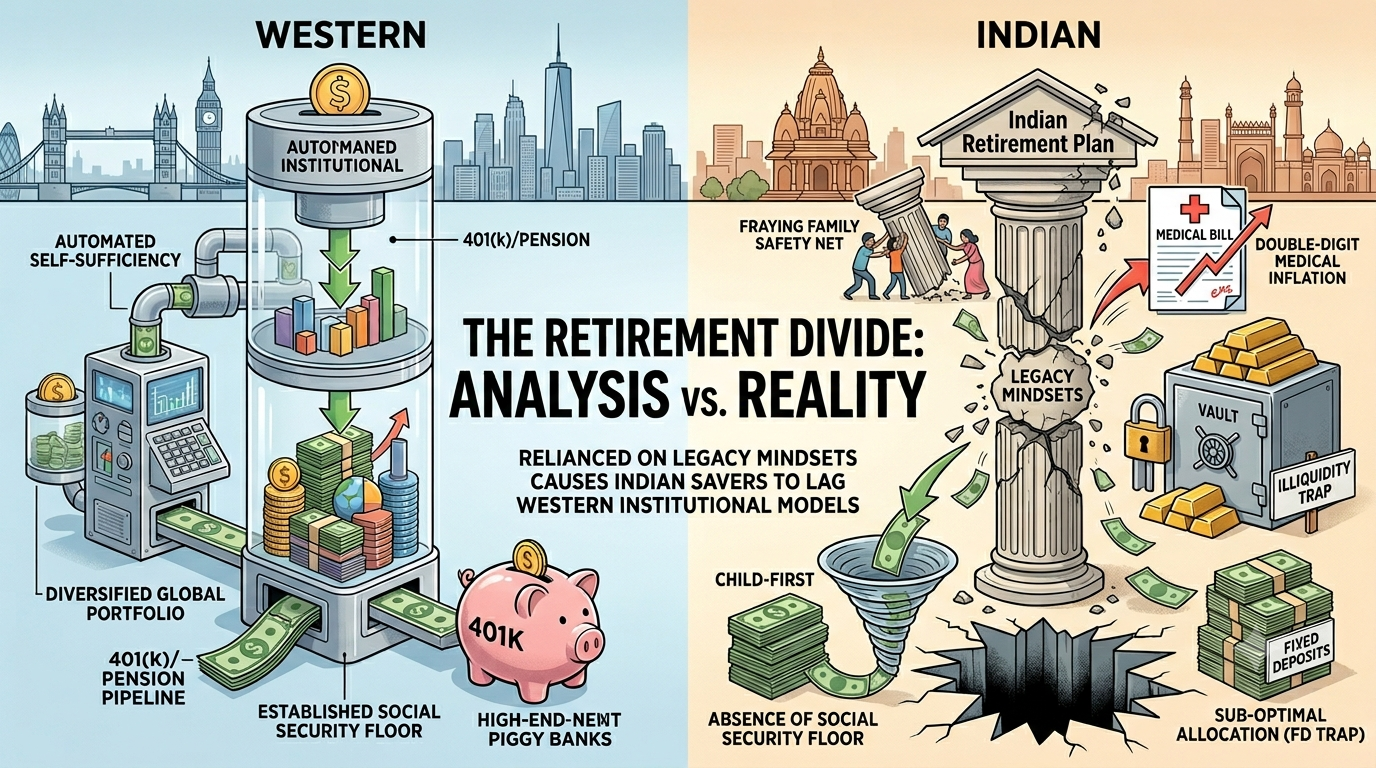
Inside This Guide
- The Fraying Family Safety Net
- Underestimating Double-Digit Medical Inflation
- The Illiquidity Trap: Gold and Real Estate Obsession
- Fixing Retirement Planning in India: Avoiding the FD Trap
- The “Child-First” Wealth Drain
- The Absence of a State Safety Net
- Actionable Steps for Modern Indian Retirement Planning
1. The Fraying Family Safety Net
Historically, retirement planning in India relied on an unwritten cultural contract. Parents funded their children’s education and upbringing. In return, children provided old-age care for their aging parents.
However, this informal safety net is rapidly dissolving. Urbanization, nuclear families, and global migration mean adult children often move away for career opportunities.
The Western Contrast: Western retirees navigate their careers with an explicit expectation of self-sufficiency. Therefore, they actively plan for independent senior living and long-term care infrastructure early on. Many Indian savers realize far too late that they must independently fund 30 or more years of life after work.
2. Underestimating Double-Digit Medical Inflation
Standard retirement calculators often use a blanket inflation rate of 5% to 6% across all expenses. Unfortunately, this is a major mathematical error. According to financial industry data, specialized healthcare inflation in India frequently hovers between 8% and 12% annually.
The Western Contrast: Western healthcare can certainly be expensive. However, it is usually backstopped by structured insurance frameworks, state-subsidized programs, or universal health coverage.
In India, advanced healthcare costs are largely paid out-of-pocket. As a result, senior health insurance becomes costly or restricted by pre-existing conditions as you age. A single major medical crisis can quickly wipe out a retiree’s life savings.
Recommended Reading: Learn how to insulate your portfolio against rising healthcare costs in our internal guide on planning for healthcare inflation in retirement.
3. The Illiquidity Trap: Gold and Real Estate Obsession
Indian households traditionally accumulate wealth in physical assets, primarily real estate and physical gold. Furthermore, data from the Reserve Bank of India (RBI) shows that Indian families hold a massive proportion of their net worth in non-financial physical assets.
Consequently, this creates a severe liquidity crisis during retirement. You simply cannot sell a fraction of an apartment or a piece of jewelry to pay for a monthly pharmacy bill or cover daily grocery runs.
| Asset Class | Liquidity Level | Drawdown Ease | Primary Risk |
|---|---|---|---|
| Physical Real Estate | Very Low | Difficult (Must sell whole unit) | Illiquidity & High Maintenance |
| Physical Gold | Moderate | Moderate (Emotional friction) | Theft & Storage Costs |
| Mutual Funds / Equities | High | Very Easy (Partial sales) | Market Volatility |
The Western Contrast: Western retirement portfolios are highly financialized. Wealth is held predominantly in liquid public equities, index funds, and dedicated pension systems. This structure allows retirees to setup automated monthly drawdowns without the hassle or legal red tape of selling physical property.
4. Fixing Retirement Planning in India: Avoiding the FD Trap
Due to a deeply ingrained fear of short-term market volatility, millions of pre-retirees rely heavily on Fixed Deposits (FDs), post office schemes, and traditional insurance plans.
While FDs offer safety of capital, they rarely offer real wealth growth. Because modern retirement can easily last over three decades, keeping your entire savings in fixed-income instruments produces negative real returns after accounting for income tax and inflation.
The Western Contrast: Western planning models rely heavily on target-date funds and equity exposure that continues well into retirement. To preserve purchasing power over 30 years, a portion of your portfolio must remain invested in growth assets like equities.
5. The “Child-First” Wealth Drain
In India, parental obligations routinely take priority over personal financial security. For instance, parents frequently drain their Employee Provident Fund (EPF), sell core investments, or take on massive debt to fund expensive foreign degrees or lavish weddings.
The Western Contrast: Culturally, Western families encourage children to use student loan frameworks and self-funded weddings to build financial independence.
There is an important rule in financial planning: “You can get a loan for education, but you cannot get a loan for retirement.” Reversing this priority leaves aging parents financially vulnerable when they can no longer work.
6. The Absence of a State Safety Net
Most Western economies offer a baseline safety floor, such as Social Security in the United States or state pensions across Europe. While these programs may not fund a luxury lifestyle, they provide a guaranteed, inflation-indexed income stream.
In contrast, India’s private sector and informal workforce lack a universal, state-funded safety net. Frameworks like the National Pension System (NPS) offer excellent tools for retirement, but the responsibility to enroll, choose assets, and build the corpus falls entirely on the individual.
7. Actionable Steps for Modern Indian Retirement Planning
Closing the gap requires shifting away from emotional, illiquid asset allocation strategies. Modern retirement planning in India requires a pragmatic, systematic approach:
- Embrace Equities Early: Move beyond fixed deposits by allocating a portion of your long-term savings to index funds and well-diversified equity portfolios.
- Insulate Against Medical Costs: Purchase comprehensive, standalone health insurance early in life before pre-existing conditions arise, as recommended by the IRDAI.
- Implement a Bucket Strategy: Divide your post-retirement funds into liquid, income-generating, and growth-oriented buckets to manage short-term cash flow while outpacing inflation long-term.
Take Control Today: Read our full breakdown on structuring a 3-bucket drawdown strategy or explore how to start early and let compounding work to make your corpus last a lifetime.




Start the conversation
Share a helpful experience, ask a thoughtful question, or add another perspective for fellow readers.