
By Monica Gill
Retirement planning usually starts with money: savings, pensions, healthcare, inflation and monthly expenses. Those things matter. But there is another question that becomes increasingly important as work moves out of the centre of life: what will make your days feel worthwhile?
After decades of deadlines, responsibilities, routines and professional goals, retirement can create something many working people have wanted for years — time. But having more time does not automatically tell you what to do with it.
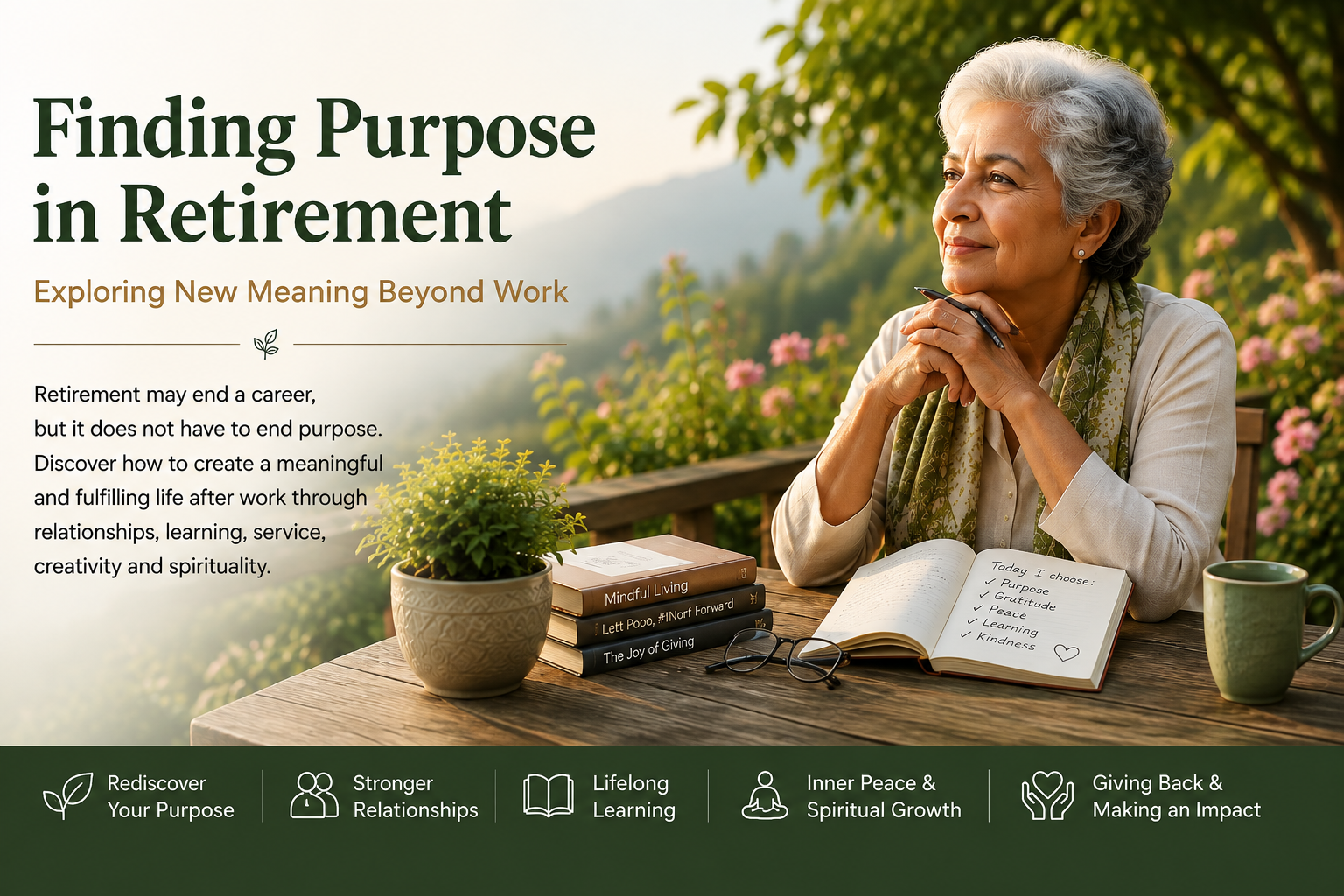
Finding purpose in retirement does not mean finding one grand mission or starting another career. It means identifying the people, activities, interests and forms of contribution that make life meaningful to you now.
At a Glance
- Retirement removes a work structure, but it does not have to remove purpose.
- Your purpose can come from relationships, learning, contribution, creativity, spirituality, travel, hobbies or simply having time for people you value.
- Your professional experience can still be useful even after your job title disappears.
- You do not need to fill every hour. A meaningful retirement is about choosing what deserves your time.
- Purpose is often discovered by trying things rather than by finding one perfect answer in advance.
Why Purpose Can Become a Retirement Question
Work provides more than income. It can give you structure, identity, colleagues, recognition and a feeling that your skills are needed. When work stops, all of those things can change at once.
That is why some people find the early period of retirement surprisingly difficult even when their finances are comfortable. The question is no longer only “What can I afford?” It can also become “What do I want my time to stand for?”
This does not mean retirement has to become another productivity project. It simply means that financial readiness and life readiness are different parts of the transition.
Start With What Already Matters to You
You do not have to invent a completely new identity after retirement. In many cases, purpose can be found by looking at things that have mattered to you for years but had to compete with work and family responsibilities.
Think about five areas:
- People: Which relationships would you like to give more time to?
- Learning: What have you always wanted to understand or learn?
- Contribution: Where could your experience help someone else?
- Enjoyment: Which activities make you lose track of time?
- Reflection: What gives you a sense of peace, meaning or perspective?
The answers do not have to produce a single purpose. They can reveal several smaller sources of meaning that together make retirement satisfying.
Your Experience Has Not Retired
One of the biggest changes in retirement is that your professional title may disappear. Your experience does not.
A retired teacher might mentor a younger educator. A former finance professional might help a community organisation understand its finances. A doctor, engineer, manager or entrepreneur may find ways to teach, guide or support people without returning to a full-time career.
Contribution can also be much more personal. Helping a grandchild with studies, preserving family stories, supporting a neighbour or being available to a friend can all be meaningful.
GreySmiles Take
Retirement does not have to be a search for a replacement career. Your working life may have given you skills, relationships and experience. The opportunity now is to decide where you want those things to matter — and what you want to do simply because it matters to you.
Do Not Confuse Purpose With Being Busy
There can be a temptation to make retirement look productive. You may feel that every day needs an activity, every hobby needs an outcome and every spare hour needs to be filled.
It does not.
A meaningful retirement can include gardening, reading, walking, travelling, music, prayer, meditation, conversations with friends or an unhurried morning with family. Not everything meaningful has to produce something.
The better question is not “How busy am I?” but “Does the way I spend my time feel worthwhile to me?”
What If You Have No Idea What Your Purpose Is?
This is more common than it may seem. You do not need to discover one grand purpose immediately after retirement.
Start with experiments rather than permanent commitments. Attend a class. Volunteer for a few weeks. Reconnect with an old interest. Teach someone something you know. Take a trip. Join a community activity. Spend more deliberate time with someone important to you.
Then notice what happens.
Which activities leave you energised rather than drained? Which conversations stay with you? Where do you feel useful? What do you look forward to doing again?
Purpose can emerge from these observations. It does not always arrive as a sudden realisation.
What Can We Learn From Older Indian Stories?
The story of King Bharata in the Śrīmad Bhāgavatam offers one possible reflection on identity and attachment. After stepping away from his responsibilities as king, Bharata became deeply attached to a deer he had rescued.
The story can be interpreted in different ways. For someone entering retirement, one useful reflection is that leaving a role does not automatically mean letting go of the need to control, achieve or feel needed.
Retirement may require a different relationship with responsibility. Children make their own decisions. Former colleagues move on. Work decisions that once depended on you may no longer be yours to make.
Letting go does not mean becoming detached from life. It can mean remaining engaged without needing to control every outcome.
Could Retirement Also Be a New Beginning?
New beginnings do not have to be dramatic.
Prabhavati Bhagwati, for example, began Nani’s Nashta, a home-based food business in Ahmedabad, at the age of 91. Her story illustrates how an interest or skill can take a new direction later in life.
Fauja Singh took up serious long-distance running late in life and became widely known for his marathon running. Guinness World Records did not ratify his oldest-marathon-runner claim because of documentation issues surrounding his birth date.
These examples are not instructions for how everyone should spend retirement. Their more useful lesson is simply that age does not automatically close the door on a new interest.
Retirement Can Include Work — Or Not
Purpose and paid employment are not the same thing.
Some people may want to consult, teach, work part-time, run a small venture or continue in some form of employment. Others may want nothing to do with paid work after retirement.
Both choices can lead to a meaningful retirement.
If continuing to work interests you, the decision should also be considered alongside your financial position, health, energy and the lifestyle you actually want. Retirement does not have to mean either “full-time work” or “doing nothing.” There is a wide middle ground.
A Simple Purpose Check
Take a few minutes and answer these questions honestly:
- What have I been postponing because work was always more urgent?
- Which relationships deserve more of my time?
- What knowledge or experience could I pass on?
- What activities make an ordinary week feel better?
- If I had to describe a worthwhile week in retirement, what would be in it?
You do not need perfect answers. Look for patterns.
If This Were My Problem, I’d Start Here
I would not begin by asking, “What is my purpose in life?” That question can be too large.
I would begin with a normal week.
What would I like to do on a Monday morning? Who would I like to see? What would I like to learn? Where could my experience be useful? What would I happily do even if nobody praised me for it?
Then I would try a few things before deciding what belongs permanently in my retirement.
What Should You Check?
Purpose is only one part of being ready for retirement. It is worth considering alongside your financial position, health, relationships, housing and the way you expect to spend your time.
Before retirement, ask yourself:
- Do I know what I want my ordinary week to look like?
- Do I have relationships and activities outside my former workplace?
- Do I have a way to use my experience if I want to?
- Am I choosing activities because they matter to me, rather than because I feel I should stay busy?
- Have I discussed my expectations for retirement with my spouse or family?
Frequently Asked Questions
How do I find purpose after retirement?
Start with what gives you energy, meaning or connection. This could include relationships, mentoring, volunteering, learning, travel, creativity, spirituality, hobbies or community involvement. Try small activities and notice what feels meaningful.
Does retirement have to mean stopping work completely?
No. Retirement can include part-time work, consulting, teaching, volunteering or a small business. It can also mean stepping away from paid work completely.
What if I have no idea what my purpose is after retirement?
Do not feel pressured to find one grand answer. Start small, experiment with activities and pay attention to what gives you energy, connection or a sense of contribution.
Can spirituality help create meaning after retirement?
For some people, prayer, meditation, reflection or spiritual practice can provide perspective and inner calm. Spirituality is personal, however, and there is no single formula for a meaningful retirement.
Also Read on GreySmiles
- What Does Retirement Mean? Lessons on Purpose, Time and Letting Go
- The New Retirement Doesn’t Have to Mean Stopping Work
- How to Calculate Your Retirement Corpus in India
Disclaimer: The philosophical stories and reflections in this article are presented as perspectives for personal reflection and are not intended as religious instruction, medical advice or professional counselling.




Start the conversation
Share a helpful experience, ask a thoughtful question, or add another perspective for fellow readers.