
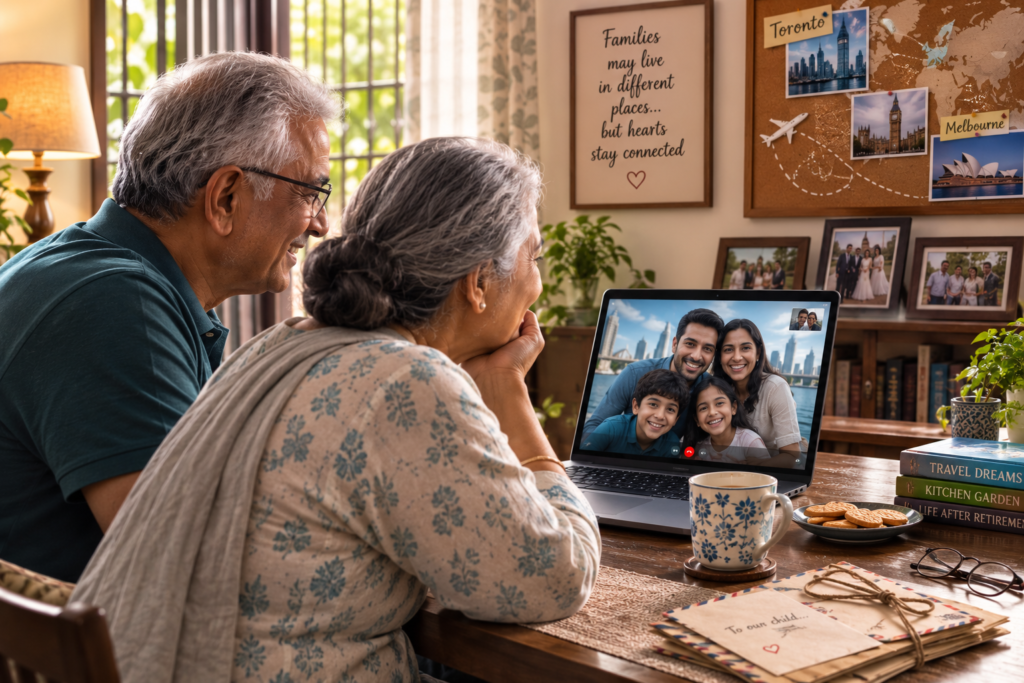
In 1986, when Pankaj Udhas sang Anand Bakshi’s poignant lyrics “Chitthi Aayi Hai” in the film Naam, it resonated deeply across millions of Indian households. The song captured the raw, unadorned longing of families separated by thousands of miles—an era when news from loved ones arrived written on paper, carried across oceans over weeks, and read with tearful eyes.
Decades later, the physical letter has largely vanished. Today, a tap on a glass screen brings high-definition video calls, instant voice notes and real-time photos across global time zones. Yet in many Indian homes, when the screen fades back to black after a Sunday morning call, a familiar quietness can remain in the room. Technology has conquered distance, but the human need for genuine companionship has not changed very much.
At a Glance: Core Essentials
- The Modern Paradox: High-definition video calls have made communication instant, but they cannot completely replace physical presence, shared silence and everyday moments.
- Validating Unspoken Emotions: Feeling a sense of emptiness when children settle abroad is a natural human reaction. You can be deeply proud of their success and still miss having them around.
- Shift from Transactional to Meaningful: Setting predictable rhythms for long-distance calls can prevent conversations from becoming rushed, scheduled or purely task-oriented.
- Rediscovering Self-Identity: Active ageing also means reclaiming personal passions, cultivating friendships and community locally, and building a dignified life that is not dependent on how often the phone rings.
In This Article
- 1. The Screen Gap: Why High-Tech Communication Leaves a Low-Tech Void
- 2. Validating the Unspoken Emotion Without Guilt
- 3. Moving Beyond “Did You Eat?”: Bridging the Conversational Divide
- 4. Reclaiming Your Life: How Parents Can Overcome Emotional Distance
- 5. Building Your “Chosen Family” and Local Purpose
- Frequently Asked Questions
1. The Screen Gap: Why High-Tech Communication Leaves a Low-Tech Void
There is a difference between staying connected and actually feeling connected. WhatsApp messages and video calls keep us updated on schedules, health, work and everyday logistics. But they cannot always recreate the small, unplanned moments that make relationships feel close.
A video call is an event. It usually needs to be scheduled around time zones, work and family routines. Everyone may also be conscious that the call is short and try to fit everything into it.
What gets lost is the effortless togetherness of everyday life—the spontaneous cup of tea, sitting quietly in the same room, watching television together, or simply knowing that someone you love is nearby.
The World Health Organization also recognises the importance of social connection and emotional well-being as people age. Physical health matters enormously, but so does having relationships and a sense of connection.
And perhaps that is why a perfectly clear video call can sometimes leave you feeling strangely incomplete. You saw your child. You heard their voice. But you could not reach across the screen and give them a hug.
2. Validating the Unspoken Emotion Without Guilt
One of the quietest burdens some senior parents carry when children move abroad is guilt.
Parents can be enormously proud when their children build successful lives in London, Toronto, Melbourne, Dubai or New York. They may have spent decades supporting their children’s education and ambitions, and seeing them succeed can feel like a wonderful reward.
But pride and sadness can exist at the same time.
You can be happy that your child is doing well and still wish they were sitting beside you for a cup of tea. You can support their choices and still miss their physical presence. One feeling does not cancel the other.
A GreySmiles thought: You do not have to choose between being proud of your children’s independence and missing their presence. Both feelings can be true at the same time.
Missing your child is not automatically a sign of weakness, dependency or ungratefulness. Sometimes it is simply what happens when someone who has been part of your everyday life for decades is suddenly several thousand kilometres away.
3. Moving Beyond “Did You Eat?”: Bridging the Conversational Divide
When long-distance communication becomes routine, conversations can easily fall into familiar patterns:
- “Did you take your medicine?”
- “Did you eat dinner?”
- “How is the weather there?”
- “When are you coming next?”
There is nothing wrong with these questions. In fact, they are often how Indian families express love. But if every call becomes a checklist, something more personal can get lost.
Try creating space for conversations that have nothing to do with errands, health updates or work schedules.
- Share everyday moments: Talk about a book you read, a neighbour you met, something funny that happened, or a new dish you cooked.
- Ask open-ended questions: Ask what they are enjoying, what they are thinking about or what they are looking forward to—not just what they are doing.
- Share something from your own life: Your children don’t need to be the only subject of the conversation. Tell them about your interests, friends, travels, hobbies and plans.
- Establish predictable rhythms: Agree on a comfortable time for a longer conversation rather than waiting anxiously for an unexpected call.
The goal isn’t to have longer calls. It is to have conversations that feel more like being part of each other’s lives.
Related Guides on GreySmiles:
- 6 Stages of Retirement Planning: A Roadmap for Life After Work
- How to Calculate Your Retirement Corpus in India
- Government Schemes for Senior Citizens in India
4. Reclaiming Your Life: How Parents Can Overcome Emotional Distance
There is a subtle danger in long-distance parenting: waiting.
Waiting for the next WhatsApp call. Waiting for the next holiday. Waiting for the next visit. Waiting for the children to have more time.
There is nothing wrong with looking forward to those moments. But your life in between them deserves attention too.
A. Reclaim Your Individual Identity
For 25 or 30 years, parenting may have been one of the central identities in your life. When children leave home, that role naturally changes.
This can be an opportunity rather than simply a loss. Revisit interests that were put aside during your working and parenting years. Read. Travel. Paint. Learn music. Join a class. Start exercising. Meet friends. Take up something that has always interested you but never seemed urgent enough to begin.
Retirement can be an opportunity to ask a very simple question: Who am I when I am not busy looking after everyone else?
B. Embrace Active Ageing and Financial Independence
Emotional resilience also becomes easier when you feel secure and self-reliant in other areas of life.
Knowing that your retirement income is adequate, your healthcare needs are planned for, and your important financial and legal documents are in order can reduce the feeling that you must depend on children living thousands of kilometres away.
GreySmiles’ six-stage retirement planning roadmap is useful here because retirement is not one single financial event. Your needs continue to change as you move through different stages of later life.
5. Building Your “Chosen Family” and Local Purpose
Your children will always occupy a special place in your life. But when they live far away, they cannot realistically be your only source of companionship.
Building friendships and routines around you is not replacing your family. It is creating a fuller life.
- Nurture peer groups: Reconnect with old friends, join morning walking groups, book circles, gardening groups, music clubs or local senior associations.
- Engage in community service: Mentoring younger people, helping children with studies, volunteering or contributing to a community initiative can restore a sense of usefulness and connection.
- Create local traditions: Celebrate festivals, birthdays and milestones with friends, neighbours and extended family instead of waiting for long-distance visits to make those occasions special.
- Keep learning: A new skill, language, hobby or interest can give structure to your week and introduce you to people with similar interests.
Sometimes the answer to an empty room is not another video call. Sometimes it is stepping outside the room and building a life around you.
Frequently Asked Questions
1. How can parents stop feeling guilty about feeling lonely when their kids are doing well abroad?
Acknowledge that pride in your child’s career and personal success and sadness about their physical absence can exist at the same time. Loving someone deeply and missing them is a natural human emotion. It is not necessarily a criticism of their choices or a sign of ungratefulness.
2. What should parents do if video calls feel rushed or superficial?
Try agreeing on a relaxed call time when neither side is rushing to work, school or household responsibilities. Share specific stories or photos from your day and ask open-ended questions about their experiences and interests. The aim is not simply to increase call duration, but to make the conversation feel more meaningful.
3. How can senior parents build a strong social network locally after retirement?
Start small. Participate regularly in neighbourhood groups, senior citizen associations, walking clubs, volunteering opportunities or interest-based groups such as gardening, music, books or travel. Consistent participation in shared activities is often how acquaintances gradually become friendships.
4. How can adult children living abroad support their parents’ emotional well-being?
Beyond routine check-ins, adult children can encourage their parents to pursue independent interests, help them discover local activities or support services, and make time for unhurried conversations. It also helps to ask about their parents’ lives rather than making every call about health, money or household administration.
5. Does having children abroad mean parents should simply learn to live independently?
Independence does not mean pretending that you do not miss your children. A healthy relationship can include both emotional closeness and independent lives. Parents can build fulfilling routines and friendships locally while continuing to maintain a warm and meaningful relationship with children who live far away.
Conclusion
“Chitthi Aayi Hai” belonged to a different technological age, but the feeling behind it has not changed very much.
The letter may have become a WhatsApp message. The waiting may have become a Sunday video call. The photographs may arrive instantly instead of taking weeks.
But we still want to know that our children are well. We still want to hear their voice. And sometimes, more than anything else, we simply wish they were sitting in the room with us.
Your relationship with children living abroad has not necessarily diminished; it has evolved into a different chapter. The answer is not to stop missing them, nor to expect technology to completely replace their physical presence.
It is to hold both things together: stay emotionally close to your children while continuing to build a life that is full, purposeful and joyful where you are.
That may be one of the most important parts of active ageing—loving your children deeply without putting your own life on hold.
