
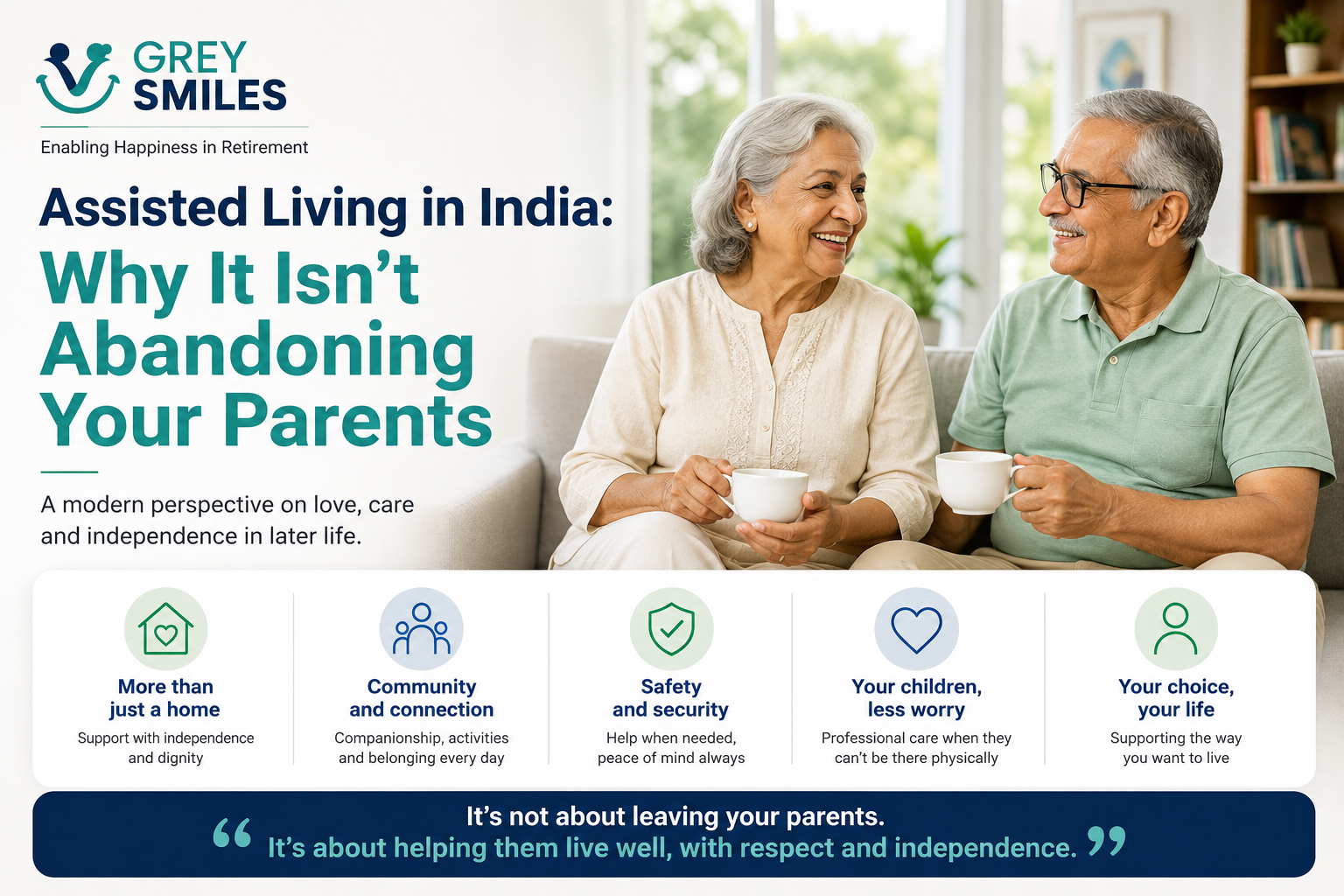
Assisted living doesn’t have to mean abandoning parents — it can provide safety, community and support while preserving independence.
For decades, the Indian idea of caring for ageing parents has been simple: children look after their parents. It is an idea rooted in love, family and responsibility, and there is nothing wrong with that. But Indian families have changed dramatically. Children now live in different cities and countries, work demanding jobs, travel frequently and raise families of their own. Meanwhile, parents are living longer, often well into their 80s and beyond.
This creates a question previous generations did not have to confront on the same scale: what happens when children love their parents deeply but cannot physically be there every day?
Assisted living could be part of the answer. Yet in India, the idea can still carry a painful stigma. Moving a parent into a senior-living or assisted-living community may be interpreted as a sign that children have failed in their responsibility. In reality, choosing the right living environment can sometimes be a thoughtful way of protecting a parent’s safety, dignity, independence and quality of life while allowing children to remain loving children rather than becoming full-time caregivers from another city or country.
At a Glance: What You Need to Know
- Assisted living is not the same as an old-age home. It can combine private living space with support for everyday needs while allowing an older person to retain considerable independence.
- India often views elder care through the question, “Who will look after my parents?” A better question may be: “What living arrangement will allow my parents to live best?”
- Assisted living can provide meals, housekeeping, transportation, security, social connection and access to help without necessarily taking away privacy or autonomy.
- For children living in another city or country, professional senior living can provide something they cannot provide from a distance: reliable physical presence when they cannot personally be there.
- The objective should not be to move parents away from their families. It should be to give older adults more choices about how they want to live.
What Is Assisted Living in India?
Let’s begin by removing one of the biggest misconceptions. Assisted living is not simply another name for an old-age home. In a typical assisted-living arrangement, an older person has their own room or apartment and retains substantial independence while receiving help with things that may have become difficult, such as bathing, dressing, medication management, housekeeping, meals, mobility or transportation. Depending on the community, there may also be security, emergency support, healthcare coordination and social activities.
The level of assistance can vary enormously. One person may be capable of deciding what to eat, where to go and whom to meet but need help with medication or household chores. Another may need greater support with mobility or personal care. Assisted living should therefore not automatically be equated with being seriously ill or incapable. It can simply mean: “I want to remain independent, but I don’t want every ordinary difficulty of ageing to become a crisis.”
What Research Tells Us
Research into attitudes towards long-term care in India found that formal care was often regarded as a last resort, with social expectations around family care playing an important role in attitudes towards care facilities.
Independent Does Not Always Mean Doing Everything Alone
This is perhaps the most important change in thinking that India can learn from the evolution of senior living in the West. Assisted living in countries such as the US has increasingly been understood as a way of combining autonomy with support. The lesson for India is not that we should copy the American model, which has its own challenges around affordability, quality, staffing and regulation. It is that ageing does not have to be divided into two choices: living completely independently or requiring intensive institutional care.
We often define independence as “I don’t need anybody.” But perhaps a better definition in later life is “I retain control over my life.” You can be independent while somebody else prepares your meals, helps organise your medication or lives nearby with support available around the clock. Having appropriate support can sometimes make it possible to remain independent for longer because ordinary difficulties no longer force a person to give up activities they enjoy.
The GreySmiles Idea
Independence in later life does not have to mean doing everything alone. It can mean choosing what help you receive while retaining control over how you live.
Why Is India Still Uncomfortable With Assisted Living?
For generations, the expected Indian model has been straightforward: children look after parents. That ideal is deeply embedded in our culture, and it can be a wonderful expression of family responsibility. The difficulty begins when a beautiful principle becomes an unrealistic obligation in a world where families no longer necessarily live close to one another.
A son may live in Bengaluru while his parents remain in Delhi. A daughter may work in Singapore, Dubai, London, Toronto or New York. Children may have demanding careers, young families and frequent travel. Parents may be healthy at 70 but need increasing support at 80. Research on ageing in urban India continues to document the social expectations around children caring for parents alongside the effects of migration, urbanisation and changing family structures.
The wider question is therefore no longer simply whether children will care for their parents. It is how families can remain emotionally close and provide good care when they are geographically separated.
A Wider Question for India
How do we build a society where ageing parents can receive good care without treating dependence as a personal or family failure?
Assisted Living Should Be a Choice, Not a Last Resort
GreySmiles should take a clear position here: assisted living should not be discussed only after something has gone wrong. Families often wait until there has been a fall, a medical emergency, forgotten medication, a kitchen accident, serious isolation or an unexpected hospitalisation. By then, an important decision has to be made under pressure, often while the older person is frightened and children are trying to coordinate everything from another city or country.
A better alternative is to discuss living arrangements while parents are still healthy enough to choose for themselves. Instead of saying, “You can’t manage anymore,” the conversation becomes, “Let’s decide how you want to live for the next 10 or 20 years while you are still in control of the decision.” That is not taking independence away. It is giving the older person more control over the future.
Can Assisted Living Actually Preserve Independence?
Consider a 78-year-old woman living alone in a large house. She can cook, walk, manage her finances and drive during the day. She is perfectly capable of living independently. But the stairs are becoming harder, maintaining the garden is tiring, grocery shopping is inconvenient, the house is increasingly difficult to manage and her closest children live overseas.
Moving into a well-designed senior community with private space, housekeeping, meals, security, social activities, transportation and emergency support would not necessarily mean she had lost her independence. It could mean she spends more energy on the things she enjoys because she no longer has to spend so much of it managing the burdens of a large house.
That is the question we should be asking.
Families considering this option should also look beyond the brochure. GreySmiles’ guide to evaluating senior living communities in India looks at the practical questions families should consider when comparing communities, services and support.
The Social Side May Be Just as Important as the Medical Side
Assisted living is often discussed as though its primary purpose is healthcare. That misses half the story. One of the greatest advantages of a thoughtfully designed senior community can be the presence of other people: people to eat with, activities to attend, outings to join, hobbies to pursue, celebrations to share and friendships to develop.
For someone whose spouse has died or whose children live far away, this everyday social environment can be enormously valuable. A video call can provide love, but it cannot provide somebody to have tea with at 4 p.m. It cannot take you to the doctor, notice that you have not eaten or knock on the door when you are unexpectedly unwell. Technology can bridge distance, but it cannot completely replace physical presence.
Research involving older adults in migrant households in Kerala similarly highlights the emotional and practical gaps that can arise when adult children move away, even when families remain connected through calls and visits. Community, companionship and everyday human contact can therefore be just as important to quality of life as the availability of medical support.
When Children Live Away: Who Cares for Ageing Parents?
This is the part of the conversation Indian families often avoid. A child living overseas may call regularly, arrange nurses, send money, coordinate doctors across time zones and fly home whenever something serious happens. And behind all of it can sit one persistent question: “What if something happens and I’m not there?”
Professional senior living can become more than a housing decision. It can become part of a family’s caregiving infrastructure. GreySmiles’ work on long-distance eldercare for parents in India explores practical systems families can put in place when adult children live abroad, including local support, emergency planning and appropriate arrangements for parents.
Imagine the same parent living in a professionally managed senior community. Their child still calls, visits, takes them on holidays and remains involved in important decisions. But the child also knows that there are people physically present when they cannot be. That does not replace family. It can allow family to return to what family should ideally be: love, companionship, conversation and choice — rather than 24-hour emergency management.
Your Children Shouldn’t Have to Choose Between You and Their Lives
Your son or daughter may love you deeply and still want to accept a job abroad, build a business, travel, take a promotion, move cities, raise their children or simply have a life of their own. A better definition of being a good child may be: “I will make sure my parents are safe, respected, cared for and connected to me — even if I cannot personally provide every hour of that care.”
What If Children Live Nearby? The Independent Proximity Option
Assisted living is not necessarily the only answer. In some Indian families, a separate senior-living community may be unnecessary when parents and adult children live within easy reach of one another.
This is where the GreySmiles concept of Independent Proximity becomes particularly interesting. The idea is simple: parents and adult children live close enough for practical and emergency support while maintaining separate homes, routines and financial independence.
For some families, living 10 or 20 minutes away from one another may provide much of the reassurance of proximity without sacrificing privacy or autonomy. The choice does not have to be “live alone” versus “move into assisted living.”
The GreySmiles Lens: Supported Independence Is a Spectrum
Families can consider home support, Independent Proximity, senior communities, assisted living and higher levels of care as needs change. The goal is to match the living environment to the person’s needs and preferences — not to force every family into one model.
Parents Have a Responsibility Too
This conversation cannot be one-sided. Parents sometimes say, “I don’t want to become a burden on my children,” but then refuse to discuss what should happen if they eventually need help. That can leave children with a problem they have to solve in a crisis.
A healthier conversation might begin with: “While I am well, let’s discuss what I want if I eventually need help.” Talk about where you want to live, how much privacy you want, what assistance you would accept, what should happen after a fall, who should help with medical decisions, how finances should be handled, what happens if one spouse dies first, how often you want your children to visit and what should happen if they live abroad.
These are not conversations about death. They are conversations about control.
Assisted Living Does Not Mean Giving Up Your Home
Not every older person who needs some support has to move permanently into assisted living. Depending on the person and circumstances, options can include home care, part-time caregivers, community-based senior programmes, respite care, temporary post-surgery support, assisted living or continuing-care communities. Needs can also change over time.
The goal is not to choose one arrangement forever. It is to match the living environment to the person’s needs and preferences at different stages of life.
What India Needs to Change
India doesn’t simply need more senior-living buildings. It needs to change the language around them. “Old-age home” can suggest abandonment. “Assisted living” suggests support. “Retirement community” suggests choice. “Senior living” suggests a lifestyle. The words matter because they shape how families think, but the physical environment matters even more.
Good senior living should not feel like a hospital. It should feel like home, with help nearby. That means privacy, dignity, good food, accessible design, healthcare access, social connection, security and the ability to make ordinary choices about one’s day.
As India’s senior-living sector develops, families should also expect greater transparency around staffing, healthcare arrangements, emergency response, contracts, fees and escalation of care.
Assisted Living Is Not for Everyone
GreySmiles should not become an advocate for assisted living as though it is automatically the best answer. Some seniors strongly prefer their own homes. Some have excellent family support nearby. Some communities may not provide the healthcare or staffing that a particular resident needs. Cost can also be significant, and assisted-living arrangements vary enormously.
The decision should therefore never be: “Assisted living is modern, therefore we should move.” A better question is: “What living arrangement gives me the best combination of independence, safety, social connection, healthcare access and quality of life?”
When Should a Family Start Thinking About Assisted Living?
Not when there is already an emergency. Start when there is still time to choose.
Signals worth discussing include a parent increasingly struggling with household maintenance, repeated falls or near-falls, difficulty managing medication, increasing isolation, difficulty getting to doctors or shops, one spouse becoming the other’s full-time caregiver, children living far away, frequent medical emergencies, anxiety about being alone, difficulty managing a large home or a parent beginning to say, “I don’t want to be a burden.”
Perhaps the most important signal is when the parent themselves starts wondering whether there might be an easier way to live.
Listen to that.
How to Start the Conversation With Your Parents
Do not start with: “You can’t live alone anymore.” That immediately turns the discussion into a battle over independence.
Start instead with: “If you could design your ideal life for the next ten years, what would it look like?” Then ask whether they would prefer to stay in their current home, whether they would like less housework, how important privacy is, whether they would accept help with medication or personal care if necessary, what would make them feel safe and whether they would consider a community where help was available but they still had their own space.
If their children live abroad, ask: “What would make you feel comfortable if I had to live in another country?” The conversation then becomes much less about moving parents somewhere and much more about designing their next chapter.
A New Definition of Being a Good Son or Daughter
Being a good son or daughter does not necessarily mean living in the same city or being available 24 hours a day. It can mean making sure your parents have a safe place to live, access to healthcare, financial security, people around them, emergency support, dignity, autonomy and regular connection with family. It can mean helping them think through their choices before a crisis forces the issue.
Then you remain their child. Not their nurse. Not their emergency-response system. Not their only social contact.
Their child.
Independence May Look Different at 75 Than It Did at 45
We need to stop measuring independence by how much we can do entirely alone. At 45, independence might mean: “I don’t need anybody.” At 75, it might mean: “I choose where I live, how I spend my day and who helps me.”
The second definition may actually be more powerful. The aim of ageing should not be to prove that we can manage everything ourselves until the day we cannot. It should be to build enough support around ourselves that we can continue living well even as our needs change.
Not dependence. Supported independence.
The Conversation India Needs to Have
For decades, the question has been: “How can we make sure our parents never need an old-age home?”
What if the question isn’t where our parents should live, but how they want to live?
How can we make sure our parents have the best possible life as they grow older — whether that is at home, with family, through Independent Proximity or in a well-designed senior-living community?
The answer will be different for every family. But there is nothing inherently shameful about choosing help, choosing community or making life easier. And there is certainly nothing shameful about allowing your children to live their lives while knowing that you are safe.
Growing older should give us more choices, not fewer. Perhaps assisted living, when chosen thoughtfully and entered on one’s own terms, is not the end of independence. It may be one of the ways we preserve it.
Before You Decide: Questions Worth Asking
- Does the older person actually want more support, or is the family deciding for them?
- Would assisted living improve safety without unnecessarily reducing independence?
- What happens if health or care needs increase later?
- How far away are children, and who is physically available during an emergency?
- Would an Independent Proximity arrangement work better than moving into a senior-living community?
- Have the parent and children discussed the decision before a crisis makes it urgent?
- Have you compared the actual cost, services, staffing, healthcare arrangements and exit terms of the community?
Frequently Asked Questions
Is assisted living the same as an old-age home?
No. Assisted living generally combines housing with varying levels of support for everyday activities while preserving as much independence and autonomy as possible. Nursing homes generally provide a higher level of medical and nursing care. The exact services differ by facility.
Is assisted living suitable only for sick or dependent seniors?
No. Some residents may need relatively modest assistance with everyday activities while remaining capable of making their own decisions and living active lives. The purpose is not necessarily to provide intensive medical care; it can be to make everyday life safer and easier.
Is moving to assisted living the same as abandoning your parents?
Not necessarily. A care arrangement should be judged by the quality of care, dignity, autonomy, safety and connection it provides — not simply by whether the family lives under one roof.
Why might assisted living be particularly useful when children live abroad?
Distance makes emergency and everyday caregiving difficult. A professionally managed environment can provide physical support and local presence while children continue to provide emotional, financial and family support from wherever they live.
Should parents move into assisted living before they actually need help?
There is no universal answer. However, exploring options while parents are still healthy can allow them to participate meaningfully in the decision and choose a community based on preference rather than crisis.
What should families check before choosing an assisted-living facility?
Look beyond the apartment and brochure. Ask about staffing, emergency response, healthcare access, medication management, meals, security, activities, dementia support, escalation of care, fees, contracts, exit terms, transparency and what happens if a resident’s needs increase.
Does assisted living mean I can no longer live independently?
Not necessarily. A good assisted-living philosophy is built around supporting independence rather than eliminating it. The question is how much assistance you want or need while retaining control over your life.
What if assisted living is not right for my family?
There are other possibilities. Depending on circumstances, families can consider home support, part-time caregivers, senior communities, Independent Proximity, community-based services or higher levels of care. The right answer depends on the older person’s preferences, health, finances, location and family support.
Final Thought
Perhaps the most important change India needs is not another senior-living project or another government scheme. It is a change in the way we think about ageing. We should stop treating every form of support as evidence that an older person has become dependent, stop assuming that good children must personally provide every aspect of their parents’ care, and stop treating the family home as the only respectable place to grow old.
Ageing well may sometimes mean staying at home. It may mean living near your children but separately. It may mean moving into a senior-living community. It may mean assisted living later, when more support is needed.
The important thing is not the address. It is whether the older person has safety, dignity, independence, connection and a meaningful life — and whether the family has built a system that can continue working when circumstances change.
That is not abandoning our parents.
That is planning to care for them well.
This article is intended for general educational and informational purposes. Assisted-living services, healthcare arrangements, costs, regulations and standards vary significantly between providers and locations. Families should independently assess any senior-living community, review its agreements and services carefully, and seek appropriate professional advice where necessary before making a significant care or financial decision.




Start the conversation
Share a helpful experience, ask a thoughtful question, or add another perspective for fellow readers.