
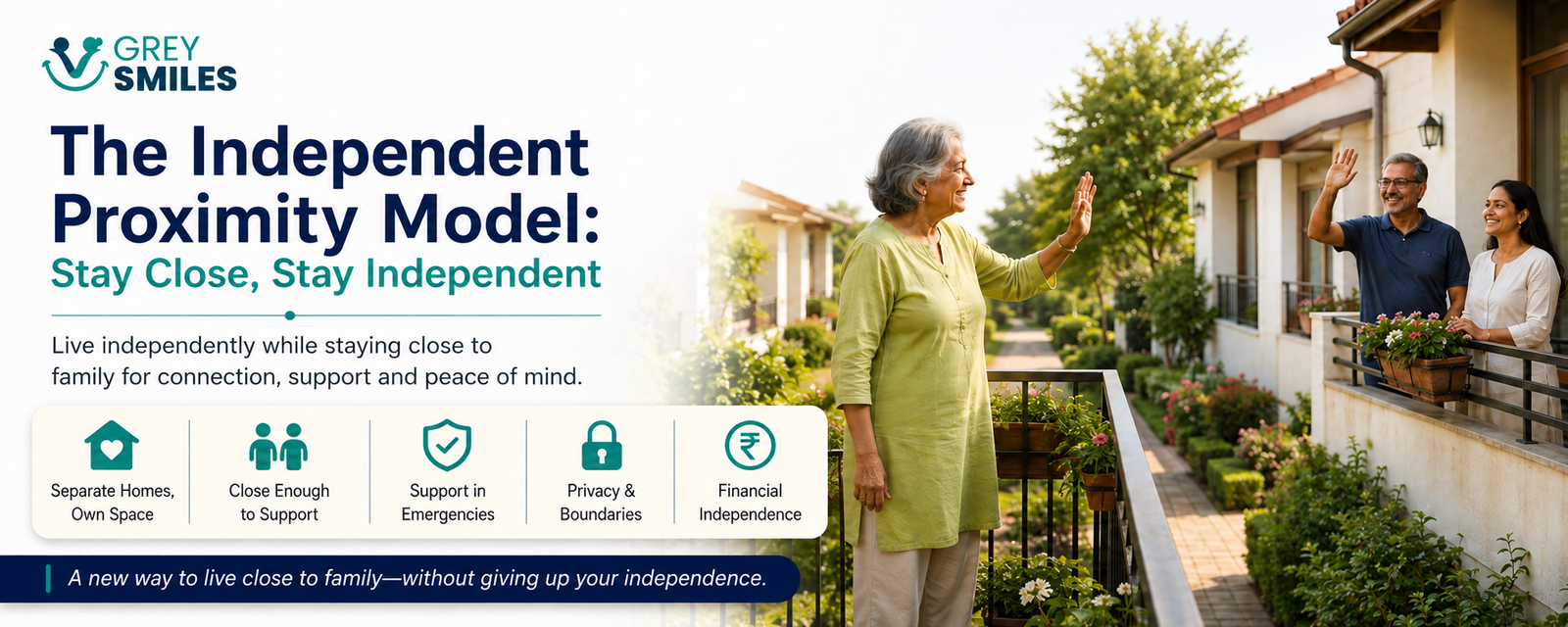
Independent Proximity helps families stay close while maintaining separate homes, privacy and independence.
At a Glance
Independent Proximity offers a third option between living completely alone and moving in with children. Parents can remain in their own home while living close enough for family connection, practical support and emergencies.
It works best when families agree on practical support, privacy, finances and boundaries while everyone is still healthy and independent.
What Is Independent Proximity?
For many older Indians, retirement housing is presented as a choice between continuing to live independently or moving in with their children. But families have changed. Children may live in another part of the city, another state or another country, while parents may want to retain their home, routines, privacy and financial independence.
Independent Proximity offers a third possibility: living close enough to family for connection and practical support while maintaining separate homes and independent lives.
There is no fixed definition of “close”. It could mean separate apartments in the same building, homes in the same community, neighbouring buildings or simply living within a distance that makes practical help realistic. The real question is whether family members can reach each other when help is genuinely needed.
Why Families Need a Third Option
The traditional Indian family model often assumed that adult children would eventually live with their parents or remain close enough to provide daily support. That still works well for many families, but careers, migration, housing costs, international mobility and changing family structures mean it cannot be the only model.
Parents may value their neighbourhood, friends and familiar routines while also recognising that having a child nearby could make later life easier and safer. Independent Proximity attempts to bring these needs together: family connection without giving up independent living.
Independent Doesn’t Mean Isolated
Independence is sometimes confused with doing everything alone. An older person can have their own home, make their own decisions and manage their own finances while still having family nearby when support is needed.
In fact, appropriate support can sometimes extend independence rather than reduce it. A parent who knows that a child can reach them quickly may feel more comfortable continuing to live independently, while the child can feel reassured without becoming responsible for every aspect of the parent’s life.
The objective is not “I don’t need anyone.” It is: “I can manage my own life while knowing that appropriate help is available when I need it.”
What Independent Proximity Is Not
It is not living with your children
Separate homes are central to the model. Parents retain their own household, routines and privacy rather than automatically becoming part of their children’s household.
It is not assisted living
Assisted living provides a professionally supported environment for people who need or want regular help with daily activities. Independent Proximity is primarily a family and housing arrangement, although professional support can be added later.
If care needs increase, families can explore options such as assisted living in India rather than assuming family proximity alone will solve every future need.
It is not simply living in the same city
Two homes can technically be in the same city and still be too far apart for practical support. Traffic, transport, work schedules and accessibility all matter when deciding whether proximity will actually work.
It is not surveillance
Being close does not mean parents have to account for where they go, who visits them or how they spend their day. Privacy is one of the principles that makes the model work.
It is not an informal caregiving contract
Parents should not assume that living near their children means unlimited care will always be available. Children should not assume that proximity gives them control over their parents’ choices.
The Five Building Blocks
1. Physical Proximity
Consider how long it actually takes to reach one another at different times of day. Possible arrangements include separate apartments in the same building, homes in the same community, neighbouring buildings or homes within a short driving distance.
There is no magic number. The right distance depends on transport, healthcare access, family availability and the level of support likely to be required.
2. Separate Homes
Parents should ideally have a home that feels like their own. They decide how they spend their day, whom they invite over and how much interaction they want. Adult children also benefit from maintaining their own household, routines and responsibilities.
Separate homes do not have to mean emotional distance.
3. Defined Support
“We’ll help if you need us” sounds reassuring, but it can become complicated during an actual emergency. Families should discuss who is the first emergency contact, who has access to the home, who coordinates with doctors or hospitals, who can help with essential errands and who acts as the backup contact if the primary child is unavailable.
The answers do not have to be complicated. What matters is that everyone understands the arrangement.
4. Boundaries and Privacy
Families should discuss how often they want to meet, whether visits should be arranged in advance, who has keys, what health information should be shared and which decisions remain entirely with the parent.
Healthy proximity has boundaries.
5. Financial Independence
Where possible, parents should retain clarity and control over their finances even when children provide support. Families can discuss housing, healthcare, household assistance and what happens if care needs increase.
Financial dependence can quietly become decision-making dependence, so expectations should be discussed openly.
What Could It Look Like?
Same Community
A retired couple lives in one apartment while their daughter and her family live in another building within the same community. They can meet easily and respond quickly during emergencies, while each household retains its own routines.
Same Neighbourhood
A widowed parent moves from a large house into a smaller apartment ten minutes from her son’s family. She remains independent while knowing that familiar support is nearby.
Same Building, Separate Homes
An older couple lives in one apartment while their adult daughter and her family occupy another floor. They can spend time together while maintaining separate finances, visitors, routines and privacy.
Can It Work for NRI Families?
Independent Proximity can be particularly useful when children live abroad, although physical proximity to children is obviously not possible in the same way. For an NRI family, the principle becomes building a reliable local support network around the parents.
That could include trusted relatives, friends, professional caregivers, emergency contacts, healthcare support and clear family communication. The objective is not to replace the children. It is to ensure that parents are not physically unsupported simply because their children live in another country.
Families dealing with long-distance support can also explore GreySmiles’ resources on supporting parents from abroad.
What Happens When Needs Change?
Independent Proximity should not be treated as a permanent promise that nothing will change. A healthy 68-year-old may need very little support, while a few years later transport, household help or healthcare assistance may become useful.
Eventually, one spouse may need regular personal care or the family may decide that a different living environment would be more appropriate.
The important question is: Does the current arrangement still provide the right balance of independence, safety, support and quality of life?
If the answer changes, the arrangement can change too.
Independent Proximity vs Senior Living
Senior-living communities can provide social connection, maintenance support, security and access to services. For some older adults, that may be exactly what they want.
Independent Proximity is different because the primary support relationship remains within the family while the parent maintains an independent household. There can also be overlap: parents may live in a senior-living community close to their children, creating both professional support and family proximity.
The question is not which model is universally better. It is which environment best matches the person’s preferences, needs, finances and family circumstances.
Our guide on what to look for in a senior-living community can help families assess that option.
When Assisted Living Becomes Relevant
Assisted living may become appropriate when a person needs regular help with activities of daily living, mobility, personal care or other support that family members cannot reliably provide.
Independent Proximity does not eliminate that possibility. It can, however, allow families to notice changing needs earlier and gradually add professional support.
That could mean occasional housekeeping, transport assistance, home nursing when medically appropriate or caregiver support before a more significant change in living arrangements becomes necessary.
The objective is to design the environment around the person before care becomes the only consideration.
The Family Conversation
Independent Proximity works best when parents and children discuss expectations before a crisis. Families should talk about how often they want to see one another, whether visits should be arranged in advance, who should have a spare key, what health information should be shared and who helps coordinate medical decisions.
They should also discuss which financial decisions remain private, how much help is expected with grandchildren, what happens when either household wants to travel and what happens if a parent becomes significantly less independent.
These conversations can feel uncomfortable, but they are still easier when everyone is healthy than after a crisis.
The GreySmiles Take
Closeness should reduce distance, not erase boundaries.
The healthiest family arrangements allow older adults to remain adults — with their own choices, privacy and identity — while making support easier when it is genuinely needed.
Independent Proximity is not about asking families to live together. It is about designing a living arrangement where family connection and personal independence can coexist.
Is Independent Proximity Right for You?
The model may be worth considering if you want to remain in your own home rather than move in with your children, your children want to remain involved but cannot provide daily care, your current home is becoming difficult to maintain, or you would feel safer knowing family is nearby.
It may also suit families who value connection but want privacy, parents who are considering moving anyway and could choose a location closer to family, or families who want to plan before a health event forces a decision.
It may be less suitable where family relationships are highly conflicted, where the proposed location has poor access to healthcare or transport, or where care needs already require a level of professional support that independent living cannot safely provide.
How to Build a Proximity Plan
- Define the preferred lifestyle: Start with what the parent actually wants from later life.
- Map the practical distance: Test the journey at different times and consider traffic, transport and accessibility.
- Define the support network: Identify family, friends, healthcare contacts and professional services.
- Establish boundaries: Discuss privacy, visits, keys, finances and decision-making.
- Plan for changing needs: Agree on the circumstances that should trigger a review.
- Review periodically: A short family conversation each year can help ensure the arrangement still works.
A New Way to Think About Ageing
Retirement housing does not have to be an all-or-nothing decision. A person may age independently at home, move closer to family, choose senior living or eventually need assisted living. These are different environments, not compulsory stages.
What matters is that the older person has as much say as possible in deciding what happens next.
For families considering broader retirement-living choices, GreySmiles’ guide to assisted living in India provides another perspective on how support can evolve as needs change.
FAQs
What does Independent Proximity mean?
Independent Proximity is a GreySmiles framework for parents and adult children living close enough for meaningful practical and emergency support while maintaining separate homes, routines, finances and personal boundaries.
How close do parents and children need to live?
There is no universal distance. The useful test is whether family members can realistically reach one another when support is needed, taking transport, traffic, healthcare access and availability into account.
Is Independent Proximity the same as living with children?
No. Separate homes are central to the concept. The aim is to maintain family connection without requiring parents and children to share a household.
Can Independent Proximity work for NRI families?
Yes, although overseas children need a reliable local support network around their parents. Trusted relatives, friends, professional support and healthcare contacts can complement involvement from abroad.
What happens if parents eventually need more care?
The arrangement can evolve. Families may add professional home support, consider senior living or move towards assisted living depending on the person’s needs, preferences and circumstances.
Disclaimer: This article presents the Independent Proximity Model as a GreySmiles framework for thinking about retirement housing and family support. It is not a prescription for every family. Housing, healthcare, financial and care decisions should be evaluated according to individual circumstances and, where appropriate, with qualified professional advice.




Start the conversation
Share a helpful experience, ask a thoughtful question, or add another perspective for fellow readers.