
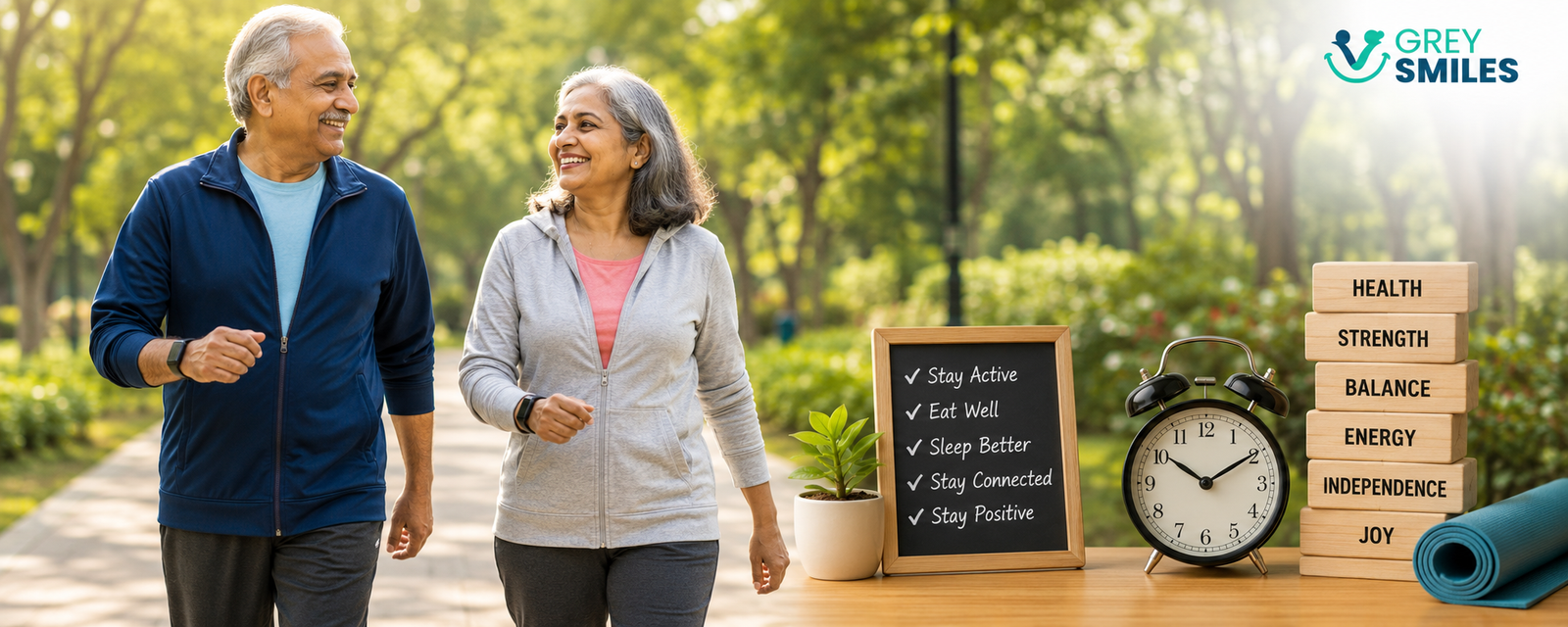
Ageing well is about staying active, capable and independent.
By: Dr. Anirban Kundu, Associate Director, Department of Cardiovascular and Thoracic Surgery (CTVS), CK Birla Hospital, Delhi
The word “insidious” usually has a sinister ring to it. It may even remind us of the hugely successful horror-film franchise. But here, the word is being used in a very different sense: to describe how ageing can creep into our lives gradually, often without a dramatic moment when we suddenly realise that we have changed.
This is not meant to be a frightening view of ageing. Quite the opposite. The aim is to take a pragmatic and balanced look at what can happen from our fifties onwards, separate normal changes from warning signs that should not be ignored, and recognise how much of later-life capability is influenced by what we continue to do rather than simply by the number of candles on the cake.
At a Glance
- Ageing usually does not arrive as one dramatic event. Many changes become noticeable gradually.
- Some changes are a normal part of getting older; others, particularly sudden or severe symptoms, should not simply be attributed to age.
- What we believe about our capabilities can influence how active we remain, which in turn affects strength, stamina and independence.
- You do not need a dramatic fitness transformation. Small, consistent increases in movement can be a practical starting point.
- As we age, the goal is not to compete with our younger selves but to preserve function, confidence and the ability to do the things that matter to us.
- Healthy ageing is about maintaining the ability to live a life that remains meaningful and manageable, not about trying to look or perform as though you are 30 again.
Why Does Ageing Feel So Insidious?
For many of us, the fifties can be a peculiar stage of life. Careers may have reached a relatively settled phase, children may be becoming independent, household finances may be more comfortable, and some of the responsibilities that dominated earlier decades may finally be easing.
At the same time, this can be when the first visible and invisible signs of ageing begin to attract our attention. We notice things that we previously took for granted. The body may need a little longer to recover, and activities that once required no thought may now require some preparation.
None of this means that life suddenly deteriorates after 50. It simply means that the relationship between age, physical capacity, habits and recovery begins to become more noticeable.
The Small Signs We Tend to Notice First
Ageing rarely announces itself. Instead, we may notice a collection of small changes:
- Climbing several flights of stairs leaves us more breathless than it once did, so we pause or unconsciously slow down.
- A brisk walk or physically demanding activity leaves us tired sooner than it did when we were younger.
- Starting an exercise routine feels increasingly difficult, even when we know it would be good for us.
- The waistline gradually expands and we become more accepting of it.
- We find ourselves wanting a short nap during the day.
- Late nights become less attractive and an early bedtime suddenly feels like a very good idea.
Individually, these observations may simply be reminders that the body is changing. But there is an important distinction to make.
Do not automatically blame ageing.
Severe, persistent or sudden shortness of breath, unusual fatigue, chest discomfort, fainting or a sudden decline in exercise tolerance should not simply be dismissed as “getting older.” Such symptoms can have many causes, some of which require medical assessment.
If a symptom is new, severe, sudden or worrying, speak to a qualified healthcare professional rather than trying to explain it away as ageing.
Ageing Changes the Body — But Not Everything Is “Just Age”
There are genuine physiological changes associated with ageing. Muscle mass and strength can decline over time, recovery may take longer, balance and reaction speed may change, and the likelihood of certain health conditions increases with age.
But ageing is not a single process that affects everyone in the same way. The World Health Organization emphasises that there is no typical older person. People of the same age can have very different levels of physical and mental capacity, depending on their health, habits, circumstances and environment.
That is an important distinction because it changes the question we should be asking.
Instead of asking, “How old am I?”, it can be more useful to ask:
“What can I still do, and what can I do to keep doing it?”
That is much closer to the idea of healthy ageing, which the WHO describes in terms of maintaining the functional ability that enables wellbeing in older age.
WHO’s overview of ageing and health is useful reading for anyone who wants to understand ageing as a process rather than simply a list of diseases associated with getting older.
The Mind Can Start the Ageing Story Too Early
One of the less obvious changes that can happen in our fifties is not necessarily physical. It is the way we begin to interpret what our bodies are capable of doing.
We may start attributing every ache, every episode of tiredness and every reluctance to exercise to age. The internal conversation gradually shifts from “I can do this” to “Perhaps I am too old for this.”
That change in thinking can influence behaviour.
If we believe we are becoming less capable, we may become less active. Less activity can then lead to reduced fitness, strength and stamina. Those changes can appear to confirm the original belief that we are becoming less capable.
It becomes a cycle: “I am getting older” → “I should do less” → “I become less fit” → “I really can’t do as much anymore.”
The important point is not that ageing is imaginary. It is not. The point is that inactivity can sometimes add to the limitations we attribute entirely to age.
Two People, the Same Age, Two Very Different Outcomes
Imagine two people who are both 55.
One routinely takes the lift, avoids longer walks, delegates anything physically demanding and regards exercise as an unpleasant obligation. The other walks regularly, takes the stairs when practical, remains active around the house and chooses hobbies that involve some movement.
Neither person has discovered a secret formula for stopping ageing. But after five or ten years, their strength, stamina, balance, confidence and ease of movement may be very different.
The difference is not necessarily because one person has “better genes”. It can also reflect years of accumulated behaviour.
That is why the fifties are worth treating as a window of opportunity. There is still time to build habits that can support the decades ahead.
The Goal Is Not to Become 30 Again
One of the easiest traps in midlife is comparing ourselves with our younger selves.
We remember running faster, staying awake later, recovering more quickly or carrying heavy luggage without thinking about it. Then we use that younger version of ourselves as the benchmark for today.
That is an unwinnable competition.
A better benchmark is functional capability.
Can you climb the stairs more comfortably than six months ago? Can you walk for longer? Can you get up from a chair more easily? Can you carry your shopping? Can you travel without worrying about whether your body will cope? Can you play with your grandchildren without needing to sit down every few minutes?
These are far more meaningful measures of ageing well than a number on a weighing scale.
Motivation May Be the Real Challenge
For many people in their fifties, the difficulty is not knowing that exercise is beneficial. We already know that. The problem is finding the motivation to begin — and then continuing when the initial enthusiasm disappears.
For decades, life has been structured around work, family responsibilities and deadlines. When some of those demands ease, there can be a surprising loss of momentum. The same person who could organise an entire working week may struggle to persuade themselves to take a 20-minute walk.
This is why a dramatic resolution can be less useful than a small routine.
You do not necessarily need to promise yourself an hour in the gym every day. Start with a ten-minute walk. If five kilometres sounds unrealistic, begin with five or ten minutes. If an exercise feels too difficult, start with a version appropriate to your current ability.
The objective is not immediate transformation. It is consistency.
Small actions that are repeated can become habits. Habits reduce the amount of motivation required to get started.
Make Movement Part of the Day
Exercise does not always have to appear as a separate appointment in your calendar.
Look for opportunities to build movement into ordinary life. Walk while speaking on the telephone. Take the stairs for a floor or two when appropriate. Park slightly farther away. Get up regularly if you have been sitting for a long period. Garden, walk, dance, swim or choose another activity you genuinely enjoy.
The WHO’s guidance is clear on one particularly useful point: some physical activity is better than none, and people who are inactive should begin with small amounts and gradually increase duration, frequency and intensity according to their abilities and circumstances.
WHO’s guidance on promoting physical activity for older people provides practical, evidence-based information on helping older adults remain active.
For adults aged 65 and above, current CDC guidance recommends a combination of aerobic activity, muscle-strengthening activity and balance activities each week. The precise amount and type should be appropriate to the person’s abilities and health circumstances.
The CDC’s guidance for older adults provides a useful overview of these recommendations.
Think Function, Not Appearance
The mirror and weighing scale can become surprisingly discouraging companions as we get older. Weight may move more slowly than we would like, body shape may change and the standards we once used to judge ourselves may no longer be realistic.
Try shifting the focus from appearance to performance.
Can you walk a little farther? Are stairs becoming easier? Has your balance improved? Can you carry something that was previously difficult? Are you sleeping better? Do you have more energy during the day?
These are practical signs that your efforts may be working.
And they matter because physical capability is closely connected to independence.
Why Independence Matters More Than Fitness
Fitness can sound like an aesthetic goal. Independence is different.
Being able to walk comfortably, get up from a chair, carry everyday objects, travel, climb stairs and manage ordinary activities gives us choices. Those choices become particularly valuable as we move through our sixties, seventies and beyond.
This is one reason healthy ageing is not simply about avoiding disease. It is about maintaining enough functional ability to continue doing the things that give life meaning.
That might mean travelling in retirement, playing with grandchildren, pursuing a hobby, volunteering, gardening, meeting friends or simply managing your own home without unnecessary dependence.
GreySmiles explores this broader idea of later-life purpose in What Is Your Life For — After Retirement?, which looks at how movement, contribution, relationships, learning and purpose can shape the quality of retirement.
Motivation Becomes Easier When the Goal Means Something
“Exercise because it is healthy” is technically correct, but it may not be enough to motivate someone.
A more powerful reason is personal.
You may want to remain fit enough to travel comfortably. You may want to keep up with your grandchildren. You may want to continue gardening, playing golf, dancing, hiking or exploring new places. You may simply want to remain independent for as long as possible.
When physical activity is connected to something you genuinely value, it becomes less about discipline and more about protecting the life you want to live.
This is particularly important as retirement approaches. Financial preparation matters, but retirement also changes how we use our time, what gives us structure and how we maintain engagement with life. GreySmiles’ article You Can Retire From Work. But Can You Retire Your Mind? explores another side of this transition — what happens when work no longer provides the structure around which everyday life has been organised.
Ageing Is Adaptation, Not Defeat
There are things about ageing that we cannot control. Recovery may take longer. Some physical capacities will change. Health conditions may appear. We may eventually need to adapt the way we do things.
But adaptation is not the same as surrender.
If running becomes difficult, walking may still be possible. If walking long distances becomes difficult, shorter walks may still be valuable. If an exercise is no longer appropriate, another form of movement may be possible.
The question changes from “Can I do what I used to do?” to “What is the best form of movement and activity for me now?”
That is a much more constructive question.
A Simple Starting Plan
If you have become less active over the years, do not turn this into another intimidating project. Start by observing where you are today.
- Choose one form of movement you do not dislike. Walking is perfectly acceptable.
- Start smaller than your ambition. A manageable routine is more useful than an impressive plan that lasts a week.
- Build consistency first. Increase duration or intensity gradually as your ability allows.
- Add variety over time. Include activities that support cardiovascular fitness, strength and, where appropriate, balance.
- Track function rather than appearance. Notice what everyday activities are becoming easier.
- Respect your health. If you have a medical condition, significant symptoms or concerns about starting exercise, seek appropriate professional guidance.
The WHO recommends that people who are inactive begin with small amounts of activity and gradually increase duration, frequency and intensity. The basic principle is reassuringly simple: you do not have to become active all at once.
What Should We Really Fear About Ageing?
Perhaps the greatest danger is not ageing itself, but deciding too early that ageing has made certain things impossible.
That belief can quietly narrow our lives. We stop walking because walking is harder. We stop travelling because travel seems tiring. We stop trying new activities because we assume they are for younger people. We become less active because we think we are less capable, and then become less capable because we are less active.
There will, of course, be genuine limitations. Ageing is real, and pretending otherwise is neither sensible nor helpful. But there is a large space between denying ageing and surrendering to it.
That space is where adaptation, movement, curiosity and sensible self-care belong.
The Goal: More Life in the Years
We cannot stop the passage of time. We cannot negotiate with birthdays. And we certainly cannot return to the physical capacity of our twenties simply by deciding to exercise more.
But we can influence how we respond to the changes that come with age.
We can challenge assumptions about what we can still do. We can remain physically active in ways that suit our bodies. We can pay attention to symptoms rather than dismissing them. We can build small habits rather than waiting for motivation to arrive. And we can measure success by independence, function and enjoyment rather than by trying to look young.
Ageing may indeed be insidious in the sense that it progresses quietly. But it does not have to be frightening.
GreySmiles Take
The goal of ageing well is not to defeat time or compete with our younger selves. It is to remain capable of doing the things that matter to us for as long as reasonably possible — and to adapt intelligently when our circumstances change.
Do not ask only, “How old am I?” Ask, “What do I want to remain capable of doing?”
Conclusion
Ageing is neither a horror story nor something we should pretend is not happening. It is a gradual process that brings genuine physical changes, but also considerable room for adaptation.
The fifties can therefore be a useful point to take stock. Not because everything suddenly changes at 50, but because the habits we establish around movement, activity, recovery and mindset can influence how we experience the decades that follow.
Start small. Stay consistent. Pay attention to what your body is telling you. Challenge the assumption that getting older automatically means doing less. And focus less on looking younger and more on remaining capable.
Ultimately, successful ageing is not about adding years to life alone. It is about adding life to those years.
The journey does not require a dramatic leap. Sometimes it begins with something much simpler: one more step today than yesterday.
Medical Reviewer
Dr. Anirban Kundu is a Cardiovascular and Thoracic Surgeon with over 24 years of experience in cardiac surgery. He is Associate Director, Department of Cardiovascular and Thoracic Surgery (CTVS), CK Birla Hospital, Delhi.
This article is intended for general informational purposes and is not a substitute for medical advice. It has been medically reviewed by Dr. Anirban Kundu. If you have new, severe, sudden or persistent symptoms, or if you have a medical condition that may affect exercise, consult an appropriate healthcare professional before changing your activity level.



Start the conversation
Share a helpful experience, ask a thoughtful question, or add another perspective for fellow readers.