
At a Glance
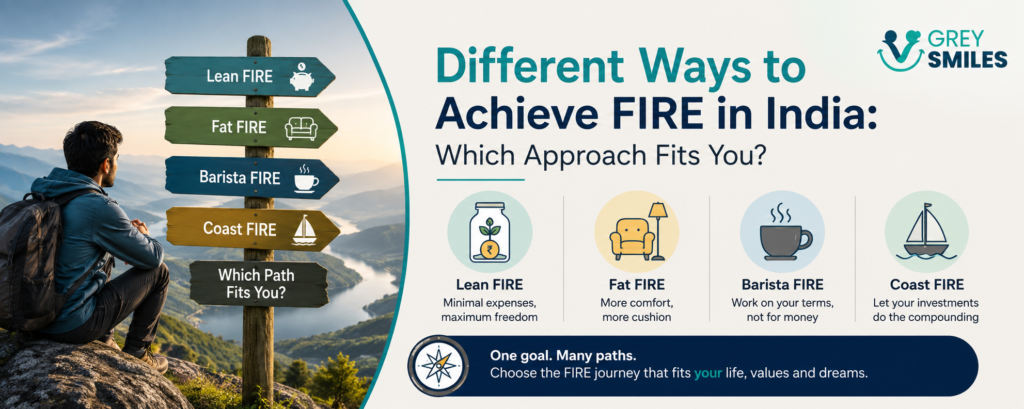
FIRE is not one fixed lifestyle. Financial independence can mean living simply, building a larger safety cushion, continuing part-time work or investing early enough to reduce pressure later. Understanding the different FIRE approaches can help you decide what financial freedom should look like for you.
- Lean FIRE: Financial independence built around a relatively simple, lower-cost lifestyle.
- Fat FIRE: A larger corpus designed to support a more comfortable or higher-spending lifestyle.
- Barista FIRE: Leaving demanding full-time work while continuing some form of part-time or flexible income.
- Coast FIRE: Building enough investments early that they can potentially grow towards a later retirement target without aggressive future saving.
- You can combine approaches: Your version of FIRE can change as your income, family and priorities change.
FIRE Does Not Look the Same for Everyone
FIRE stands for Financial Independence, Retire Early. But the phrase can create the impression that everyone following FIRE is trying to do exactly the same thing: save as much as possible, build a large investment portfolio and stop working completely at a young age.
That is only one version of the idea.
For some people, financial independence means being able to live on a modest budget without depending on a salary. For others, it means accumulating enough wealth to maintain a comfortable lifestyle. Someone else may simply want to leave a high-pressure corporate job while continuing to earn from consulting or part-time work.
That is why it is useful to think of FIRE as a spectrum of financial independence rather than a single destination.
If you are new to the concept, start with the GreySmiles guide to FIRE in India. This article looks specifically at the different ways FIRE can be pursued.
What Are the Main Types of FIRE?
The four commonly discussed approaches are Lean FIRE, Fat FIRE, Barista FIRE and Coast FIRE.
They differ mainly in three areas: how much you spend, how large a financial cushion you want and whether you intend to continue earning after reaching a certain level of financial independence.
| FIRE approach | Core idea | Best suited to |
|---|---|---|
| Lean FIRE | Financial independence with relatively low spending. | People comfortable with a simple lifestyle. |
| Fat FIRE | A larger corpus designed to support higher spending. | People who want greater lifestyle flexibility. |
| Barista FIRE | Investments cover most needs while some income continues. | People who want to leave full-time corporate work. |
| Coast FIRE | Early investments are allowed to grow towards a later retirement target. | People who want less pressure to save later. |
Lean FIRE: Freedom Through Simplicity
Lean FIRE is based on the idea that you can reach financial independence with a relatively modest corpus if your lifestyle costs relatively little.
The attraction is obvious: the less you need to spend, the less you need to accumulate.
Someone who is comfortable living in a smaller home, cooking at home, travelling selectively and keeping discretionary spending under control may need a considerably smaller portfolio than someone who wants a premium lifestyle.
Lean FIRE does not necessarily mean deprivation. It can simply mean being deliberate about what you consider worth spending money on.
The advantage
Your financial independence target can potentially be lower, which may shorten the accumulation period.
The trade-off
A lower spending plan leaves less room for unexpected expenses or lifestyle changes. Healthcare, housing, family responsibilities and inflation can make an ultra-lean plan harder to maintain over a long retirement.
Lean FIRE therefore requires an honest assessment of how much simplicity you are genuinely comfortable with — not a lifestyle you are willing to tolerate for two years just to reach a target.
Fat FIRE: More Financial Cushion, More Lifestyle Choice
Fat FIRE takes the opposite approach.
Instead of designing retirement around a lean spending level, the goal is to accumulate a significantly larger corpus that can support a more comfortable lifestyle.
This might include frequent travel, premium housing, expensive hobbies, greater discretionary spending or a larger allowance for unexpected expenses.
For high earners, Fat FIRE can also be attractive because a high income does not automatically translate into a desire for a low-cost retirement lifestyle.
The advantage
A larger financial cushion can provide more flexibility when spending changes or unexpected costs arise.
The trade-off
The bigger the lifestyle you want to maintain, the larger the corpus you need — and the longer the accumulation journey may become.
There is also a behavioural risk: continually increasing the definition of “enough” can keep the FIRE target moving further away.
Barista FIRE: Work Less, Not Necessarily Never
Barista FIRE may be one of the most practical approaches for people who want to leave demanding full-time employment but are not ready to depend entirely on their investment portfolio.
The idea is simple: build enough financial resources to cover a substantial part of your needs, then use lower-stress or part-time work to cover the remaining expenses.
That work could be consulting, freelancing, teaching, writing, coaching, a small business or another activity that provides both income and purpose.
Why it can work well
Even a modest income can reduce the amount you need to withdraw from investments each year.
It can also provide structure, social interaction and a sense of purpose after leaving a conventional corporate career.
The trade-off
You are not completely financially independent in the traditional sense because some level of earned income remains part of the plan.
But that may not be a weakness.
For many people, the ability to choose what work they do and how much they work may be more valuable than never working again.
Coast FIRE: Let Time Do More of the Work
Coast FIRE takes advantage of one of the most powerful ideas in long-term investing: time.
The basic idea is to build a sufficiently large investment base early in life and then allow compounding to do much of the remaining work towards a traditional retirement target.
Once you reach your Coast FIRE point, you may be able to reduce the amount you save aggressively from your salary because your existing investments have a long period in which to grow.
This does not necessarily mean retiring early.
You may continue working because you enjoy your career, want to build something, travel or simply prefer the structure of employment.
The advantage
Coast FIRE can reduce the psychological pressure of constantly asking whether you are saving enough for retirement.
The trade-off
It relies heavily on time and disciplined early investing. It also requires realistic assumptions about future returns and retirement needs.
Market returns are not guaranteed, so Coast FIRE should be treated as a planning framework rather than a promise that a particular corpus will reach a particular value.
Which FIRE Approach Is Right for You?
There is no universal answer.
Your preferred FIRE model should reflect the life you actually want rather than the version that sounds most impressive on social media.
Consider these questions:
- How much do I genuinely need to live comfortably?
- Would I be happy with a simpler lifestyle?
- Do I want to stop working completely?
- Would part-time or consulting work give me more freedom?
- How important are travel, housing and discretionary spending to me?
- What family responsibilities will continue after I leave full-time employment?
- How much healthcare and emergency cushion do I want?
- How early am I starting?
The answers may point you towards one FIRE model — or a combination of several.
You Don’t Have to Choose One FIRE Model Forever
Your FIRE strategy can change.
You might begin your career pursuing Coast FIRE by investing aggressively in your 20s. Later, you may decide that Barista FIRE suits you better because you want to leave corporate employment but still enjoy earning.
Someone pursuing Lean FIRE may eventually realise that travel or family responsibilities require a larger cushion. Their target can then move closer to a more comfortable version of FIRE.
Financial independence is not a contract you sign with yourself at age 30.
Your plan can evolve as your life evolves.
FIRE in the Indian Context
The different FIRE models can be especially useful when thinking about Indian retirement realities.
Family responsibilities, housing choices, healthcare, children’s education and support for parents can all affect the amount you need.
Someone with a paid-off home and limited family obligations may have a very different FIRE target from someone supporting multiple generations.
This is why copying another person’s FIRE number is rarely useful.
Your FIRE plan needs to start with your expenses, your responsibilities and your desired lifestyle.
For help calculating the actual corpus you may need, see the GreySmiles guide to calculating your FIRE number in India.
What All FIRE Approaches Have in Common
Although Lean FIRE, Fat FIRE, Barista FIRE and Coast FIRE look different, they share several principles.
Spend deliberately
Financial independence becomes easier when you understand where your money goes and spend according to your priorities.
Save consistently
A sustainable savings habit matters more than one extraordinary year of saving.
Invest for the long term
Your investment strategy should match your time horizon and risk tolerance rather than being built around whichever asset performed best recently.
Protect against major setbacks
Emergency savings, appropriate insurance, manageable debt and a diversified portfolio can make a FIRE plan more resilient.
Know what financial independence is for
Money is the tool. Freedom, flexibility, purpose and choice are the potential outcomes.
A Simple Way to Choose Your FIRE Path
Instead of asking, “Which FIRE movement should I follow?”, work backwards from the life you want.
- Define your desired lifestyle. What would a good ordinary month look like if you did not need a full-time salary?
- Estimate your annual spending. Include housing, healthcare, travel, family responsibilities and discretionary spending.
- Calculate your starting FIRE number. Use a planning multiple rather than treating any single number as guaranteed.
- Decide how much work you want after financial independence. Full retirement, consulting, part-time work and continued employment are all legitimate choices.
- Build the appropriate portfolio. Match your investments and risk level to the length and purpose of the goal.
- Review the plan regularly. Your FIRE model can change as your circumstances change.
If you are planning broader financial independence rather than only early retirement, GreySmiles’ retirement planning guide for Indian salaried professionals can help put the FIRE goal into the larger retirement picture.
FAQs
What is Lean FIRE?
Lean FIRE is a form of financial independence based on maintaining a relatively simple lifestyle and lower spending. Because the annual spending target is lower, the required corpus may also be lower.
What is Fat FIRE?
Fat FIRE aims for a substantially larger financial cushion so that financial independence can support a higher level of discretionary spending and lifestyle flexibility.
What is Barista FIRE?
Barista FIRE means reaching a level of financial independence where investments cover a significant portion of your needs while part-time, flexible or lower-stress work covers the rest.
What is Coast FIRE?
Coast FIRE involves building a sufficiently large investment base early enough that, under reasonable assumptions, it can potentially grow towards a future retirement target without requiring aggressive additional retirement saving.
Can I combine different FIRE approaches?
Yes. FIRE is a framework rather than a fixed formula. Your approach can evolve from Coast FIRE to Barista FIRE, for example, or move from Lean FIRE towards a larger financial cushion as your lifestyle and responsibilities change.
The GreySmiles Take
There is no prize for choosing the most extreme version of FIRE.
The right approach is the one that gives you greater financial freedom without forcing you into a lifestyle you do not actually want.
For one person, that could mean Lean FIRE. For another, Fat FIRE may provide the comfort they value. Someone else may simply want to leave corporate life and continue working on their own terms.
FIRE is not about finding the one correct way to retire early. It is about finding the level of financial independence that gives you more control over your life.
Disclaimer: This article is for general educational purposes and does not constitute personalised financial, investment, tax or retirement advice. Investment returns are not guaranteed, and your appropriate FIRE strategy depends on your individual circumstances, goals and risk tolerance.
