
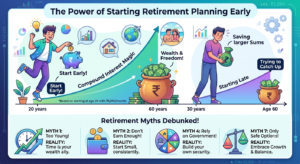
Smart Retirement Planning: Debunking 8 Myths for Millennials & Gen Z
Myth 1: “I’m Too Young to Think About Retirement”
The Reality: Starting early gives your savings massive room to grow through the power of compounding. When you invest early, your investment returns earn their own returns, snowballing your wealth over decades.
Consider this stark math: A 20-year-old who saves ₹5,000 every month at an average annual return of 10% can accumulate over ₹3.16 crore by age 60. If you wait until age 30 to start saving that exact same amount, your final nest egg drops to roughly ₹1.14 crore. Waiting just one decade effectively slashes your potential wealth by nearly two-thirds. Early, consistent action beats trying to catch up later every single time.
Myth 2: “I Don’t Earn Enough to Save for Retirement”
The Reality: You do not need a massive salary to kickstart a retirement fund. Small, regular contributions grow meaningfully over time.
If you put away just ₹1,000 per month into an equity Systematic Investment Plan (SIP) averaging a 12% annual return over 35 years, your total contribution of ₹4.2 Lakh grows into a substantial ₹64.9 Lakh. The goal here is establishing the psychological habit of consistency. Start small, automate your savings on payday, and scale up your contributions by 5% to 10% every time you get a raise.
Myth 3: “Retirement Is Only for Employees with Employer‑Sponsored Plans”
The Reality: While formal corporate benefits like the Employees’ Provident Fund (EPF) provide a fantastic foundation, they are not the only path to a secure retirement.
Freelancers, gig economy workers, and self-employed professionals possess excellent alternative avenues to build structured wealth. You can open a Public Provident Fund (PPF) account for tax-free, guaranteed returns backed by the government, or subscribe to the National Pension System (NPS) for low-cost market exposure. Supplement these regular accounts with direct mutual fund SIPs to construct a tailored portfolio that matches your specific cash flow patterns.
Myth 4: “I Can Rely Solely on Government Pensions or Social Security”
The Reality: Public safety nets and legacy pension structures rarely cover the total cost of maintaining a comfortable lifestyle, especially when factoring in modern inflation.
The India Retirement Index continuously underscores that relying exclusively on structural public payouts leaves retirees highly vulnerable to funding gaps. Healthcare inflation consistently outpaces general inflation, meaning medical costs can quickly decimate an inadequate fixed income. You must build a personalized, diversified investment portfolio to act as your primary financial engine.
Myth 5: “I Can Withdraw Money from My Retirement Accounts Anytime”
The Reality: Retirement accounts maintain strict lock-in periods, withdrawal penalties, and tax consequences specifically designed to protect your future self from your present impulses.
For instance, the NPS restricts major premature withdrawals to specific critical life events (like higher education or emergency medical treatments) and caps the percentage you can take out. Dipping into these funds early derails the compounding process. Treat your retirement portfolio as a sacred, one-way vault—build a separate, easily accessible liquid emergency fund covering 6 months of expenses so you never have to break your retirement accounts.
Myth 6: “I Will Continue Working and Support Myself in Retirement”
The Reality: Assuming you can work indefinitely is a dangerous retirement strategy.
Data compiled by organizations like the Pew Research Center indicates that a significant percentage of older workers exit the labor force much earlier than they originally intended. Health complications, corporate downsizing, fast-evolving technological shifts, and family caregiving responsibilities frequently force early retirement. You should plan your finances under the assumption that you will choose or *need* to stop working by your late 50s or early 60s.
Myth 7: “I Should Only Invest in Safe Options”
The Reality: Playing it too safe is its own form of risk. While traditional fixed deposits (FDs) and standard savings accounts protect your principal amount, their post-tax returns frequently fall below the rate of inflation. Over time, inflation silently erodes your actual purchasing power.
To build true long-term wealth, a young investor’s portfolio needs growth-oriented assets like equities. Over long horizons, equities historically outperform fixed-income instruments. Balance your asset allocation by blending secure, wealth-preserving options (like PPF) with wealth-generating options (like diversified equity mutual funds) to keep your money growing faster than the cost of living.
Myth 8: “Financial Planning Is Too Complicated”
The Reality: You do not need a degree in finance to secure your future. The fundamental principles of wealth building remain incredibly straightforward: track your cash flow, spend less than you earn, invest the difference into diversified growth assets, and leave it alone to compound.
Dozens of modern, intuitive tools simplify this journey. Automated budgeting apps track your monthly spending, robo-advisors handle complex portfolio rebalancing based on your risk profile, and online retirement calculators show you exactly where you stand. Break the process down into bite-sized steps—spend 15 minutes this week analyzing your expenses, and take action from there.
Secure Your Future Today
Dispelling these common financial myths empowers Millennials and Gen Z to step out of uncertainty and take definitive control of their financial destinies. Retirement planning is not a sprint won by the highest earner; it is a marathon won by the most disciplined tracker. By starting early, remaining consistent through market cycles, diversifying your assets, and leveraging structured instruments like the NPS and PPF, you turn time into your ultimate ally. Every small, informed financial decision you execute today compounds into profound freedom down the road. Embrace the journey, trust the process, and secure the vibrant future you deserve!
Related articles:
A New Era for Retirement: How Millennials and Gen Z Must Evolve Their Financial Planning
Creating a Budget: A Step-by-Step Guide to Retirement Savings for Millennials and Gen Z