
At a Glance
FIRE — Financial Independence, Retire Early — can be a realistic goal for some Indians, but it is not simply a matter of saving aggressively and reaching a particular corpus. Your age, spending, family responsibilities, healthcare needs, housing, investment risk and willingness to keep working in some form can all change the equation.
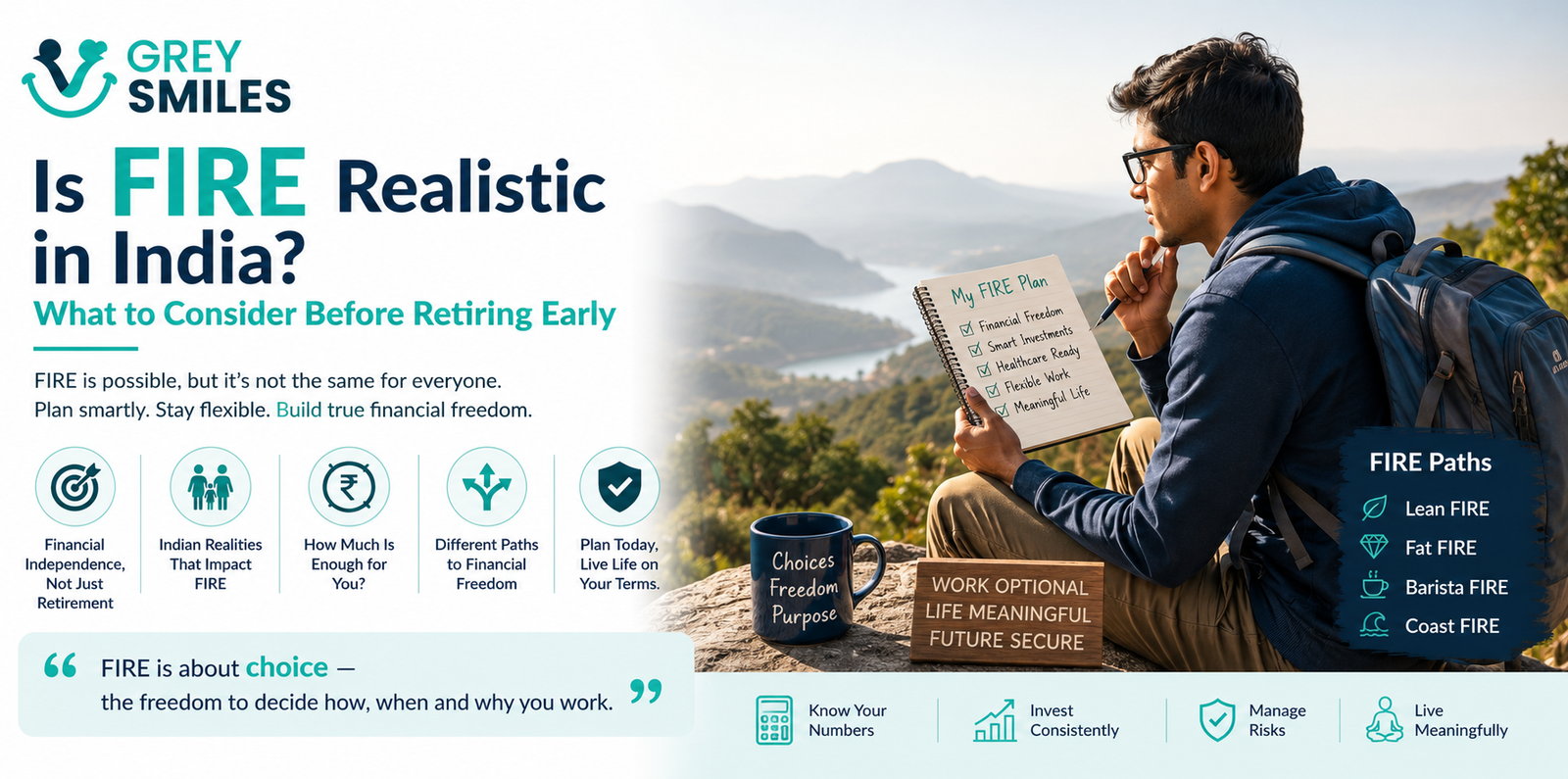
- FIRE is about financial choice, not necessarily never working again.
- Indian families may have responsibilities that traditional FIRE calculations overlook.
- Healthcare and inflation need more attention when planning for a long retirement.
- There is more than one version of FIRE, from Lean FIRE to Coast FIRE.
- A flexible or gradual transition may be more realistic than abruptly leaving work.
What Does FIRE Really Mean?
FIRE stands for Financial Independence, Retire Early. The idea is to build enough financial resources that employment becomes a choice rather than an absolute financial necessity.
That does not necessarily mean leaving work forever in your 30s or 40s. For one person, FIRE may mean leaving a stressful corporate career. For another, it may mean moving into consulting, working part-time, starting a business, taking a career break or simply knowing that a job loss would not threaten the family’s financial security.
That distinction matters in India because the practical question is often not “Can I stop working?” but “How much financial independence do I need before I can change the way I work?” If you want to understand the broader FIRE framework first, see the GreySmiles guide to FIRE in India and financial independence.
Is FIRE Realistic in India?
Yes — but not in the same way for everyone. FIRE becomes more achievable when there is a meaningful gap between income and spending, that gap is invested consistently, and the investor has enough time for the portfolio to grow. But early retirement also requires a much longer financial runway than conventional retirement. Someone leaving work at 40 may need their resources to support them for several decades. That makes the FIRE calculation particularly sensitive to inflation, healthcare, family responsibilities, investment returns and spending behaviour.
The goal should therefore not be to copy an American or European FIRE formula and apply it mechanically to an Indian household. The goal is to build a financial independence plan that reflects your actual Indian cost structure and your actual life.
The Indian Realities That Can Change the FIRE Equation
Inflation matters for a long retirement
If you retire early, inflation has a very long period in which to affect your purchasing power. A lifestyle that costs ₹8 lakh a year today may cost substantially more when you actually stop working. This is why your FIRE plan should use future spending assumptions rather than simply multiplying today’s expenses by a fixed number and treating the result as permanent.
Do not confuse this with assuming that inflation will remain at one particular rate forever. It is better to test your plan under several reasonable scenarios.
Healthcare needs a separate safety margin
Healthcare is one of the biggest uncertainties in a long retirement. Regular insurance premiums, deductibles, medical procedures, medicines and potential long-term care can all affect retirement spending. A FIRE plan that works perfectly on paper but leaves no room for a major healthcare expense is not particularly resilient. This is also why health insurance should not be treated as an afterthought simply because you have accumulated a large investment corpus.
Family responsibilities can be different
Indian retirement planning often involves more than the individual or couple pursuing FIRE. Support for parents, children’s higher education, family events, housing decisions and other responsibilities can materially change both the amount you need and the age at which you can realistically become financially independent.
A FIRE calculation should therefore distinguish between your personal lifestyle expenses and financial commitments you may continue to have towards others.
Housing can make or break the calculation
Housing is often one of the largest components of an Indian household’s spending. A person who owns a fully paid home may have a very different FIRE requirement from someone who expects to rent throughout retirement. Downsizing, moving to a lower-cost city or changing the type of housing you need after leaving full-time work can also materially alter the calculation.
Investment risk does not disappear when you reach FIRE
Accumulating a large corpus is only one part of the challenge. Once you stop earning a salary, a significant market fall can become more difficult to absorb because you may also be withdrawing money from the portfolio. This is commonly described as sequence-of-returns risk. The order in which good and bad investment years occur can matter when withdrawals have already begun.
That is why a FIRE portfolio should not simply be designed around maximising returns. Liquidity, diversification, asset allocation and a sensible withdrawal approach matter too.
How Much Is Enough?
There is no universal FIRE number for India. A common starting point is the 25X rule — multiplying annual expenses by 25. Someone spending ₹6 lakh a year, for example, would arrive at a starting figure of ₹1.5 crore. But someone planning to leave work at 40 may reasonably want a larger margin of safety than someone retiring at 60. That is why 25X, 30X or another multiple should be treated as a planning framework rather than a magic number.
For the actual calculation, see GreySmiles’ guide to calculating your FIRE number in India.
Four Ways to Think About FIRE
FIRE is not a single lifestyle. Different people can pursue financial independence at different levels of spending, work and investment intensity.
| Approach | What it means | Who it may suit |
|---|---|---|
| Lean FIRE | Financial independence based on a relatively lean lifestyle and lower spending. | People comfortable with a simple lifestyle and lower discretionary spending. |
| Fat FIRE | A substantially larger corpus designed to support higher spending. | High earners who want greater lifestyle flexibility after leaving full-time work. |
| Barista FIRE | Leaving demanding full-time employment while earning enough from part-time or lower-stress work to cover some expenses. | People who want more freedom without depending entirely on investments. |
| Coast FIRE | Building enough early that existing investments can potentially grow towards a later retirement target without aggressive future saving. | People who enjoy working but want less pressure to maximise retirement savings later. |
These labels are useful because they show that financial independence does not have to mean choosing between two extremes: working full-time until 60 or never working again.
The Case for a Gradual FIRE Transition
One of the most practical ways to approach FIRE may be to reduce your dependence on salary before eliminating employment income altogether.
For example, someone might move from a high-pressure corporate role into consulting. Another person might work four days a week. Someone else might build a small business or develop a professional skill that generates occasional income. Every rupee earned after leaving full-time employment reduces the amount that needs to be withdrawn from investments. More importantly, continued work can provide structure, social interaction and a sense of purpose while reducing the financial pressure of an abrupt retirement.
Don’t make “never work again” the only definition of FIRE. If financial independence lets you choose what work you do, how much you work and when you stop, you have already achieved an important part of the goal.
What a Practical FIRE Plan Could Look Like
A realistic FIRE strategy does not begin with an aggressive investment target. It begins by understanding your financial foundation.
Know your spending
Track your actual expenses rather than relying on estimates. Separate essentials from discretionary spending and identify which costs are likely to continue after you stop working.
Build an emergency reserve
Keep money available for short-term emergencies instead of assuming your long-term investment portfolio can always be sold at the right time.
Manage expensive debt
High-cost consumer debt can work directly against financial independence. Reducing expensive debt can be as important as increasing investment returns.
Invest consistently
Build a diversified portfolio appropriate to your time horizon and risk tolerance. FIRE is a long-term process, so a strategy you can stick with through market cycles is generally more useful than a complicated strategy that encourages frequent changes.
Protect the plan
Insurance, emergency savings and an appropriate asset allocation can protect a FIRE plan from risks that a simple investment-return calculation cannot capture.
Review the plan
Your FIRE number should not be frozen forever. Changes in income, expenses, family responsibilities, markets and retirement timing can all change the amount you need.
The Biggest FIRE Mistakes to Avoid
Chasing an unrealistic savings rate
Saving more can accelerate financial independence, but an extreme savings rate that makes your present life miserable may not be sustainable.
The right question is not simply how much you can save for one year. It is how much you can save consistently for many years.
Assuming investment returns will be smooth
Real portfolios do not grow in a straight line. Planning based on one fixed annual return can create false confidence.
Ignoring healthcare
A retirement plan without a healthcare buffer is incomplete.
Counting every asset as retirement money
Your primary home, locked-in investments and assets that you do not intend to sell should not automatically be treated as available retirement capital.
Assuming your lifestyle will never change
Your spending at 40 may not be the same at 55, 65 or 75. Travel, healthcare, family responsibilities and housing needs can all change over time.
Making FIRE entirely about money
Leaving work can solve a financial problem while creating a lifestyle problem.
Before retiring early, think about what will replace the structure, social connections, purpose and identity that employment may currently provide.
FIRE Is Also a Lifestyle Decision
The financial calculation is only half the decision.
Imagine reaching your target corpus at 45. You have enough money on paper, but you have no idea how you want to spend the next 30 years.
That is not necessarily financial failure. It is a reminder that retirement is a life transition, not simply an investment milestone.
Ask yourself:
- What will I do with my time?
- Where do I want to live?
- Do I want to continue working in some form?
- How much travel do I want?
- What relationships and communities matter to me?
- What role will purpose and learning play in my life?
Financial independence becomes much more valuable when you know what you are becoming financially independent for.
A Practical FIRE Roadmap
- Define your desired lifestyle: Decide what you want your post-work life to look like.
- Calculate your current spending: Separate essential and discretionary expenses.
- Estimate your future spending: Allow for inflation and changing needs.
- Calculate your FIRE number: Use a planning multiple as a starting point rather than a guarantee.
- Build your investment plan: Match asset allocation to your time horizon and risk tolerance.
- Protect the plan: Maintain suitable insurance, liquidity and emergency reserves.
- Test different scenarios: Consider higher expenses, lower returns, longer retirement and unexpected costs.
- Review regularly: Adjust your target as your life changes.
If you are still building your overall retirement strategy, GreySmiles’ retirement planning guide for Indian salaried professionals provides the wider framework.
FAQs
Is FIRE really possible in India?
Yes, it can be possible for some people, but the timeline and required corpus vary significantly. Income, savings rate, expenses, investment returns, family responsibilities, healthcare and retirement age all affect the outcome.
Is 25X enough for FIRE in India?
25X can be a useful starting heuristic, but it is not a guarantee. Someone retiring particularly early may want a larger margin of safety and should consider inflation, healthcare, taxes and the length of the retirement period.
Do I have to stop working completely to achieve FIRE?
No. Financial independence can mean having enough financial security to choose the type and amount of work you do. Part-time work, consulting or a lower-stress career can all form part of a FIRE lifestyle.
What are the biggest risks to FIRE in India?
Major risks include inflation, healthcare costs, market volatility, sequence-of-returns risk, unexpected family responsibilities, inadequate liquidity and underestimating how long the money may need to last.
What is the biggest mistake people make when pursuing FIRE?
One common mistake is focusing entirely on reaching a corpus target while ignoring the life they want to live afterwards. A sustainable FIRE plan needs both financial resilience and a realistic plan for life after full-time employment.
The GreySmiles Take
FIRE is possible in India, but it should not become another race.
The strongest FIRE plan is not necessarily the person who saves the largest percentage of their salary or reaches a headline corpus at the youngest age. It is the person who builds enough financial resilience to make meaningful choices without sacrificing the life they are trying to secure.
For some, that may mean retiring at 45. For others, it may mean leaving corporate life at 50, working independently, or simply reaching a point where money no longer dictates every career decision.
Financial independence is ultimately about having choices. Early retirement is only one of them.
Disclaimer: This article is for general educational purposes and does not constitute personalised financial, investment, tax or insurance advice. Investment values can rise or fall, and retirement outcomes depend on individual circumstances, assumptions and market conditions.in




Start the conversation
Share a helpful experience, ask a thoughtful question, or add another perspective for fellow readers.