
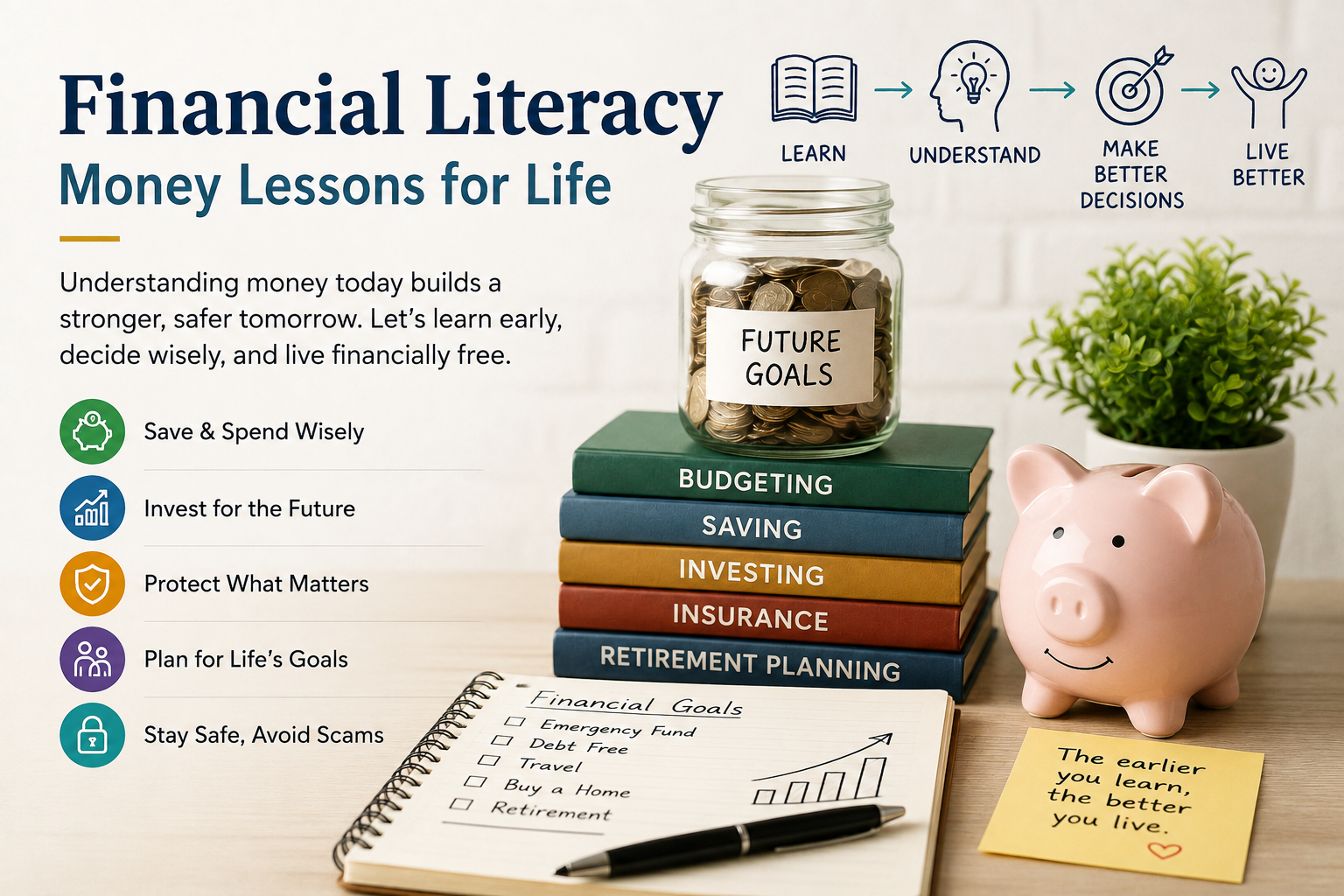
Financial literacy is a life skill—from learning to save and invest to understanding risk, protection and retirement.
At a Glance: Why This Matters
- Financial access is not financial understanding. India has made enormous progress with bank accounts and digital payments, but knowing how to transact is not the same as knowing how money works.
- Financial literacy is a life skill. Saving, inflation, interest, debt, insurance, investing and financial safety affect almost every adult’s life.
- Digital money makes literacy more important. UPI and investing apps have made money faster and easier to move, while scams and financial misinformation have become easier to spread.
- We should start in school. Children should learn basic money skills before they receive their first salary—not after they make their first expensive financial mistake.
We teach children mathematics because they will use numbers throughout their lives.
We teach language because they need to communicate.
We teach science because understanding the world around them matters.
Money deserves the same seriousness.
Every child will eventually earn, spend, borrow, save, insure or invest. Yet financial education often begins only after someone starts earning—and sometimes only after a major financial mistake.
India has made extraordinary progress in financial access. Bank accounts, digital payments and online financial services are now part of everyday life for millions of people.
But there is an important gap:
Being able to use money is not the same as understanding money.
My Father, Shares and a Very Different India
My own introduction to investing came when I was 16. My father encouraged me to trade in shares.
It was a completely different financial world.
Shares existed in physical certificate form. They could take weeks to be issued and, in my experience, the certificates arrived through the post only much later—sometimes after around three months.
Then came the actual transaction.
We had a broker next door. You would take the physical shares to him, instruct him to sell them and wait. There was no smartphone showing a live market price. No app showing whether your order had gone through. No instant transaction history.
There was very little transparency by today’s standards.
Compare that with today. A young person can see a share price change every few seconds, open an investment account online and potentially buy or sell an investment from a phone.
The technology has changed almost beyond recognition.
But my father’s lesson has stayed with me: money becomes much less intimidating when you start learning about it early.
And that is why financial literacy matters even more today.
Financial Literacy Is Not About Turning Children Into Investors
Financial education in school should not be about encouraging children to trade stocks or chase returns.
It should teach them how to think about money.
A financially literate young person should understand:
- the difference between saving and investing
- why inflation reduces purchasing power
- how interest and compounding work
- why borrowing money has a cost
- what an EMI actually means
- the difference between needs and wants
- why insurance is primarily about protection
- why higher potential returns usually involve higher risk
- why diversification matters
- how to recognise common financial scams
- why passwords, OTPs and financial credentials must be protected
These aren’t advanced investment concepts.
They are adult-life skills.
Why Financial Education Belongs in School
We shouldn’t expect parents to teach every child about money. Not every parent understands investing, insurance, taxation or retirement planning themselves.
Schools can give every child a basic foundation, regardless of their family’s financial background.
The lessons don’t need to become another complicated textbook.
They can be practical.
At a younger age
Children can learn about saving, spending, needs versus wants and the idea that money is limited.
A simple classroom question could be:
“You have ₹500. What would you spend, what would you save and why?”
That teaches more than memorising a definition of saving.
As they grow older
Students can learn about bank accounts, interest, inflation, budgeting, digital payments, borrowing and financial safety.
Later, they can be introduced to insurance, investing, diversification, pensions, taxes and retirement planning at an age-appropriate level.
The objective should not be to create teenage stock traders.
It should be to create financially capable adults.
The Digital World Makes This More Urgent
Money has never been more convenient.
It has also never been easier to move without fully understanding what we are doing.
Today we can:
- open bank accounts remotely
- transfer money instantly
- buy insurance online
- invest through an app
- take digital credit
- shop with one-click payments
- receive investment advice through social media
Convenience is wonderful. But it can also remove the pause in which people once had time to think.
That makes digital financial literacy just as important as traditional financial literacy.
Young people should learn not only how to make a digital payment, but also when to stop, verify and question something that looks suspicious.
What Should Financial Literacy Actually Teach?
A useful school programme could focus on a handful of practical ideas rather than trying to turn children into finance experts.
| Skill | What a young person should understand |
|---|---|
| Saving | Why saving before spending creates financial freedom. |
| Budgeting | Where money goes and how to make deliberate choices. |
| Interest | How interest can help savings grow—and make debt expensive. |
| Inflation | Why the same amount of money buys less over time. |
| Risk | Why investments with greater potential returns can also lose value. |
| Insurance | Why insurance protects against financial shocks rather than being a shortcut to wealth. |
| Digital safety | How to protect accounts and recognise common financial scams. |
Financial Literacy Is a Family Conversation Too
Schools can provide the foundation. Families can turn it into everyday behaviour.
Parents don’t have to reveal their entire financial situation to their children. But they can involve them in simple, age-appropriate conversations.
Why do we save before making a large purchase?
Why do we insure a car or a home?
Why does borrowing cost money?
Why might something advertised as a “great investment” actually be risky?
These small conversations make money less mysterious.
My father’s decision to introduce me to shares at 16 was, in retrospect, a lesson that went beyond the shares themselves.
He made money something I could learn about rather than something I had to be intimidated by.
Financial Literacy Is Also Retirement Literacy
This matters to GreySmiles for another reason.
Financial decisions made at 20 can affect the quality of life at 60.
A missed decade of saving. An expensive loan. Inadequate insurance. No emergency fund. Ignoring inflation. Depending too heavily on property.
These decisions accumulate.
By the time someone reaches retirement, there may be less time to correct them.
Retirement planning doesn’t really begin at retirement. It is the result of decades of financial decisions.
Financial literacy is the foundation underneath those decisions.
The GreySmiles View
We often think of education as preparation for a career.
Perhaps we should think more broadly.
Education should prepare children for life—and money is an unavoidable part of life.
Financial literacy isn’t about making everyone an investor. It is about making people less vulnerable, more confident and more capable of making their own financial decisions.
Every child deserves to learn how money works before they are expected to manage it.
A Simple Financial-Literacy Test
Whether you are 18 or 58, ask yourself:
- Do I know where my money goes every month?
- Do I understand the difference between saving and investing?
- Do I understand inflation?
- Do I know what my debt is really costing me?
- Do I have an emergency fund?
- Do I understand what my insurance actually covers?
- Do I understand the risks of the investments I own?
- Could I recognise a likely financial scam?
- Could I explain basic money concepts to a young person in my family?
If several answers are “no”, that isn’t a failure.
It simply means there is more to learn.
Conclusion: We Teach Children How to Earn. We Should Teach Them How to Handle Money.
My father’s introduction to shares belonged to a completely different financial era.
Physical certificates. A neighbourhood broker. Long waits. Very little information at your fingertips.
Today, markets are visible in real time and money can move across the country in seconds.
But the fundamental question remains:
Do we understand what we are doing with our money?
That is why financial literacy should become a core part of school education in India—not an optional workshop and not something we expect people to learn only after their first major financial mistake.
Because regular education prepares us to earn a living.
Financial education prepares us to live with the money we earn.
And the earlier we start, the better equipped we are to build not just wealth, but financial resilience, independence and dignity across an entire lifetime.
Continue the GreySmiles Financial Literacy Series
This is the first article in our Financial Literacy series. We will explore the subject from different stages of life—from a parent’s first money lesson to the financial decisions that matter most later in life.
- Coming next: I Was 16 When My Father Introduced Me to the Stock Market. Here’s What I Learned.
- Coming soon: Why Every Child Should Learn About Money Before Their First Salary
- Coming soon: UPI Is Easy. Understanding Money Isn’t.
- Coming soon: 7 Money Lessons Every Teenager Should Know Before Turning 18
- Coming soon: Why Financial Literacy Matters More After 60
Related GreySmiles reading: Ultimate Retirement Planning Guide for Indian Salaried Professionals
Disclaimer: This article is intended for general education and information. It is not personal financial, investment, tax or legal advice. Financial products, regulations and tax rules can change. Consider seeking qualified professional advice before making significant financial decisions.




Start the conversation
Share a helpful experience, ask a thoughtful question, or add another perspective for fellow readers.