
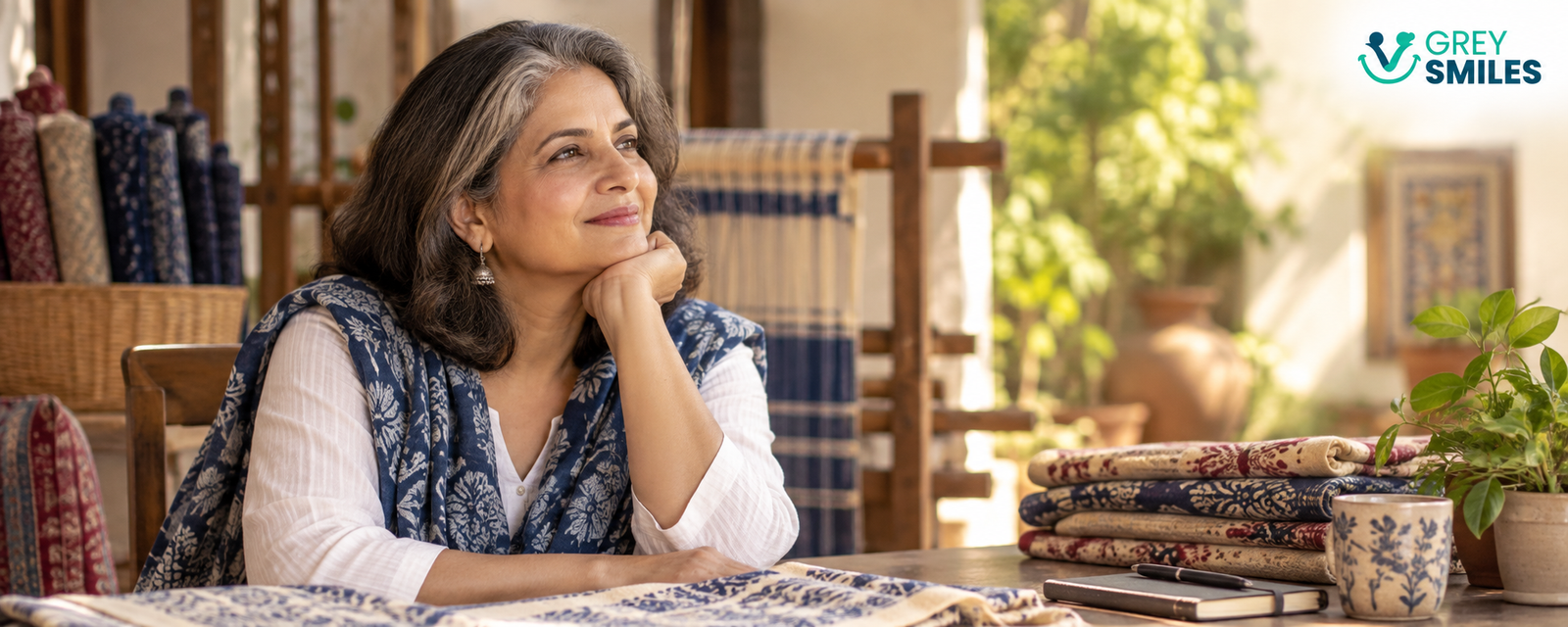
Life after 50 can be a time to rethink work, purpose, identity and personal choice.
By Ridhima Srivastava, Founder, Weavehand
For many women, retirement is not simply the point at which a career comes to an end. A woman’s working life is often closely intertwined with family responsibilities, caregiving and the roles she has played at home, which can make the transition into retirement very different from simply leaving a job.
Some women have spent most of their lives in formal employment, while others have moved in and out of the workforce as family circumstances changed. Many have managed households, raised children, cared for ageing parents or supported family businesses without thinking of these experiences as part of their working lives. By the time they reach their 50s, they may have considerable experience and capability, but may not always have stopped to think about how they want to use it in the next phase of their lives.
My work with artisans has made me look at this differently. At Weavehand, we meet people whose skills have often been developed over decades. For many women artisans, what they do is not just a way of earning money. Their craft is connected to their family, their community and their sense of who they are. Some learnt their skills from an older generation and are now passing them on themselves.
Watching this has made me think about how much of our own identity is built through the things we learn, practise and contribute over a lifetime, and what happens to that identity when the formal role associated with it comes to an end.
At a Glance
- Retirement can change a woman’s identity and daily routine as much as it changes her income.
- Years spent managing a family, career and responsibilities create valuable experience, even when that experience does not appear on a formal CV.
- Purpose after 50 does not necessarily mean starting another career or earning another income.
- Continuing a skill, learning something new, mentoring others, volunteering or pursuing a long-delayed interest can all become meaningful parts of later life.
- Financial independence matters because it gives women greater freedom to make choices about how they want to live.
- Retirement can be an opportunity to think about what a woman wants to continue doing, what she wants to let go of and what she finally wants to do for herself.
The Work We Often Do Not Count
One of the difficulties in talking about women’s retirement is that we tend to define work too narrowly. A professional career is easy to recognise because it comes with a designation, salary and employment history. The work done at home is less visible, even though managing a family can involve years of planning, organising, negotiating and solving problems.
A woman may have taken a career break to raise children and later returned to work. She may have looked after ageing parents while continuing to manage other responsibilities, or helped run a family business without ever being formally employed by it. None of this necessarily appears on a CV, but none of it disappears simply because a woman retires.
This experience can become particularly important after 50. When children become independent, parents are no longer around to care for, or employment comes to an end, a woman may suddenly have more time but fewer responsibilities that previously gave structure to her day. The freedom can be welcome, but it can also be unsettling when so much of her identity has been built around being needed by others.
For years, her day may have been organised around the needs of other people. Suddenly, there may be fewer demands and more hours that belong to her, which can lead to a surprisingly difficult question: What do I want to do now? Retirement planning therefore needs to include more than the question of whether there is enough money. It is also worth thinking about how the years ahead might be spent, what relationships and activities matter, and which parts of one’s identity one wants to carry forward. GreySmiles’ Retirement Readiness Test looks at retirement readiness from a broader perspective.
Purpose Does Not Have to Become Another Career
There is often pressure on people approaching retirement to find a new purpose, almost as though retirement requires a completely new identity. I am not sure it does. Purpose can be found in ordinary activities and existing strengths, and it does not necessarily require another career or a new source of income.
A woman who has always enjoyed teaching may decide to mentor younger people. Someone who has spent years cooking for her family may become involved in a community food initiative. Another person may return to painting, textiles, gardening or music after putting those interests aside for many years. For someone else, purpose may simply mean spending more time with friends, travelling, reading, being part of a community or learning something she never had the time to explore earlier.
The activity itself does not have to generate an income to be worthwhile. This distinction is important because we increasingly describe every retirement interest as a potential business or side income. Financial independence is important, particularly for women, but not every meaningful activity needs to be monetised. Sometimes the value lies in having something that keeps us engaged, gives us a reason to get up in the morning, brings us into contact with other people or allows us to see the results of our own effort.
This is something I see in craft. The finished object matters, but so does the process of making it. There is satisfaction in knowing a technique well, improving with practice and creating something that another person values. That sense of contribution can remain important at any age.
Experience Does Not Have an Expiry Date
One of the things that gets overlooked when people retire is that their experience does not retire with them. A person’s formal role may end, but the knowledge accumulated over 20 or 30 years remains. The challenge is finding a way to use it that suits the next stage of life.
For women, this can sometimes require an additional shift in thinking. Many have spent years putting the needs of children, spouses, parents and workplaces ahead of their own. When those demands reduce, it can take time to become comfortable asking what they themselves want. That question is worth asking without feeling guilty about it.
A woman does not need to justify wanting to learn something simply because she enjoys it. She does not need to turn a hobby into a business, and she does not need to remain busy every minute of the day. At the same time, she should not feel that retirement means becoming invisible or that the experience she has accumulated is no longer relevant.
There is a difference between stepping away from a job and stepping away from contribution. The first may be necessary or desirable. The second is a choice. For a broader look at how work, identity and routine can change after retirement, read Retirement: What Comes Next?.
What Craft Teaches Us About Passing Things On
Traditional craft provides another useful way of looking at experience. Much of India’s craft knowledge has moved between generations through families and communities. A younger artisan may learn from a parent or grandparent, first by watching and then by practising. The knowledge includes the technique itself, but also an understanding of materials, patience, quality and the small decisions that come only with experience.
The same principle applies outside craft. Every generation has knowledge that may not be written down anywhere. It could be professional experience, a way of solving practical problems, knowledge of a family tradition or simply the lessons learnt through decades of making decisions. Passing that knowledge to someone younger can become an important part of later life.
For some women, this may be particularly meaningful because they have spent much of their lives acquiring knowledge that was never formally recognised. Retirement can provide an opportunity to bring some of that experience into the open, whether through mentoring, teaching, volunteering, community work or simply sharing it within the family.
There is also something valuable in being the person who can say, “I have learnt this over many years, and I can pass it on.” That role does not require a job title.
Financial Independence and Personal Choice
Purpose should not, however, be discussed without talking about financial independence. The ability to make choices in later life is closely linked to financial security. A woman who has her own income or savings may have greater freedom to decide how she spends her time, whether she wants to work, what support she can provide to others and how much responsibility she wants to take on.
This is why financial planning for women needs to sit alongside the wider conversation about retirement. Knowing what income will be available, what expenses are likely to continue, how healthcare costs will be managed and what assets are available can make it easier to think about the life one wants to lead rather than simply worry about whether the money will last. GreySmiles’ guide to Money Management for Retirees in India explores these practical questions in greater detail.
Money provides security, but it can also provide something equally important: choice. That choice becomes particularly valuable when a woman is entering a phase of life in which she may want to make decisions for herself rather than always making them around the needs of others.
Financial independence does not mean that every woman needs to live independently or stop supporting her family. It means having some ability to make decisions without financial dependence becoming the only factor determining those decisions. For a wider look at the financial realities women can face in retirement, see Women and Retirement.
Retirement Can Also Be a Time to Reclaim Yourself
For many women, the years before 50 are filled with responsibilities and roles that can be deeply meaningful. They may be daughters, wives, mothers, caregivers, professionals, business partners or family organisers, often moving between several of these roles at the same time. These responsibilities can also leave little room for asking what they themselves want.
Life after 50 can create that space. For one woman, it may mean finally learning something she always wanted to learn. For another, it may mean returning to work on her own terms. Someone else may want to spend more time with grandchildren, travel, work with a community or devote herself to a cause.
There is no need to turn every choice into a productivity exercise. A slower life can also be a meaningful life. The important thing is that the choice is conscious rather than simply the result of habit.
A Larger Conversation About Life After 50
The years after 50 do not have to be viewed simply as the period after one’s productive life. For many people, they can be a period in which experience becomes more useful because there is greater freedom to decide where to apply it. Some will continue working, some will start something new, and others will devote more time to family, friendships, travel or interests that were difficult to pursue earlier.
There is no single model of a successful retirement, and there should not be one. What matters is that women have the financial security and personal freedom to make choices that suit their own circumstances. For some, that may mean doing less. For others, it may mean doing something they never had the opportunity to do earlier.
The stories of women artisans are a reminder that skills and identity can remain meaningful across a lifetime. A craft learnt decades ago can still be practised, improved and passed on. The same can be true of knowledge gained through a career, a business, a family or simply through living.
GreySmiles Take
Retirement planning for women should not end with calculating a corpus. Financial security is the foundation, but the life built around that security matters too. It is worth thinking about relationships, interests, independence, health, social connections and the things that give everyday life a sense of meaning.
Perhaps the more useful question as we approach 50 and beyond is not simply, “When will I stop working?” It is: “What kind of life do I want to have when work is no longer the centre of my life?”
For every woman, the answer will be different. The important thing is to give herself the space, financial independence and confidence to find her own answer.
About the Author
Ridhima Srivastava is an entrepreneur, social-impact leader and founder of Weavehand, a social enterprise working to preserve India’s traditional crafts while creating sustainable livelihoods for artisans. With over 14 years of experience across corporate, e-commerce and entrepreneurship, she works at the intersection of craft, livelihoods and women’s economic independence.
This article is part of a GreySmiles & Weavehand conversation on women, work, purpose and life after 50.



Start the conversation
Share a helpful experience, ask a thoughtful question, or add another perspective for fellow readers.