
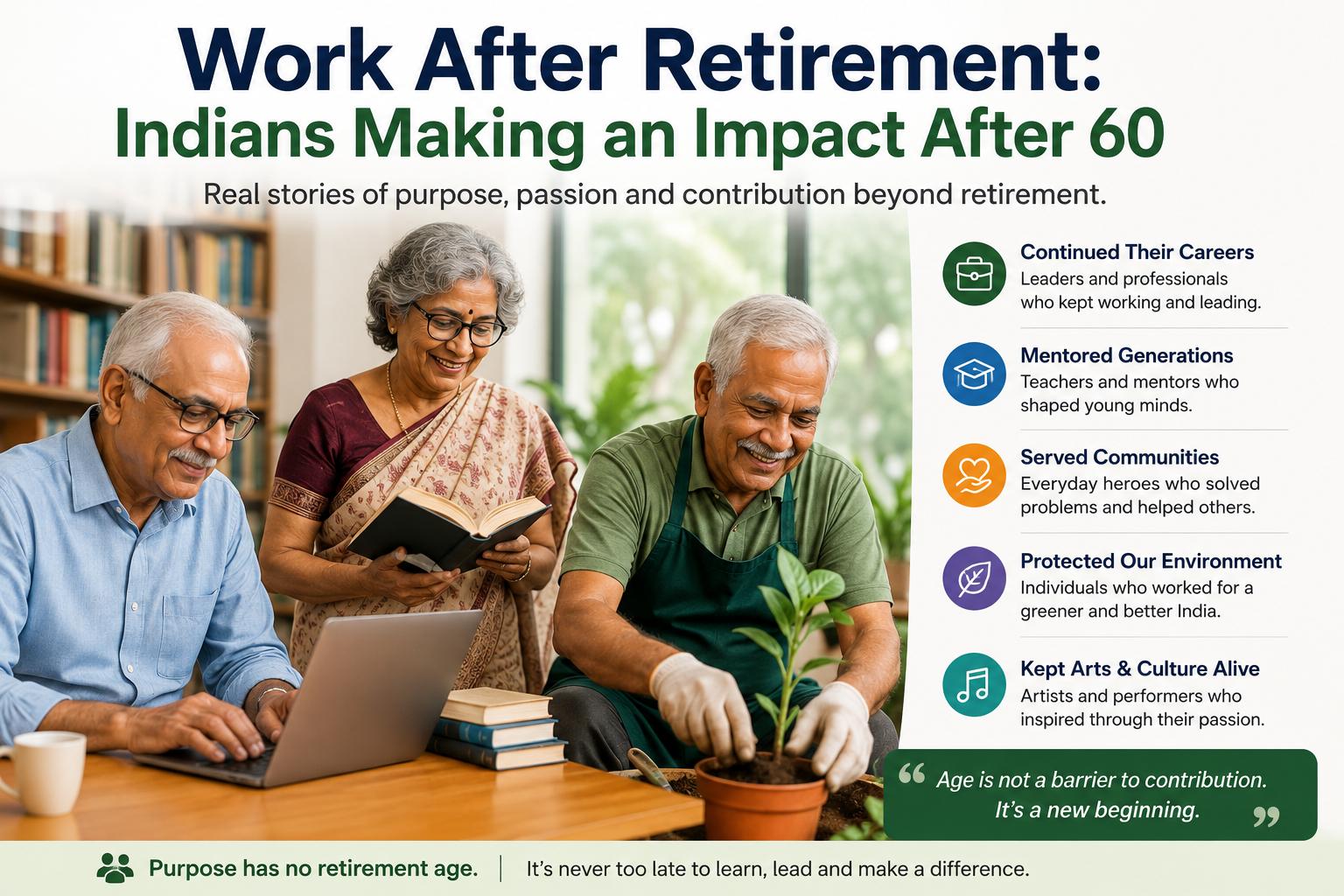
Work after retirement is changing the way many Indians think about life after 60. Retirement does not necessarily mean stepping away from contribution, learning or purpose. Across India, people have continued to lead organisations, teach, practise medicine, build institutions, mentor younger generations and solve community problems well beyond traditional retirement age.
Growing older is often described as a time to slow down. But what if it can also be a time to do something you never had the freedom, confidence or opportunity to do earlier?
Many Indians are breaking stereotypes by pursuing successful careers, social causes, creative work and new ventures well beyond the age of 60. Some continued in the professions they had built over decades. Others used their experience to mentor, teach, build institutions or serve society. And some ordinary retirees simply looked around their neighbourhood and decided that something needed to be done.
While names like Dr. Verghese Kurien, the Father of the White Revolution; Mr. Ratan Tata; Ms. Arundhati Bhattacharya, former Chairperson of the State Bank of India; and former RBI Governors Dr. Y. V. Reddy and Dr. C. Rangarajan are well known, there are many other Indians whose later-life contributions deserve attention.
Some of the people below are famous. Others are much less well known. Their fields are completely different—from medicine and biotechnology to music, law, environmental work and community service.
What connects them is not a particular profession, level of wealth or educational background.
It is the belief that getting older does not automatically mean becoming less useful, less curious or less ambitious.
In this article:
Why Work After Retirement Is Changing
The traditional retirement model was relatively straightforward: work for several decades, retire around 60, spend more time with family and gradually reduce your responsibilities.
That model still works for many people. But it is no longer the only model.
People are living longer. Many remain healthy and intellectually curious for decades after their formal working lives end. Professionals may have accumulated valuable knowledge that cannot simply be switched off on their 60th birthday.
At the same time, retirement can create a strange contradiction. Someone may have more time than ever before, but suddenly have fewer opportunities to use their skills.
That is why the idea of a “second act” is becoming increasingly relevant.
Your second act does not have to mean starting another full-time career. It could mean teaching two days a week, advising a younger entrepreneur, writing, volunteering, consulting, running a small business, pursuing an artistic passion or becoming deeply involved in your community.
Grey Smiles’ 6 Stages of Retirement Planning is useful here because retirement is better understood as a journey than as a single day when work ends.
14 Indians Who Continued Working, Creating or Contributing After 60
The people below worked in completely different fields. Some were nationally recognised. Others were ordinary citizens who simply decided to do something useful with their time and experience.
Not every person on this list started their major work after 60. Some built their careers much earlier and continued, expanded or redirected their contribution in later life. That distinction matters: the point is not that success begins at 60, but that achievement and contribution do not have to end there.
1. Dr. Usha Barwale Zehr
Field: Agriculture and Biotechnology
The daughter of Dr. B. R. Barwale, Dr. Usha Barwale Zehr built her career in plant genetics and agricultural biotechnology and became associated with Mahyco, one of India’s major seed companies.
Her story is particularly interesting in the context of retirement because agriculture and biotechnology are fields where experience, research knowledge and long-term thinking can remain valuable well beyond traditional retirement ages.
Her career is a reminder that scientific work does not necessarily have a neat “finish line” at 60. Research, mentoring and institution-building can continue to create value over a much longer working life.
2. R. K. Krishna Kumar
Field: Business and the Tata Group
R. K. Krishna Kumar was a prominent Tata Group executive and director of Tata Sons. He was also a trustee of the Sir Dorabji Tata Trust and Sir Ratan Tata Trust.
His contribution extended beyond conventional corporate leadership into philanthropic and institutional work associated with the Tata trusts.
His later years illustrate an important distinction: retirement from a particular executive position does not necessarily mean retirement from responsibility.
For experienced professionals, the second half of a career may increasingly involve governance, mentoring, philanthropy, advisory roles and institution-building rather than day-to-day corporate management.
3. Dr. V. Shanta
Field: Medicine and Oncology
Dr. V. Shanta was one of India’s most respected cancer specialists and served as Chairman of the Cancer Institute (WIA), Chennai.
She joined the Cancer Institute in 1955 and dedicated more than five decades of her medical life to cancer care, research, prevention, training and the development of specialists. She remained Chairman of the institution until her death in January 2021.
Her contribution was not simply about continuing to practise medicine. It was about building a system that could continue serving people after she was gone.
The Cancer Institute she helped nurture became a major centre for cancer care, research, education and preventive oncology, with many patients receiving free or heavily subsidised treatment.
4. T. N. Seshan
Field: Public Administration and Electoral Reform
T. N. Seshan became famous as Chief Election Commissioner of India from 1990 to 1996 and is widely remembered for strengthening the authority and independence of the Election Commission and enforcing electoral rules more rigorously.
His influence went far beyond the formal title he held. The reforms and institutional discipline associated with his tenure changed how many Indians thought about the Election Commission.
His example also raises a broader question about retirement: what happens when an experienced professional leaves office but still has ideas, knowledge and a strong desire to contribute?
Public speaking, writing, teaching, mentoring and participation in civic life can all become ways for retired professionals to continue contributing without returning to a conventional nine-to-five job.
5. Kiran Karnik
Field: Technology, Public Policy and Social Development
Kiran Karnik has had an unusually broad career spanning ISRO, broadcasting, the technology industry and public policy. He served as President of NASSCOM from 2001 to 2008 and later remained involved with not-for-profit organisations, public institutions, corporate boards and policy-related work.
His post-corporate career illustrates an increasingly important form of retirement: portfolio work.
Instead of having one employer and one job title, an experienced professional can contribute through several roles—perhaps advising an organisation, serving on a board, mentoring younger professionals, writing, teaching or supporting a social cause.
For someone in their 60s or 70s, that can provide both intellectual stimulation and purpose without replicating the pressures of a full-time corporate career.
6. Dr. Prabha Atre
Field: Hindustani Classical Music
Dr. Prabha Atre was one of India’s most respected Hindustani classical vocalists, teachers and scholars. She continued performing, teaching, researching and writing about music well into later life.
Her career demonstrates something particularly relevant to retirement: creative work does not necessarily have an expiry date.
For musicians, writers, artists, teachers and performers, the years after 60 can actually offer something that younger years often do not—depth of experience, perspective and a body of work that can be shared with others.
Teaching can also turn experience into legacy. A person who has spent decades mastering a craft can influence another generation without needing to chase the same career milestones that defined their younger years.
7. Dr. N. R. Madhava Menon
Field: Legal Education and Institution Building
Dr. N. R. Madhava Menon was one of the most influential figures in modern Indian legal education. He is closely associated with the creation and development of the National Law School of India University and the National University of Juridical Sciences, among other academic and institutional roles.
His career is a powerful example of how professional influence can shift with age.
Earlier in life, the focus may be on building a career. Later, the focus can shift toward building institutions, shaping policy, mentoring young professionals and improving the profession itself.
That is a very different way of looking at retirement.
8. Rukmini Devi Arundale
Field: Arts, Culture and Education
Rukmini Devi Arundale founded Kalakshetra and played a transformative role in Indian classical dance and arts education.
She remained closely involved with Kalakshetra and its mission until her death in 1986 at the age of 82. Her later years demonstrate how influence can become institutional rather than personal.
You may no longer perform every task yourself. But you can continue to shape an organisation, teach others, protect a tradition and influence what comes next.
9. Dr. S. I. Padmavati
Field: Cardiology
Dr. S. I. Padmavati was a pioneering Indian cardiologist and one of the country’s earliest women leaders in cardiovascular medicine.
She founded the All India Heart Foundation in 1962 and established the National Heart Institute in Delhi in 1981, after retiring from her earlier institutional leadership role. She continued working with the institute for many years.
Her story is particularly striking because her post-retirement contribution was not simply an extension of her previous job. She created something new.
Retirement can sometimes provide the freedom to build the institution, clinic, foundation, consultancy or initiative that you could not build while navigating the demands of a conventional career.
10. Dr. Shyam Sundar Pati
Field: Grassroots Environmental Work, Odisha
Dr. Shyam Sundar Pati is associated with grassroots environmental work and the idea that meaningful contribution does not have to begin with a large organisation, a large budget or a famous name.
Stories of retired people taking up environmental causes show how professional and life experience can be redirected toward community needs.
Planting trees, maintaining local green spaces, supporting biodiversity or educating communities can turn retirement into an active form of civic contribution.
The larger lesson is perhaps more important than the number of trees planted: you do not need a new career to have a new purpose.
11. Saalumarada Thimmakka
Field: Environmental Conservation, Karnataka
Saalumarada Thimmakka became one of India’s best-known grassroots environmentalists. A Padma Shri awardee, she became famous for planting and nurturing trees in Karnataka and inspiring environmental awareness across generations.
Her story has been told around the world, including through coverage of her remarkable longevity and environmental work. Her legacy is associated particularly with the long avenue of banyan trees she helped nurture.
What makes Thimmakka’s story so powerful for retirement audiences is that her contribution did not depend on formal education, corporate status or a prestigious professional position.
It began with a simple act repeated over years.
Sometimes a second act starts with something very small.
12. B. M. Giriraj
Field: Adult Literacy and Community Education
B. M. Giriraj is an example of the lesser-known category of people whose contribution after retirement is local rather than national.
Stories of retired people supporting adult literacy and education show how professional and life experience can be redirected toward community needs.
For a retired teacher, administrator or professional, teaching after retirement does not necessarily mean returning to a classroom full-time. It could mean helping adults learn basic literacy, teaching digital skills to older people, mentoring students or helping someone navigate the world of online services.
13. Gangadhar Tilak Katnam
Field: Community Service, Hyderabad
Some retirement stories are so ordinary that they become extraordinary.
Gangadhar Tilak Katnam, a retired railway employee from Hyderabad, became popularly known as the “Road Doctor” after he and his wife began filling potholes using their own resources.
Reports described the couple using their own money and a vehicle they called a “pothole ambulance” to address dangerous potholes. Their work attracted attention from the Greater Hyderabad Municipal Corporation, which subsequently encouraged them to coordinate with the civic body rather than carrying out repairs independently.
This is not a conventional post-retirement career. It is something more interesting: using retirement time to solve a problem that bothered you.
14. Sindhutai Sapkal
Field: Social Work and Child Welfare
Sindhutai Sapkal, affectionately known as “Mai” or the “Mother of Orphans,” built an extraordinary life around caring for abandoned and orphaned children.
Her journey was very different from the corporate or professional examples in this list. She faced extreme hardship and poverty and eventually devoted her life to caring for children who had been abandoned or left without support.
Her foundation describes her as having raised more than 2,100 children. She received the Padma Shri in 2021 and continued her social mission into later life.
Her story is not really about retirement at all. It is about something bigger: purpose can emerge from circumstances you never planned for.
What Can We Learn From Indians Who Worked After Retirement?
These people worked in completely different fields. Some were famous. Some were not. Some built institutions. Some worked with their hands.
But several common themes emerge.
1. Retirement Can Be a Transition, Not a Full Stop
The word “retirement” often creates an artificial boundary: before 60, you are productive; after 60, you are retired.
Real life is rarely that simple.
You can retire from one job without retiring from your skills. You can retire from a company without retiring from your profession. And you can retire from paid employment without retiring from purpose.
2. Experience Becomes an Asset
At 25, you may have energy and ambition. At 60, you may have something equally valuable: perspective.
Decades of experience can help you spot mistakes faster, understand people better, manage difficult situations and mentor someone who is still learning.
This is why advisory work, mentoring, teaching and board positions can be particularly suitable forms of work after retirement.
3. The Second Act Does Not Have to Look Like the First
If you spent 35 years in banking, you do not have to spend the next 15 doing banking. If you were a teacher, you do not have to return to a classroom. If you were an engineer, you could become a mentor, writer, consultant or community volunteer.
Your previous career gives you skills. It does not have to dictate your next chapter.
4. Purpose Can Be More Important Than Income
For some retirees, earning money remains essential. For others, financial security allows them to prioritise something else.
The next act might be about:
- Teaching
- Mentoring
- Volunteering
- Writing
- Consulting
- Starting a small business
- Social work
- Environmental work
- Arts and culture
- Community service
- Helping younger entrepreneurs
- Learning something completely new
5. The Second Act Can Be Smaller—and Better
There is another misconception worth challenging: that a successful second act must become another major achievement.
It does not.
Perhaps your ambition after 60 is to work three days a week. Perhaps you want to teach ten children. Perhaps you want to mentor two young professionals, write a book, volunteer at a hospital or travel for three months every year.
A meaningful retirement does not have to impress anybody.
It has to make sense to you.
Does Work After Retirement Have to Mean a Full-Time Job?
No.
And this is an important distinction.
Some people need the income. Others want intellectual stimulation, social interaction or purpose. If your finances are secure, you may find that part-time work, consulting, volunteering or mentoring gives you the benefits of working without recreating the pressures of a full-time career.
For others, stopping full-time work is exactly what they need. They may want to spend more time with family, travel, pursue hobbies, rest or simply enjoy the freedom that decades of work have earned them.
The question is not whether you should work after retirement.
Ask yourself:
“What do I want my time to be worth after I stop working full-time?”
The answer could be money. It could be purpose. It could be family. It could be learning. It could be service. Or it could be a combination of all five.
How to Find Your Own Second Act After 60
You don’t need to decide your entire post-retirement life in one sitting.
Instead, ask yourself five questions:
- What am I still good at?
- What do people regularly ask me for help with?
- What have I always wanted to learn or try?
- What problem around me bothers me enough to do something about?
- Do I want my next chapter to earn, teach, create, serve—or simply enjoy?
Your answers may point towards a completely new direction.
And remember: the first version does not have to be permanent. You can experiment.
Volunteer for three months. Teach one class. Mentor one person. Take one consulting project. Start a small garden. Join a local organisation. Write ten articles. Try something and see how it feels.
Work after retirement can be much more flexible than the career you had before retirement.
Retirement gives you something your working years often did not: the freedom to experiment without having your entire identity tied to the result.
A Different Way to Think About Retirement
Financial planning remains critical. You need enough money to live comfortably, manage healthcare costs and protect yourself against the uncertainties of a long retirement.
Grey Smiles’ guide to calculating your retirement corpus in India covers the financial side of retirement planning.
But once you know you have enough money, another question appears:
That is where these stories become relevant.
Retirement can be about slowing down. It can also be about changing direction.
It may be the first time in your adult life when you can choose work based not just on salary, designation or promotion—but on meaning.
And that is perhaps the most interesting possibility of work after retirement: you finally get to decide what your work is for.
Age Is Not the Finish Line
Whether as high-profile leaders shaping policy and business, respected doctors and educators, artists preserving India’s cultural traditions, environmentalists nurturing trees, or everyday citizens solving problems in their neighbourhoods, many Indians have shown that age is no barrier to contribution.
Their stories are a reminder that every stage of life can be purposeful and impactful.
But perhaps the biggest lesson is not that everyone should keep working after 60.
It is that you should not allow a retirement date to decide when your useful life ends.
You may work differently. You may work less. You may stop working for money altogether.
But you can continue learning, creating, teaching, mentoring, helping, building, travelling, experimenting and contributing.
Frequently Asked Questions About Work After Retirement
Can you start a new career after 60 in India?
Yes. A new career after 60 does not necessarily mean returning to a conventional full-time job. Consulting, teaching, mentoring, entrepreneurship, writing, advisory roles and social-sector work can all become second-career options.
Is 60 too late to start something new?
No. Age may affect the amount of time and energy you want to commit, but it does not eliminate the ability to learn, contribute or create. Starting small can make a new venture more manageable.
Should I continue working after retirement?
There is no universal answer. Some people need the income; others want intellectual stimulation, social interaction or purpose. If your finances are secure, consider whether part-time work, consulting, volunteering or mentoring might provide the benefits of work without the demands of a full-time career.
What can retirees do after 60 besides working?
Retirees can mentor younger people, volunteer, teach, travel, write, pursue creative interests, participate in community projects, support environmental causes, learn new skills or start a small venture. The right choice depends on your interests, health, finances and available time.
Can my experience be useful after retirement?
Absolutely. Professional experience can be valuable in mentoring, advisory work, teaching, consulting, board roles and community initiatives. Often, the ability to share decades of experience is one of the most valuable contributions an older professional can make.
What if I don’t want another career after retirement?
That is perfectly fine. A purposeful retirement does not have to involve paid work. Family, travel, friendships, hobbies, learning, volunteering and community involvement can all provide meaning.
What is a second act in retirement?
A second act is the phase of life after a major career or life transition in which you pursue something new or different. It might involve work, entrepreneurship, volunteering, creative pursuits, mentoring or simply a different way of living.
Related Grey Smiles Reads
- 6 Stages of Retirement Planning — Why retirement should be viewed as a journey rather than one event.
- How to Calculate Your Retirement Corpus in India — The financial foundation for a secure retirement.
- Making New Friends After 50 — Building meaningful social connections in later life.
- Medical Inflation vs Lifestyle Inflation — Why healthcare costs matter in retirement planning.
Sources and Further Reading
For factual background on the people featured in this article, readers can refer to institutional and reputable sources including the Adyar Cancer Institute’s profile of Dr. V. Shanta, the Kalakshetra Foundation’s biography of Rukmini Devi Arundale, and the Population Foundation of India’s profile of Kiran Karnik.
For the story of Gangadhar Tilak Katnam, see reporting on the Hyderabad “Road Doctor” by The Economic Times.
For Dr. S. I. Padmavati’s contribution to Indian cardiology and the National Heart Institute, see the published biographical review of her work in PubMed Central.
For Sindhutai Sapkal’s life and social work, see the Sindhutai Sapkal Foundation and published academic research on her work.
Editorial note: “After 60” is used here as a broad theme rather than suggesting that every individual listed began their most significant work specifically after their 60th birthday. Several people began their major careers earlier and continued, expanded or redirected their contribution in later life.
Disclaimer: This article is intended for general information and inspiration. Decisions about employment, retirement, financial planning or starting a business should take account of individual circumstances.

Start the conversation
Share a helpful experience, ask a thoughtful question, or add another perspective for fellow readers.