
Building wealth is not one financial decision made at one point in life.
What matters in your 30s may be very different from what matters in your 40s, 50s or after retirement. Income changes. Family responsibilities change. Debt comes and goes. Children become financially independent. Retirement moves from something distant to something that needs a number attached to it.
The mistake is to treat wealth building as a single race towards a target amount.
A better approach is to understand how the job of your money changes as your life changes.
Your Wealth Journey Has Different Phases
There is no universal financial plan for every Indian household. But most people move through recognisable stages.
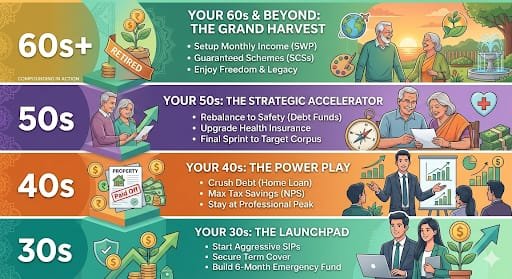
| Life stage | Financial priority | What deserves attention |
|---|---|---|
| 30s | Build the foundation | Income growth, emergency savings, insurance, debt and long-term investing |
| 40s | Accelerate and balance | Retirement corpus, children’s goals, debt reduction and portfolio discipline |
| 50s | Prepare for the transition | Retirement readiness, asset allocation, healthcare and future income |
| 60s and beyond | Protect and use wealth | Cash flow, longevity, healthcare, taxation, estate planning and financial flexibility |
The boundaries are not rigid. Someone may enter retirement at 55, while another may continue working into their 70s. The important thing is to recognise when the financial job has changed.
Your 30s: Build the Foundation
Your 30s can be a powerful period for wealth creation because you potentially have many years before retirement.
But this is also when competing demands can become intense. A home loan, marriage, children, career changes and lifestyle expenses can all arrive at roughly the same time.
The temptation is to postpone retirement investing until the immediate pressures disappear.
That can be costly because retirement is a long-term goal, and the years available to accumulate capital matter.
Focus on the Basics First
- Build an emergency reserve.
- Protect income through appropriate insurance.
- Control high-cost debt.
- Start investing regularly for long-term goals.
- Increase investments as income grows.
- Keep retirement separate from short-term spending goals.
The objective at this stage is not to construct a complicated portfolio. It is to establish financial habits that can continue as income rises.
If retirement is already on your radar, GreySmiles’ retirement planning guide explains the broader planning process.
Your 40s: The Years of Competing Goals
For many Indian households, the 40s are financially demanding.
Income may be higher than it was in the 30s, but so are responsibilities. Children’s education, home loans, lifestyle expenses and support for ageing parents can all compete with retirement savings.
This is where financial prioritisation becomes important.
You do not need to fund every goal at the same rate. But retirement should not continually lose out simply because it is the goal furthest away.
Watch the Lifestyle-Creep Trap
Income increases can create an opportunity to increase savings.
Instead, households sometimes allow almost the entire increase to become additional spending.
A useful discipline is to direct at least part of every meaningful income increase towards long-term wealth creation.
This can increase retirement savings without requiring a dramatic reduction in today’s lifestyle.
Review Your Retirement Number
By your 40s, retirement planning should become more specific.
Instead of simply saying “I need enough for retirement”, estimate what your future spending could look like and how much dependable income you may have.
Your retirement corpus is not determined by a universal multiple such as 25X or 30X. It depends on your spending requirement, inflation, retirement age, longevity, investment returns and other sources of income.
GreySmiles’ retirement corpus calculation provides a framework for thinking through these variables.
Your 50s: The Financial Transition Gets Real
In your 50s, retirement stops being an abstract event for many people.
You may now have a reasonably clear idea of when you want to stop working, what your accumulated assets look like and what kind of lifestyle you want afterwards.
This is the time to identify gaps rather than hope they disappear.
Ask the Hard Questions
- How much will I actually spend after retirement?
- Which income sources can I reasonably depend on?
- How large is my current retirement corpus?
- How much debt will remain when I retire?
- What happens if I live much longer than expected?
- How will healthcare costs affect my finances?
- How much market volatility can my portfolio now tolerate?
- Where will my retirement income come from?
This is also the point at which asset allocation deserves serious attention.
A portfolio that was appropriate when retirement was 20 years away may not be appropriate when withdrawals are only a few years away.
From Wealth Accumulation to Retirement Readiness
Having a large portfolio does not automatically mean you are ready to retire.
Readiness depends on whether your resources can support the life you want after employment income stops.
That means looking at the relationship between your spending, dependable income, assets, liabilities, healthcare requirements, longevity and investment risk.
GreySmiles’ Retirement Readiness Test brings these considerations together as a broader assessment.
The important distinction is this:
Wealth is about what you have accumulated. Retirement readiness is about whether what you have accumulated can support what comes next.
Your 60s: The Job of Money Changes
Once you retire, accumulating wealth is no longer the only objective.
Your portfolio may now need to support regular spending while continuing to preserve purchasing power over a potentially long retirement.
This creates a different set of priorities.
- Maintain sufficient liquidity.
- Generate dependable cash flow.
- Manage investment risk.
- Protect against inflation.
- Plan for healthcare expenses.
- Review taxation and withdrawal decisions.
- Ensure the portfolio can support a long retirement.
The transition from earning a salary to drawing from accumulated assets can require a significant change in financial behaviour.
GreySmiles’ retirement corpus withdrawal framework looks at this phase in more detail.
Why Asset Allocation Changes Across the Journey
Asset allocation is not a decision that should be made once and forgotten.
When retirement is far away, the portfolio may have greater capacity to absorb short-term market volatility. As the retirement date approaches, the consequences of a large market decline can become more significant.
But moving from growth assets to supposedly “safe” investments is not automatically the answer either.
A retirement that could last 25 or 30 years still needs to contend with inflation and purchasing-power risk.
The objective is to find an allocation that reflects both the need for growth and the need for stability.
GreySmiles’ retirement asset-allocation article explores why fixed percentage formulas are often less useful than understanding the role each asset plays.
Do Not Confuse More Investments With More Wealth
As income grows, many investors accumulate financial products.
There may be several mutual funds, fixed deposits, insurance policies, NPS, EPF, PPF, gold and property.
But owning more products does not necessarily mean having a better financial plan.
What matters is whether the overall portfolio is aligned with your goals.
You may own ten investments and still have too much exposure to one type of risk. Conversely, a relatively simple portfolio can sometimes be easier to understand, maintain and rebalance.
Debt Is Part of the Wealth Journey Too
Wealth creation is not only about investments.
The debt side of the balance sheet matters just as much.
A home loan may be manageable during peak earning years but become uncomfortable if it continues into retirement. High-cost consumer debt can also undermine the benefits of long-term investing.
This does not mean every loan must be eliminated immediately. Debt should be evaluated against its cost, purpose, cash flow impact and the overall financial plan.
Protecting Wealth Is Different From Building It
During the accumulation years, investors naturally focus on returns.
Later in life, the cost of a major mistake can become much higher.
A large portfolio concentration, excessive equity exposure close to retirement, inadequate liquidity or dependence on a single income source can create risks that are not obvious when markets are rising.
Wealth protection therefore becomes increasingly important as retirement approaches.
This is not about eliminating every risk. It is about making sure that one adverse event cannot derail the entire financial plan.
Healthcare Needs a Place in the Plan
Healthcare is one of the expenses that can become more difficult to predict with age.
Medical insurance can help with eligible covered expenses, but insurance should not be treated as a complete solution to every healthcare cost.
Retirement planning should leave room for deductibles, exclusions, uncovered expenses, changing premiums, care needs and the possibility of living longer than expected.
The point is not to predict the exact healthcare bill decades in advance.
It is to make sure that healthcare is not an afterthought in a plan that otherwise looks complete.
Do Not Build Your Retirement Around Your Children
Family support is an important part of Indian life, but there is a difference between maintaining close family relationships and making children responsible for funding your retirement.
A financially independent retirement gives parents greater freedom to help children when they genuinely want to — rather than because they have no other option.
The same principle applies when supporting grandchildren.
Helping the next generation can be deeply meaningful, but it should come from a position of financial stability rather than by sacrificing your own ability to fund later life.
The Wealth Journey Is Also About Decisions
Financial progress is often measured through numbers: salary, savings, investments, property value and corpus.
But the quality of the decisions behind those numbers matters too.
Can you explain why you own each major investment?
Do you know what your retirement portfolio is expected to do during a market decline?
Do you know which assets could fund the first few years of retirement?
Do you know how your family would manage financially if you were suddenly unable to make decisions?
These are not investment-product questions. They are planning questions.
A Simple Way to Review Your Wealth Journey
At least once a year, step back from individual investments and look at the whole picture.
- Review income and expenses.
- Review debt.
- Review emergency reserves.
- Review insurance and healthcare protection.
- Review retirement savings and projected corpus.
- Review asset allocation.
- Review major life changes.
- Review your retirement date and expected spending.
- Review how your assets will eventually produce income.
- Review nominations, wills and other succession arrangements.
The purpose of an annual review is not to constantly change investments.
It is to determine whether the financial plan still matches the life you are actually living.
What a Strong Wealth Journey Looks Like
A strong financial journey does not necessarily produce the person with the largest portfolio.
It produces someone who gradually becomes more financially resilient.
In their 30s, they build the foundation.
In their 40s, they balance competing goals while accelerating long-term wealth creation.
In their 50s, they test whether their assets can actually support the retirement they want.
In their 60s and beyond, they use their wealth thoughtfully while protecting against longevity, healthcare, inflation and other later-life risks.
And throughout the journey, they understand that money is not the destination.
Money is the resource that helps make the life they want possible.
Final Thoughts
The Indian wealth journey does not have a single formula.
Your priorities will change as your income, family, responsibilities and ambitions change. A portfolio that makes sense in your 30s may need to look very different in your 50s. And a retirement portfolio has a fundamentally different job from an accumulation portfolio.
The most useful approach is therefore to keep asking whether your money is doing the job your current stage of life requires.
Build when you have time. Protect when the stakes become higher. Prepare before retirement arrives. And once you retire, use your wealth in a way that supports both the life you want today and the uncertainty of the years ahead.
Sources & References
Disclaimer: This article is for educational purposes only and does not constitute personalised financial, investment, tax or legal advice. Financial circumstances vary from person to person. Investment products are subject to market risks, and applicable rules and taxation may change. Consider obtaining appropriate professional advice before making significant financial decisions.




Start the conversation
Share a helpful experience, ask a thoughtful question, or add another perspective for fellow readers.