
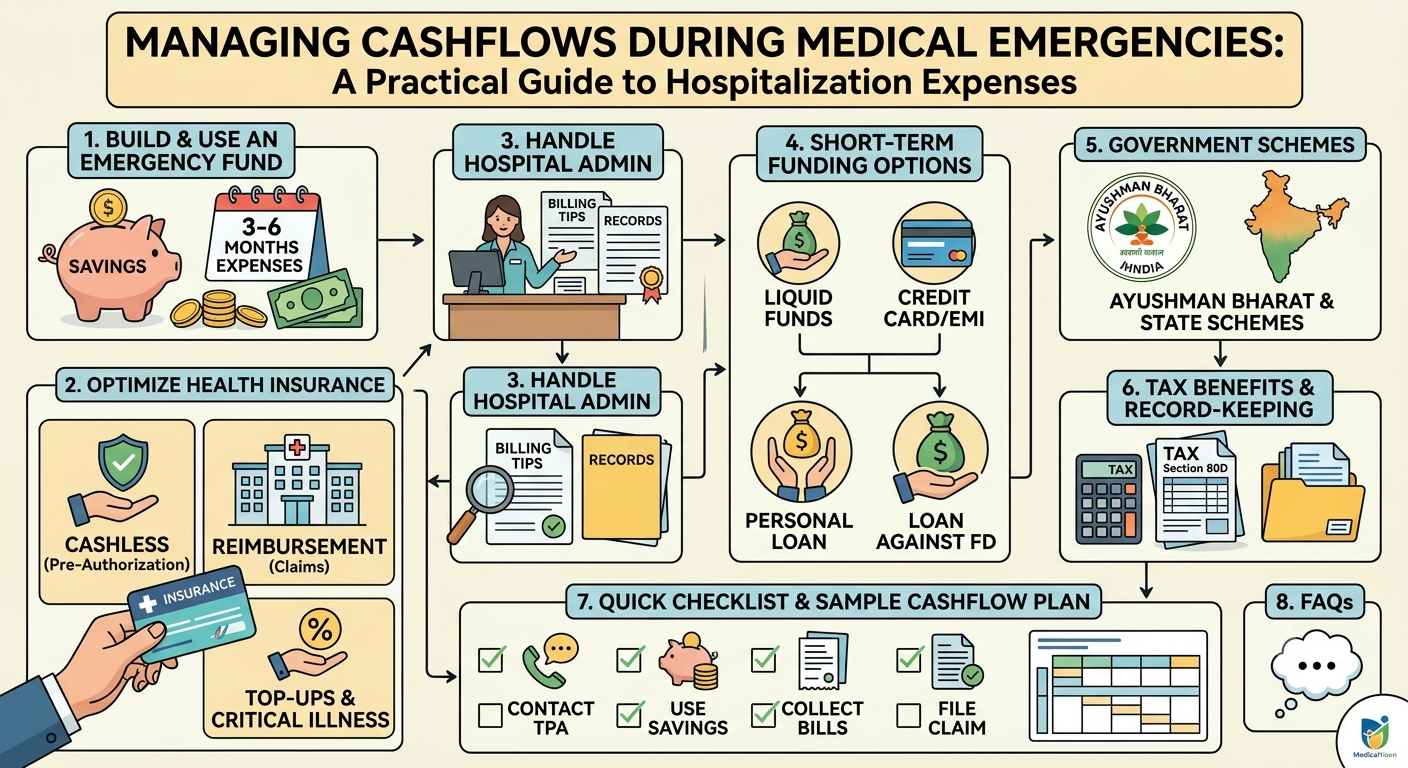
A step-by-step visual roadmap for managing urgent medical expenses and safeguarding your finances during hospitalization emergencies.
Managing Cashflows During Medical Emergencies: A Practical Guide to Hospitalization Expenses
Medical emergencies can be sudden, stressful, and financially draining. When a health crisis strikes, having clear strategies to manage immediate cashflows for hospitalization and related medical expenses makes all the difference. This comprehensive guide outlines practical, actionable steps to handle urgent healthcare costs in India without liquidating long-term investments or falling into high-interest debt traps.
Summary Table
Quick Snapshot: Options to Manage Urgent Medical Cash Needs — Pros, Cons, and Access Time
| Option | Quick Use | Typical Cost / Limit | Time to Access | Section Link |
|---|---|---|---|---|
| Emergency Fund (Savings) | Immediate cash for hospitalization and ancillary expenses. | Depends on savings (recommended 3–6 months expenses). | Immediate | Emergency Fund Details |
| Health Insurance — Cashless | Hospital directly bills insurer via TPAs/network hospitals. | Policy sum-insured (e.g., ₹3–10 lakh or more). | Pre-authorization in hours (if eligible) | Cashless Options |
| Health Insurance — Reimbursement | You pay upfront; insurer reimburses later via claim process. | Policy limit applies. | Days–weeks (claims processing) | Reimbursement Details |
| Liquid Investments | Redeem cash; avoid premature withdrawal penalties. | Depends on holding; minimal exit load possible. | Same day to 2 business days | Liquid Fund Options |
| Credit Card / Personal Loan | Covers immediate bills; EMI conversion possible. | Credit limit or loan amount; interest applies. | Immediate to a few hours | Credit & Loans |
| Government Schemes | Free or subsidized treatment for eligible beneficiaries. | Scheme limit (e.g., Ayushman Bharat ₹5 lakh/family p.a.) | Depends on enrollment & verification | Public Schemes |
1. Build and Use an Emergency Fund
Why an Emergency Fund Matters
An emergency fund is your first line of defense. Having dedicated liquid cash avoids high-cost emergency borrowing, prevents distress sales of long-term investments, and reduces delays in critical medical care. For broader context on structuring family wealth reserves, check out our guide on asset allocation strategies for long-term goals.
Target Savings
- Standard Reserve: Aim for 3 to 6 months of essential living expenses.
- Higher-Risk Reserve: If your family has pre-existing health conditions or dependents, consider expanding this reserve to 6 to 12 months of expenses.
Where to Keep It
Keep emergency funds in highly liquid instruments:
- High-interest savings accounts
- Fixed deposits (FDs) with sweep-in features
- Liquid mutual funds
Usage Rules
Use these funds for direct hospital admission deposits, urgent diagnostic tests, emergency transport/ambulance costs, and immediate prescriptions. Always make it a priority to replenish your emergency fund as soon as your cashflow normalizes.
2. Optimize Health Insurance: Cashless, Reimbursement, Top-ups & Critical Illness
Health insurance is the core anchor of any robust hospitalization cash management strategy.
Cashless Facility
If your hospital is in your insurer’s network, request pre-authorization immediately through the hospital’s Third-Party Administrator (TPA) desk. This dramatically reduces immediate out-of-pocket cash requirements. You can verify network status directly on the official portal of the Insurance Regulatory and Development Authority of India (IRDAI).
Reimbursement Claims
If a cashless facility isn’t available, retain all original bills, prescriptions, discharge summaries, and investigation reports. Submit your claim forms promptly. Keep in mind that reimbursements can take anywhere from a few days to several weeks.
Top-Up & Super Top-Up Plans
Consider buying a super top-up policy. These activate once your base policy limit is exhausted, providing an economical way to scale your total sum insured to ₹20–50 lakh without paying heavy base premiums. Learn how insurance integrates into broader estate and life planning in our article on guiding your parents in retirement planning.
Critical Illness Covers
Critical illness policies pay a lump-sum amount upon diagnosis of specific listed conditions (like cancer or major organ failure). This payout is vital for non-medical expenses, home care adjustments, or replacing lost income during recovery.
Policy Fine Print to Check
Before an emergency arises, review your policy terms for:
- Room rent capping and sub-limits
- Daycare procedures covered
- Co-payment clauses and deductible thresholds
- Pre-existing disease (PED) waiting periods and explicit exclusions
Pro Tip: Keep your policy number, insurer helpline, TPA contact details, and network hospital list saved digitally on your phone for instant access during emergencies.
3. Handle Hospital Admin: Pre-Authorization, Documents & Billing Tips
Navigating administrative processes quickly ensures faster claims processing and lower out-of-pocket strain.
- Pre-Authorization: For cashless treatments, instruct the hospital’s billing/TPA desk to initiate pre-authorization immediately upon admission.
- Documents to Carry: Always keep physical or digital copies of official identification documents, health insurance cards, policy documents, and prior medical history.
- Keep Original Copies: Request itemized final bills, payment receipts, pharmacy bills, diagnostic reports, and detailed discharge summaries. These are mandatory for reimbursement processing and dispute resolution.
- Audit & Verify Bills: Review hospital bills line-by-line. Verify that there are no duplicate charges or unadministered medications, and that listed consumables match actual usage.
- Escalate Billing Issues: If a cashless request is unexpectedly denied, escalate immediately to the hospital’s TPA manager or reach out directly to your insurance provider’s customer grievance desk.
4. Short-Term Funding Options
When immediate cash from savings or cashless insurance approval falls short, leverage these bridge financing solutions:
- Liquid Mutual Funds / Sweep-in FDs: These offer rapid redemptions (same day to T+1 business days) at lower costs than personal loans, though minimal exit loads may apply for very short holding periods.
- Credit Cards: Excellent for immediate, frictionless payments at hospital desks. Many major Indian banks allow you to convert large medical transactions into manageable monthly EMIs.
- Personal Loans: Ideal for covering shortfalls when you need larger amounts rapidly. Check pre-approved loan offers from your primary bank for faster disbursal.
- Loan Against FD or Investments: A low-interest, fast-disbursing option where you retain your underlying fixed deposit or security while accessing immediate liquidity. Read our guide on leveraging fixed income instruments for more details.
- Employer & Family Support: Inquire about employer emergency advances, corporate group health insurance extensions, or interest-free family support to bridge immediate cash shortfalls.
- Fintech Healthcare Loans: Several hospital chains partner with fintech platforms offering instant No-Cost EMI or Buy-Now-Pay-Later (BNPL) options for medical procedures. Always inspect processing fees and hidden interest terms carefully.
5. Government & Public Schemes
- Ayushman Bharat (PM-JAY): The Ayushman Bharat PM-JAY scheme provides secondary and tertiary hospitalization coverage up to ₹5 lakh per family per year for eligible beneficiaries. Verify your family’s eligibility status on the official portal in advance.
- State Specific Health Schemes: Many Indian states run dedicated health insurance and relief initiatives (e.g., Mahatma Jyotirao Phule Jan Arogya Yojana in Maharashtra or Chief Minister’s Comprehensive Health Insurance Scheme in Tamil Nadu).
- Public Healthcare Institutions: Government medical colleges and district hospitals provide heavily subsidized or free medical procedures, making them viable options for planned or non-urgent treatments when private costs are prohibitive.
6. Tax Benefits and Record-Keeping
- Section 80D Deductions: Payments made toward health insurance premiums for yourself, your family, and senior citizen parents qualify for tax deductions under Section 80D of the Income Tax Act.
- Deduction for Medical Expenses: Under Section 80D, preventive health check-ups (up to ₹5,000) and actual medical treatment expenses incurred for senior citizen parents who do not have health insurance coverage are eligible for deductions subject to statutory limits.
- Digital Documentation: Maintain a centralized cloud folder (e.g., DigiLocker or Google Drive) containing scanned copies of health policies, hospital discharge sheets, receipts, and medical reports. Organized record-keeping simplifies tax filing and accelerates claim approvals.
7. Quick Checklist & Sample Cashflow Plan
Immediate Action Plan During a Medical Crisis
- Contact TPA: Call your insurance/TPA helpline instantly to verify if the hospital is in-network and request immediate cashless pre-authorization.
- Utilize Savings: Use your primary emergency fund to pay initial admission deposits, test fees, or transport charges.
- Document Everything: If cashless is denied, pay using a credit card or liquid funds and collect fully itemized bills, receipts, and doctor prescriptions.
- File Reimbursement: Submit the complete reimbursement claim package to your insurer within the mandated window (usually within 7–15 days post-discharge).
- Bridge Shortfalls: For lingering shortfalls, access low-cost loans against FDs or corporate medical advances before resorting to high-interest personal loans.
Sample Family Cashflow Structure
+-----------------------------------------------------------------------+
|                       TOTAL HEALTH PROTECTION                          |
+-----------------------------------------------------------------------+
                                    |
     +------------------------------+------------------------------+
     |                              |                              |
     v                              v                              v
[Tier 1: Immediate Cash]    [Tier 2: Health Insurance]   [Tier 3: Liquid Backup]
- ₹50,000 in Liquid          - ₹5 Lakh Base Floater       - ₹1 Lakh in Liquid
  Savings Account              + ₹5 Lakh Super Top-Up       Mutual Funds (T+1)
- Credit Card Limit
                                    |
                                    v
                        [Tier 4: Emergency Fallback]
                        - Pre-approved Personal Loan /
                          Loan Against FD (> ₹1 Lakh)
8. Frequently Asked Questions (FAQs)
Q1. What should I do if my cashless health insurance request is rejected at the hospital?
If cashless pre-authorization is rejected, it does not mean your claim is denied. Pay the initial expenses using your emergency savings or credit card, collect all original itemized bills, diagnostic reports, and the discharge summary, and submit a reimbursement claim directly to your insurer after discharge.
Q2. How much money should I keep in an emergency fund specifically for health issues?
It is recommended to hold 3 to 6 months’ worth of essential living costs in an emergency fund. For health emergencies, keeping at least ₹50,000 to ₹100,000 readily accessible in savings or sweep-in FDs covers instant admission deposits while insurance processing takes place.
Q3. Can I claim tax benefits for medical expenses paid in cash?
Under Section 80D of the Income Tax Act, payments for health insurance premiums must be made via non-cash modes (net banking, UPI, cards) to claim deductions. However, preventive health check-up expenses up to ₹5,000 can be claimed even if paid in cash.
Q4. Is a super top-up health insurance plan better than buying a larger base policy?
Super top-up plans are highly cost-effective. They provide high coverage (e.g., ₹20–50 lakh) at a fraction of the cost of a base policy by utilizing a deductible threshold (which is covered by your primary base policy or out-of-pocket savings).
article>




Start the conversation
Share a helpful experience, ask a thoughtful question, or add another perspective for fellow readers.