
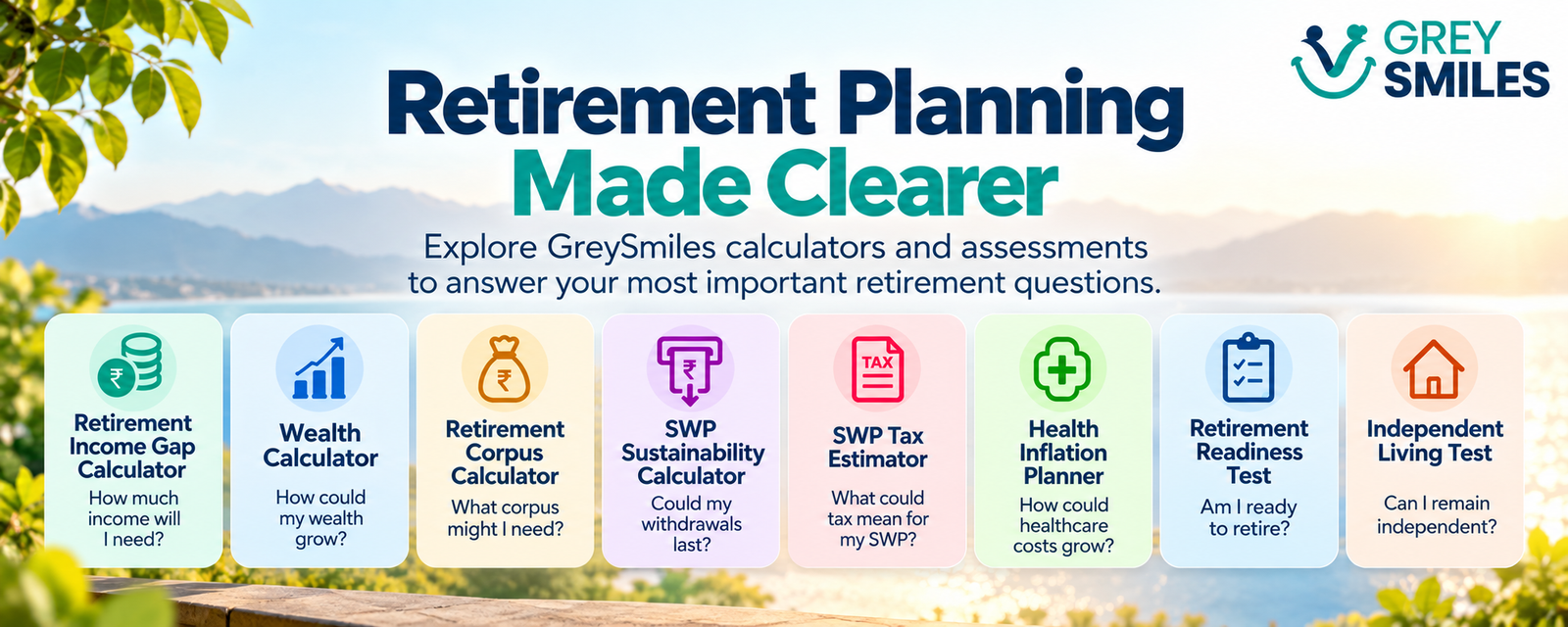
Retirement planning can quickly become confusing because there is rarely one number that answers everything. You may want to know how much income you will need, how large your retirement corpus should be, whether a planned withdrawal could last, what tax may do to your withdrawals, or how healthcare costs could change over time. At the same time, some of the most important retirement questions are not purely financial.
Are you actually ready to retire? Is your home suitable for the years ahead? Can you remain independent as your circumstances change? What happens if your spouse lives much longer than expected, or if your family responsibilities continue into retirement?
That is why GreySmiles has built a set of calculators and assessments rather than one large retirement calculator that tries to answer everything. Each tool has a specific purpose. The calculators help you explore numbers and scenarios, while the assessments help you step back and look at the wider picture.
This guide explains what each GreySmiles calculator and assessment does, who should use it, when it can be useful and, most importantly, what question it is designed to help you answer.
At a Glance
GreySmiles currently brings together six calculators and two broader assessments. You do not need to use all of them. Start with the question you are trying to answer and choose the tool that fits that question.
- Calculators help you explore specific financial or healthcare numbers.
- Assessments help you examine broader retirement readiness and independent living.
- A calculator produces an illustration based on the assumptions you enter.
- An assessment helps identify areas that may deserve further attention.
- The most useful result is often not a number, but a better question about what you need to do next.
Which GreySmiles Tool Should You Use?
If you already know the question you want to explore, you can go directly to the relevant tool below. Each link takes you to the corresponding calculator or assessment.
- How much of my retirement spending will my own resources need to cover? → Retirement Income Gap Calculator
- How could my wealth change over time? → Wealth Calculator
- How much retirement corpus might I need? → Retirement Corpus Calculator
- Could my planned withdrawals last? → SWP Sustainability Calculator
- What could tax mean for my SWP? → SWP Tax Estimator
- How could my healthcare costs grow? → Health Inflation Planner
- Am I actually ready to retire? → Retirement Readiness Test
- How prepared am I to remain independent? → Independent Living Test
THE CALCULATORS
The GreySmiles calculators are designed to help you explore one specific financial or healthcare question at a time. They do not try to produce a single answer to your retirement. Instead, each one gives you another piece of the picture.
1. Retirement Income Gap Calculator
What question does it answer?
Will the retirement income I expect cover the spending I expect?
Your retirement expenses may be substantial, but your investments may not need to fund all of them. You may have a pension, annuity, rental income, dividends, an SWP or even some part-time or consulting income.
The Retirement Income Gap Calculator compares your expected monthly spending with the income you expect to receive. The current GreySmiles tool allows you to consider essential spending, lifestyle spending and other regular spending alongside several potential income sources. :contentReference[oaicite:2]{index=2}
Who should use it?
- People approaching retirement
- Existing retirees
- People with pension or annuity income
- People with rental or other regular income
- Couples planning their combined retirement income
- Anyone asking how much their investments may actually need to provide
When should you use it?
Use it when you have a reasonable idea of your expected spending and the income you can depend on. It can help bridge the gap between your planned lifestyle and the amount your own financial resources may need to fund.
GreySmiles Take:
Instead of starting with “How much corpus do I need?”, start by asking, “How much of my retirement spending will my own resources actually need to cover?”
2. Wealth Calculator
What question does it answer?
How could my starting wealth change over time?
The Wealth Calculator allows you to explore what could happen to a starting balance when you apply an assumed annual return and add money, withdraw money or do both over a chosen period. :contentReference[oaicite:3]{index=3}
This makes it useful for understanding the relationship between your starting wealth, future additions, withdrawals, growth and time. It can also help you see how regular withdrawals may affect a portfolio over a longer period.
Who should use it?
- People beginning retirement planning
- People in their 40s and 50s taking stock of their finances
- People still accumulating wealth
- People considering future withdrawals
- Anyone who wants to explore how money may change over a chosen period
When should you use it?
Use it when you want to explore a financial scenario rather than simply look at your current balance. It can help you move from knowing what you have today to understanding how additions, withdrawals and assumed growth could affect the picture over time.
3. Retirement Corpus Calculator
What question does it answer?
How much retirement corpus might I need?
The Retirement Corpus Calculator connects your current spending with your retirement age, assumed inflation and expected return to estimate the corpus required to support inflation-adjusted living expenses over the calculation period.
The current GreySmiles calculator uses a 25-year retirement period for its illustration. It is an estimate based on the assumptions entered, not a guaranteed amount. :contentReference[oaicite:4]{index=4}
Who should use it?
- People still working towards retirement
- People approaching retirement
- People unsure whether their current savings are sufficient
- People trying to establish a retirement target
- Anyone who wants to test a retirement corpus assumption against their own spending
When should you use it?
Use it when you want to move from “I have some savings” to “I have an indicative financial target I am working towards.”
Remember that the result depends on the assumptions you enter. Retirement age, spending, inflation and expected return can all materially change the illustration.
4. SWP Sustainability Calculator
What question does it answer?
Could my planned monthly withdrawal last for the period I am considering?
Building a retirement corpus is only one part of retirement planning. Once you retire, the question changes from how much you have accumulated to how that money might support your life.
The SWP Sustainability Calculator lets you explore a starting corpus, monthly withdrawal, expected annual return, planning period and an annual increase in withdrawals. The result illustrates the potential closing corpus and total withdrawals under those assumptions. :contentReference[oaicite:5]{index=5}
Who should use it?
- Existing retirees
- People close to retirement
- People considering regular withdrawals from investments
- People who already have a retirement corpus
- Anyone exploring how withdrawal assumptions interact with a starting corpus
When should you use it?
Use it once you have some idea of your retirement income requirement and want to test a possible withdrawal scenario.
The important thing is to test different assumptions rather than treat one result as a prediction. A different withdrawal amount, return assumption, planning period or annual increase can materially change the illustration.
GreySmiles Take:
An SWP is a withdrawal mechanism. It is not a guaranteed pension.
5. SWP Tax Estimator
What question does it answer?
What could taxation mean for my systematic withdrawals?
The amount you withdraw through an SWP is not necessarily the same as the amount that represents taxable gains. The SWP Tax Estimator creates a simplified illustration of potential tax on the gains portion of systematic withdrawals.
The current tool allows you to consider the monthly withdrawal, estimated gain portion, investment type, holding period and, where relevant, an applicable income-tax slab. :contentReference[oaicite:6]{index=6}
Who should use it?
- Existing retirees using an SWP
- People considering an SWP
- People comparing retirement-income scenarios
- Anyone who wants to understand the possible tax impact of systematic withdrawals
When should you use it?
Use it after you have started thinking about your withdrawal requirement and want to explore the possible tax effect.
This is a simplified educational estimate. Tax treatment depends on the investment, holding period, applicable law and individual circumstances, so the result should not be treated as a tax determination. :contentReference[oaicite:7]{index=7}
6. Health Inflation Planner
What question does it answer?
How could my out-of-pocket healthcare costs grow over time?
Healthcare is one of the retirement expenses that can be particularly difficult to predict. You may know what you spend today, but future healthcare costs can look very different as you get older.
The Health Inflation Planner projects how annual out-of-pocket healthcare expenses could grow over a chosen planning horizon using your current spending and an assumed medical inflation rate. :contentReference[oaicite:8]{index=8}
Who should use it?
- People approaching retirement
- Existing retirees
- People with recurring healthcare expenses
- Couples planning long-term healthcare costs
- People who have health insurance but want to consider costs outside insurance
- Children helping parents think about future healthcare costs
When should you use it?
Use it when healthcare is becoming a meaningful part of your retirement planning. The resulting illustration can then be considered alongside your retirement spending, income and corpus assumptions.
THE ASSESSMENTS
Calculators help you explore numbers. Assessments help you step back and look at the wider retirement picture. They are useful when the question is bigger than a single financial calculation.
7. Retirement Readiness Test
What question does it answer?
Am I actually ready to retire?
Retirement readiness goes beyond a single corpus number. You may have substantial savings and still have important questions around retirement spending, income generation, healthcare, housing, longevity, debt, family responsibilities and life after work.
The GreySmiles Retirement Readiness Test is a 12-question diagnostic with a maximum of 36 points and takes approximately 10–15 minutes. Its purpose is to help identify gaps that may deserve attention before you make the decision to stop working. :contentReference[oaicite:9]{index=9}
Who should take it?
- People seriously considering retirement
- People within several years of retirement
- People unsure whether they have considered the major retirement questions
- Couples planning retirement together
- People who want to identify their biggest retirement-planning gaps
When should you take it?
You do not need to have every financial number perfectly worked out before taking the test. One of its useful roles is to identify what you still need to work out.
The test looks beyond your corpus.
Its questions cover areas including retirement spending, longevity, retirement income, market risk, housing, healthcare, family responsibilities, debt, financial organisation and life after work. :contentReference[oaicite:10]{index=10}
8. Independent Living Test
What question does it answer?
How prepared am I to remain independent as my circumstances change?
Independent living is about more than simply living alone. It includes your home, everyday life, access to essential services, practical support, healthcare access and the people you can turn to when circumstances change.
The Independent Living Test is designed to help you think through independence, support and future living needs rather than waiting until a change in circumstances forces a decision.
Who should take it?
- People approaching retirement
- Existing retirees
- People currently living independently
- Couples thinking about future living arrangements
- People whose children live in another city or country
- Anyone thinking about how their current home and support system may work in the future
- Someone taking the assessment on behalf of a parent or family member
When should you take it?
You do not need to wait until independence becomes difficult. Thinking about future living needs while you are still healthy and independent can give you more time to understand your options and plan around them.
Calculator or Assessment: Which One Do You Need?
There is no need to use every GreySmiles tool at once. Start with the question that matters to you today, then use the calculator or assessment designed to explore that question. You can return to the other tools as your planning becomes clearer.
| If you are asking… | Start with… |
|---|---|
| How much of my retirement spending will my own resources need to cover? | Retirement Income Gap Calculator → |
| How could my wealth change over time? | Wealth Calculator → |
| How much retirement corpus might I need? | Retirement Corpus Calculator → |
| Could my planned withdrawals last for the period I am considering? | SWP Sustainability Calculator → |
| What could taxation mean for my systematic withdrawals? | SWP Tax Estimator → |
| How could my out-of-pocket healthcare costs grow? | Health Inflation Planner → |
| Am I actually ready to retire? | Retirement Readiness Test → |
| How prepared am I to remain independent as my circumstances change? | Independent Living Test → |
Not sure where to start?
If you want to look at the bigger picture first, start with the Retirement Readiness Test. It can help identify the areas that deserve more detailed exploration before you move into individual calculations.
How to Use the GreySmiles Tools Together
You do not need to treat these tools as a checklist. Think of them as different windows into your retirement. The right sequence depends on where you are in your planning and what you are trying to understand.
Start with the bigger picture. If you are unsure about your overall retirement preparedness, take the Retirement Readiness Test. It can help identify the areas that may need attention.
Understand your financial position. Use the Wealth Calculator to explore how a starting balance could change when you add or withdraw money over time.
Establish an indicative target. If your question is about how much you may need to accumulate, use the Retirement Corpus Calculator.
Understand the income gap. Use the Retirement Income Gap Calculator to compare expected retirement spending with expected income.
Explore withdrawals. Once you have a sense of your income requirement and corpus, the SWP Sustainability Calculator can help you explore a withdrawal scenario.
Look at taxation. If an SWP forms part of your retirement income strategy, use the SWP Tax Estimator to explore a simplified tax illustration.
Bring healthcare into the plan. Use the Health Inflation Planner to explore how future out-of-pocket healthcare costs could change.
Then look beyond money. The Independent Living Test helps you think about independence, support and future living needs.
Your assumptions may change as you work through these questions. That is not a problem. It is one of the reasons to use the tools more than once as your retirement plan develops.
Why Retirement Planning Needs More Than One Number
It is tempting to reduce retirement planning to a single target: “How much money do I need?” That number matters, but it cannot answer every question that determines whether a retirement plan will work in real life.
Your retirement may depend on the relationship between spending and dependable income, the size of your corpus, how you withdraw from it, taxation, healthcare costs, housing, family responsibilities and how long the money may need to last. Your ability to remain independent and the life you want after work matter too.
That is why the GreySmiles tools are deliberately separated. Each calculator tackles a particular numerical question, while the assessments help you step back and look at the broader situation.
Frequently Asked Questions
Which retirement calculator should I use first?
It depends on the question you are trying to answer. If you want to understand your broader retirement situation, start with the Retirement Readiness Test. If you want to explore how your current wealth could change over time, use the Wealth Calculator. If you want to explore an indicative retirement corpus requirement, use the Retirement Corpus Calculator.
What is the difference between a retirement corpus calculator and a retirement income calculator?
A corpus calculator helps you explore how much you may need to accumulate for retirement. An income-gap calculation helps you understand how much of your expected retirement spending may need to be funded by your own resources.
Is an SWP calculator the same as a retirement calculator?
No. The SWP Sustainability Calculator focuses on a specific withdrawal scenario. It looks at a starting corpus, withdrawal amount, assumed return, planning period and potential increase in withdrawals. It does not assess overall retirement readiness.
Should I take the Retirement Readiness Test before using the calculators?
You can. The Retirement Readiness Test can help identify the areas you need to explore. You can then use the relevant calculator to examine a specific financial or healthcare question.
Can I use the GreySmiles calculators if I am already retired?
Yes. Several tools can be useful after retirement. The Retirement Income Gap Calculator, SWP Sustainability Calculator, SWP Tax Estimator and Health Inflation Planner can all help explore specific questions depending on your situation.
Are the GreySmiles calculator results guaranteed?
No. Calculator results are illustrations based on the assumptions entered. Actual investment returns, inflation, taxes, healthcare costs, spending and personal circumstances can differ. The current GreySmiles calculators themselves describe their outputs as illustrations rather than guarantees. :contentReference[oaicite:11]{index=11}
What is the difference between a calculator and an assessment?
A calculator primarily works with numerical inputs to produce an illustration. An assessment looks at a broader set of circumstances and helps identify areas that may require attention. The Retirement Readiness Test and Independent Living Test serve this broader purpose.
Can these tools replace a financial adviser?
No. GreySmiles calculators and assessments are educational planning tools. They do not provide personalised financial, investment, tax, legal or medical advice.
GreySmiles Take
Don’t start retirement planning by asking, “Which calculator should I use?” Start by asking what you are actually trying to understand.
Do you want to know how much you have? How much you may need? How much income you may need? How much your investments may need to provide? Whether a withdrawal plan could last? What taxation could mean? What healthcare could cost? Whether you are ready to retire? Or whether your current way of living will continue to support your independence?
Once you know the question, the right GreySmiles tool becomes much easier to find.
Numbers can tell you where you stand. Assessments can help you see what the numbers don’t.
Important: GreySmiles calculators and assessments are educational planning tools. They provide simplified illustrations based on the information and assumptions entered and do not constitute personalised financial, investment, tax, legal or medical advice. Actual outcomes may differ because of investment returns, inflation, taxes, fees, healthcare costs, timing and individual circumstances. Consider appropriate professional advice before making important financial decisions.




Start the conversation
Share a helpful experience, ask a thoughtful question, or add another perspective for fellow readers.