
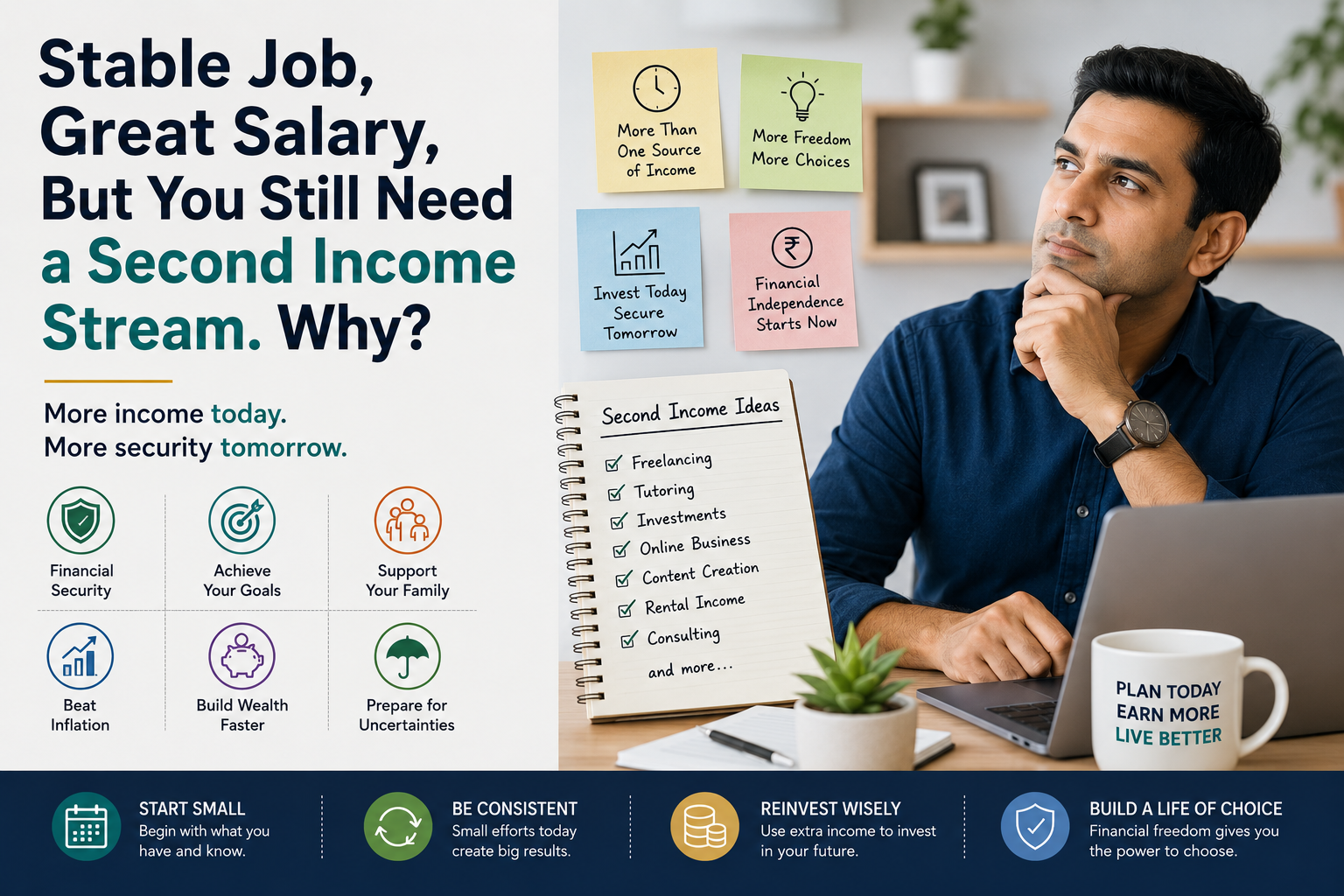
A second income stream can strengthen financial security while helping build long-term wealth and retirement independence.
For many Indians, one salary or one source of income no longer feels enough. A second income can help absorb rising costs, handle unexpected expenses, fund major goals and, importantly, strengthen your retirement plan.
It can also reduce dependence on a single employer or business. The growth of digital platforms, remote work and the gig economy has made it easier to monetise skills, knowledge, assets and even spare time.
But there is one important reality: a second income rarely becomes meaningful overnight. Give yourself three to twelve months to test an idea, understand what works, find your first paying customers and improve your approach. Start small, learn, course-correct and keep going.
Quick Takeaway
A second income does not have to mean starting a large business or working every evening. It could come from a professional skill, teaching, consulting, content, a small business, investments or an existing asset.
The best option is one that fits your time, skills, capital and risk appetite—and ultimately helps you build greater financial independence.
Why a Second Income Matters
A second income can serve several purposes at the same time. It can provide additional cash flow for everyday expenses, help you build an emergency fund, accelerate a home or education goal, or give you more money to invest.
For someone in their 30s or 40s, the long-term benefit can be even greater. If additional income is invested consistently for decades, the money has time to compound and potentially become a meaningful part of the retirement corpus.
For someone approaching retirement, a second income can serve a different purpose: it can delay the need to draw down retirement savings and create a greater sense of financial independence.
For a broader look at whether your retirement finances are on track, read Can I Retire? Grey Smiles Retirement Readiness Test.
First Decide: What Kind of Second Income Do You Want?
Not all additional income works in the same way. A useful starting point is to divide the possibilities into three categories.
| Type | How it works | Examples |
|---|---|---|
| Active | You exchange time and skills for income. | Freelancing, consulting, tutoring, local services |
| Semi-passive | You do substantial work upfront and can earn repeatedly from it. | Courses, books, YouTube, digital products |
| Passive / investment income | Your existing capital or assets generate income. | Interest, dividends, REITs, rental income, investments |
There is no prize for choosing the most “passive” option. If you have skills but little capital, active income may be the most sensible place to start.
10 Practical Second-Income Ideas in India
1. Freelancing and Consulting
If you already have a professional skill, this can be one of the lowest-cost ways to start.
IT, design, writing, finance, marketing, HR, business consulting, coaching and specialised professional services can all potentially be monetised outside a full-time job, subject to your employment contract and professional rules.
How to start: Pick one skill, create two or three strong examples of your work and start looking for small assignments. Platforms such as Upwork, Fiverr and LinkedIn can help, but your existing professional network may be even more valuable.
Time: Around 5–15 hours a week to begin.
Potential income: Highly variable. A small side practice may begin at ₹10,000 a month and can grow considerably with experience, specialisation and recurring clients.
Scale-up: Move from hourly work to retainers, specialised consulting or eventually an agency.
2. Online or Offline Tutoring and Coaching
Teaching is one of the most accessible ways to monetise knowledge. You could teach school subjects, competitive exams, languages, music, coding, accounting or a professional skill.
You don’t necessarily need a large online following. A handful of students, strong results and referrals can be enough to create a useful second income.
How to start: Choose one subject and audience, offer a few introductory sessions and build credibility through results and referrals.
Time: Evenings and weekends can work well.
Potential income: ₹8,000–₹50,000+ a month depending on subject, student numbers, format and pricing.
3. Create Digital Products
If you have knowledge that people repeatedly ask you about, consider turning it into a digital product: an online course, e-book, workbook, template, checklist or specialised guide.
The initial work can be substantial, but the same product can potentially be sold multiple times.
How to start: Solve one specific problem rather than trying to create a huge course. Test the idea with a small audience before spending heavily on production.
Important: Treat “passive income” claims cautiously. Digital products usually require ongoing marketing, updating and customer support.
4. Content Creation and Affiliate Income
Writing, video, podcasts and newsletters can eventually become sources of income through advertising, sponsorships, subscriptions, affiliate commissions or products and services of your own.
YouTube, for example, has formal eligibility and monetisation requirements that can change over time, so check the current rules before building your financial expectations around advertising revenue.
How to start: Pick a narrow subject where you can consistently offer useful information. Build an audience first and monetise later.
Time to traction: Often months rather than weeks. Give yourself 6–12 months before deciding whether the experiment has potential.
5. E-commerce and Reselling
Selling products online can be attractive, but it is a business rather than easy passive income.
You could explore marketplaces, your own website, private-label products, niche products or local products with an online audience.
Start small: Test demand before buying significant inventory. Returns, logistics, customer service, advertising and working capital can quickly become bigger challenges than expected.
Also understand the applicable GST, income-tax and marketplace compliance requirements before scaling.
6. Mutual Funds, Stocks and REITs
Investment income is different from earning income through work. Here, your existing money is being put to work.
Mutual fund SIPs can help build a long-term investment corpus, while listed REITs provide a way to gain exposure to income-generating real estate without directly buying a property.
SEBI notes that REITs allow investors to participate in real estate assets through listed units rather than owning physical property directly.
Important: Market-linked investments do not provide guaranteed income. Equity and REIT prices can fall, and dividends or distributions can change.
For retirement-focused investing, also read NPS vs PPF vs EPF: Which Is Better for Your Retirement?
7. Rental Income or Short-Term Leasing
If you already own suitable property, rental income may provide an additional cash flow stream.
This could involve a residential property, a spare room or another suitable asset, depending on local regulations and practical considerations.
However, don’t look only at the gross rent. Account for maintenance, vacancy, property tax, repairs, society charges, tenant issues and taxation.
For people who don’t want the responsibility of owning and managing property, REITs offer a different route to real-estate exposure.
8. Fixed-Income Income Streams
Bank deposits, government small-savings schemes and other fixed-income instruments can generate interest income from existing capital.
They may suit someone who prioritises capital stability over higher but uncertain returns.
However, interest income should not automatically be described as “passive income without risk.” There can be inflation risk, taxation, reinvestment risk and, depending on the instrument, credit or liquidity considerations.
9. Gig Work and Local Services
Not every second income needs a laptop.
Delivery work, driving, home services, repair work, photography, cooking, pet care, event support and other local services can create additional income for people who have the time and ability to do them.
There is sometimes an unfortunate tendency to look down on gig and service work. There should be no shame in earning honestly. The more useful question is whether the work is financially worthwhile, physically sustainable and compatible with your main responsibilities.
10. Monetise Something You Already Own
Before starting something completely new, look at what you already have.
It could be an unused room, parking space, equipment, professional network, domain knowledge, hobby, small piece of land or even a collection of skills accumulated over decades.
Sometimes the easiest second income is hidden in an asset you have stopped noticing.
What About Peer-to-Peer Lending?
P2P lending is sometimes promoted as an attractive source of passive income. We would put it in a different category: income with meaningful credit risk.
RBI-regulated NBFC-P2P platforms are intermediaries connecting lenders and borrowers. Importantly, the RBI framework makes clear that the lender bears the risk of loss; a P2P platform does not guarantee repayment of principal or interest.
For most people building financial security, this should not be treated as a substitute for a bank deposit or guaranteed retirement income.
Our view: understand the risk before considering it, and never use emergency money or essential retirement savings for speculative income strategies.
Don’t Forget the Tax and Compliance Side
A second income can feel simple when the first payment arrives. It can become considerably less simple when tax and compliance obligations start appearing.
Depending on what you do, your additional income may have implications under income-tax, GST, professional regulations or other applicable laws.
The Income Tax Department distinguishes between income from business or profession and other forms of income, and the appropriate return depends on your circumstances.
GST registration requirements also depend on the nature of the activity, turnover, state and other conditions. Don’t rely on a generic “₹X lakh threshold” copied from an old article. Check the current rules applicable to your situation.
If your side income becomes meaningful, speak to a qualified tax professional or GST practitioner.
Simple Record-Keeping From Day One
- Keep a separate bank account once the activity becomes substantial.
- Maintain invoices and receipts.
- Track payments received through UPI, bank transfers and platforms.
- Record legitimate business expenses.
- Keep contracts and client records.
- Set aside money for taxes instead of treating every rupee received as spendable income.
Second Income: Mistakes to Avoid
Don’t Chase “Guaranteed” Returns
Promises of extraordinary returns with little or no risk should immediately make you cautious. MLM schemes, investment scams, fake trading gurus and “guaranteed” online income models can turn a second-income plan into a financial loss.
Don’t Invest Your Emergency Fund
Your emergency fund has a different job. Don’t put money required for near-term emergencies into speculative investments or a business experiment.
Don’t Start Five Things at Once
One of the biggest mistakes is confusing activity with progress. Start with one idea. Give it enough time to produce evidence. Then decide whether to continue, change direction or stop.
Don’t Ignore Your Main Job
If you are salaried, check your employment contract, conflict-of-interest provisions, confidentiality obligations and employer policies before taking on outside work.
Don’t Underestimate the Time Commitment
A side business can slowly become a second full-time job. That may be worthwhile if it is intentional, but it can also affect health, family time and your primary career.
A Simple 6-Step Plan for a Busy Salaried Person
- Audit yourself: List your strongest skills, available time and investible capital.
- Choose one path: Prefer low-capital, skill-led opportunities if you are starting from scratch.
- Run a three-month experiment: Don’t spend heavily before proving demand.
- Schedule the work: Reserve specific evenings or weekend hours.
- Find your first paying customers: Even five paying customers can teach you more than months of planning.
- Reinvest selectively: Once the idea starts working, use a portion of the income to improve tools, marketing or capacity.
What Should You Do With the Extra Income?
This is where a second income can become genuinely powerful.
Instead of allowing the additional money to disappear into lifestyle upgrades, consider giving it a specific job.
| Priority | Possible use of additional income |
|---|---|
| Financial protection | Build or strengthen emergency savings |
| Debt reduction | Pay down expensive consumer debt |
| Short-term goals | Build a separate fund for planned expenses |
| Long-term wealth | Invest through suitable diversified investments |
| Retirement | Increase retirement contributions and investments |
| Business growth | Reinvest a measured portion into the side business |
This is particularly important if your ultimate goal is early or financially independent retirement.
If you’re wondering whether you can actually stop working earlier than planned, our Can I Retire Early? guide looks at the question from a practical perspective.
How Much Should You Reinvest?
There is no universal percentage. A useful starting point is to divide additional income between financial security, long-term investing and improving the income source itself.
For example, someone earning ₹30,000 a month from a side activity might decide to invest ₹9,000, retain ₹6,000 for taxes or business expenses and use the remainder for a current financial goal. Another person may have different priorities.
The important principle is simple: don’t let every rupee of additional income become additional lifestyle spending.
How Long Does It Take to Build a Second Income?
Be realistic.
You may get your first freelance assignment within weeks. But creating a reliable additional income stream can take considerably longer.
A reasonable framework is to give yourself 3–12 months to test, learn and build.
The cycle is straightforward:
Patience matters. Your first idea may not work. That doesn’t mean the larger objective has failed.
The Bigger Picture: Second Income and Retirement
A second income becomes particularly valuable when you stop thinking of it as “extra spending money” and start seeing it as another component of your financial plan.
Imagine earning an additional ₹15,000 a month and investing a meaningful portion of it consistently for many years. The contribution itself matters, but so does the time available for compounding.
Over time, the objective could be to move from:
- One salary → salary + side income
- Side income → side income + investments
- Investments → growing retirement corpus
- Retirement corpus + other income → greater financial independence
That is why a second income can be more than a short-term financial hack. It can become part of a long-term strategy for financial resilience and retirement independence.
For a broader look at retirement preparedness, take the Grey Smiles Retirement Readiness Test.
Frequently Asked Questions
What is the best second income in India?
There is no single best option. If you have valuable skills but little capital, freelancing, consulting or tutoring may be sensible. If you have capital but limited time, investments or suitable rental assets may be more appropriate. The right choice depends on your skills, time, capital and risk tolerance.
How can I earn a second income while working full-time?
Start with something that fits into 5–10 hours a week. Consulting, tutoring, freelancing, digital products and content creation can be tested outside normal working hours. Check your employment contract and employer policies before beginning outside work.
How much money can I earn from a side income?
There is no reliable fixed range. A small side activity may generate a few thousand rupees a month, while a specialised consulting practice or business can eventually generate much more. Your skill, niche, time commitment, pricing and ability to find customers will matter more than the platform you choose.
Is passive income really passive?
Usually, not completely. Investments require capital and monitoring. Rental property requires management. Digital products require marketing and updates. Content requires consistent creation. “Passive” generally means less active involvement after setup, not income without effort or risk.
Should I invest my second income?
If your emergency fund is adequate and high-cost debt is under control, investing part of your additional income can turn it into long-term wealth. The right investment depends on your goals, time horizon and risk profile.
Can a second income help me retire early?
Yes, potentially. A second income can increase the amount available for long-term investments and reduce dependence on your primary salary. However, early retirement requires a sufficiently large corpus, sustainable spending and a realistic plan for inflation, healthcare and longevity.
Do I have to pay tax on my second income in India?
Additional income can have tax implications, depending on its source and your circumstances. Freelancing, consulting, business income, rental income, investment income and other sources can be treated differently. Keep records and seek professional tax advice when the activity becomes substantial.
Do I need GST registration for a side business?
Not necessarily. GST registration depends on factors such as the nature of your activity, turnover, location and applicable exemptions or special rules. The threshold and requirements can change, so check the current GST rules rather than relying on an old threshold quoted online.
Should I use my retirement savings to start a side business?
Generally, be very cautious. Retirement money has an important job: funding your later years. If you want to experiment with a business, use an amount you can genuinely afford to lose rather than compromising your essential retirement security.
Also Read on Grey Smiles
Final Thoughts
A second income does not need to be glamorous. It does not have to become a startup, a YouTube channel or a large online business.
It can simply be a skill you monetise, a few students you teach, a small consulting practice, a service you provide, an asset you rent or money you invest consistently.
Start with what you already know. Keep the initial investment small. Give the idea time to prove itself. Keep records, understand the tax implications and avoid schemes promising easy money.
Most importantly, give your additional income a purpose. If some of it eventually strengthens your emergency fund, reduces debt and builds your retirement corpus, your second income could end up doing much more than paying for a few extra comforts today.
Disclaimer
This article is for general educational purposes and does not constitute financial, investment, tax, legal or business advice. Income ranges are illustrative and are not guaranteed. Investment values can rise or fall, and business and gig income can be uncertain. Tax, GST, platform and regulatory rules may change. Check the latest applicable rules and consult a qualified professional where appropriate.




Start the conversation
Share a helpful experience, ask a thoughtful question, or add another perspective for fellow readers.