
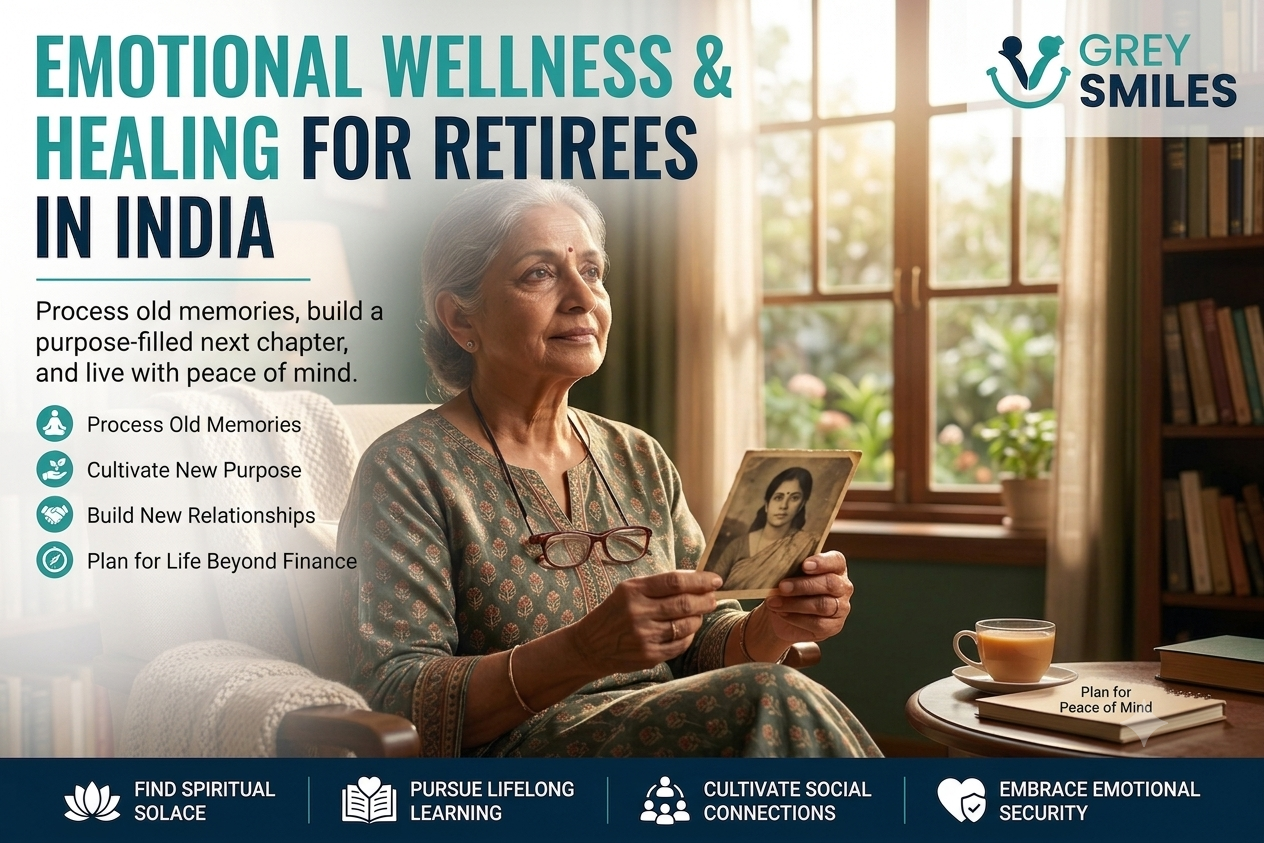
Navigating past memories, emotional health, and personal growth during retirement in India.
By Monica Gill · Spiritual educator, intuitive guide & certified practitioner
Retirement is often imagined as a time to slow down, breathe and finally enjoy a freedom that was difficult to find during busy working years. But the quiet can bring something unexpected too: old memories that had little room to surface when life was filled with work, family responsibilities and everyday problems.
These memories may come from loss, difficult relationships, childhood experiences, financial hardship, caregiving, illness or events that were never fully processed. Retirement does not necessarily create these wounds. It can simply create the space in which they become easier to feel.
That can be unsettling. Yet retirement can also offer something that earlier stages of life often did not: time to understand your experiences without allowing them to define the rest of your life.
At a Glance
- Retirement can bring old memories closer because there is less distraction and more time for reflection.
- Trauma can be emotional, physical, financial or connected to loss, relationships and major life changes.
- Healing does not mean forgetting, pretending something was acceptable or forcing yourself to forgive.
- New relationships, meaningful activities, spirituality, boundaries and professional support can all help.
- If difficult memories begin affecting sleep, relationships, daily activities or your ability to enjoy life, professional support is worth considering.
Why Do Old Memories Return After Retirement?
For much of adult life, there is always something demanding our attention. There is work to complete, children to raise, parents to care for, bills to pay and responsibilities that simply cannot wait. Even painful experiences can be pushed into the background because there is little time to stop and think about them.
Retirement changes that rhythm. The working day disappears, the commute ends and some familiar responsibilities become lighter. The sudden availability of time can feel wonderful, but it can also create mental space for memories that have been sitting quietly in the background for years.
For some people, this may be the memory of a difficult marriage. For another, it could be the loss of a parent, a friendship that ended badly, financial difficulties, an unhappy career or something from childhood that was never discussed. Sometimes the memory is not even particularly dramatic; it may simply be a period of life that still carries sadness or regret.
Instead of asking, “Why am I thinking about this now?”, a gentler question may be: “What do I need today to live well with what happened then?”
Trauma in Later Life Can Take Many Forms
When we hear the word trauma, we often think of a single major event. But difficult experiences can affect us in many different ways. Bereavement, relationship wounds, childhood hardship, years of caregiving, financial insecurity, loneliness, serious illness and major changes in independence can all leave emotional marks.
Physical experiences can have an emotional impact too. Someone who has experienced a serious fall may become afraid of walking alone. A person recovering from major surgery may become anxious about every new physical symptom. Someone whose mobility has changed may grieve the independence they once took for granted.
The body may recover faster than the mind. That does not mean the fear is irrational or that someone is being unnecessarily negative. It means that physical recovery and emotional adjustment can be two different journeys, and both deserve attention.
The World Health Organization’s healthy ageing resources also emphasise maintaining wellbeing and functional ability as people grow older.
Retirement Can Change the Way We Understand Our Past
Growing older often gives us a perspective that was unavailable when we were younger. At 35, we may simply be trying to survive a difficult period. At 50, there may still be too many responsibilities to stop and examine it. At 70, there can finally be enough distance to ask, “Why did that affect me so deeply?”
This does not mean retirement should become an endless exercise in analysing the past. Looking backwards can be useful when it helps us understand ourselves, but it should ultimately help us live better in the present.
One useful distinction is between remembering what happened and allowing what happened to determine what happens next. The first may be unavoidable. The second is something we can gradually influence.
You Are More Than What Happened to You
The Bhagavad Gita offers a particularly meaningful way to think about identity during difficult periods. At the beginning of the Gita, Arjuna is overwhelmed. His body and mind are struggling with the situation in front of him, and he does not know how to move forward. His vulnerability is not treated simply as weakness; it becomes the starting point for reflection and wisdom.
There is a gentle lesson here for retirement. We can describe ourselves through what has happened: I was betrayed. I lost someone. I made a mistake. I became ill. I struggled financially. I am alone. These experiences matter, but they are not the whole story.
A painful chapter can belong to your life without becoming the title of your book.
You may also be a parent, grandparent, friend, traveller, gardener, reader, mentor, volunteer, teacher or learner. You may still have places you want to visit, people you want to meet and things you want to learn.
This is one reason retirement planning should extend beyond finances. The GreySmiles Retirement Readiness Test looks at retirement as a broader life transition, because being financially prepared is only one part of creating a satisfying next chapter.
Strength Does Not Always Mean Carrying Everything Alone
Many people from older generations were taught to endure silently. You worked, provided for your family, solved problems and carried on. That resilience deserves enormous respect.
But carrying on is not always the same as processing. Sometimes strength means admitting that something still hurts. It can mean speaking to a trusted friend, counsellor, family member or spiritual guide rather than continuing to carry everything privately.
Seeking support does not erase the resilience that helped you through earlier years. It simply adds another tool.
Forgiveness Is Not a Requirement for Healing
Forgiveness can be meaningful, but it should never become another obligation. You do not have to pretend that something was acceptable. You do not have to rebuild a harmful relationship. And you do not have to feel compassion towards someone before you are ready.
Moving forward may involve forgiveness, but it may equally involve boundaries, distance, acceptance or deciding that a person who hurt you will no longer occupy so much of your mental space.
Peace does not always require reconciliation.
For some people, healing also involves rebuilding their social world. Retirement can sometimes increase isolation, particularly when work friendships disappear. Creating new routines and relationships can therefore become an important part of emotional wellbeing. Our GreySmiles guide on staying happy during retirement explores practical ways older adults can build a more connected and purposeful life.
Healing Can Also Come Through New Experiences
Healing does not happen only by thinking about the past. Sometimes it happens because life gradually becomes larger again.
Travel can provide curiosity and a change of environment. Learning can create a new sense of capability. Volunteering can turn difficult experiences into empathy and contribution. A hobby can provide structure to an otherwise empty afternoon. Reconnecting with an old friend can remind us that our identity exists outside the experiences that hurt us.
Even small rituals matter: morning walks, meeting someone for tea, reading, gardening, listening to music or becoming part of a local community. These activities do not erase painful memories. They simply ensure that those memories are not the only things occupying our attention.
For those who enjoy travel, our guide on embracing post-retirement bliss looks at how slower, more meaningful travel can become part of a fulfilling retirement rather than simply another item on a bucket list.
Be Careful With the Idea That “Everything Happens for a Reason”
Well-meaning people sometimes tell someone who has suffered that everything happens for a reason. While this may be comforting to some, it can feel dismissive to others. Not every loss needs to be turned into a lesson, and not every painful experience needs to be explained.
A gentler question may be: “Given that this happened, what do I want to do with the life still in front of me?”
This shifts attention away from finding a perfect explanation for the past and towards making meaningful choices in the present.
When Is Professional Support Worth Considering?
Not every difficult memory requires professional treatment. Conversation, friendship, spirituality, meditation, community and time can all be valuable sources of support. But there are times when additional help is appropriate.
If memories regularly cause intense anxiety, panic, nightmares, persistent sadness, severe avoidance, social withdrawal or difficulty managing everyday activities, consider speaking with a qualified mental-health professional. The same applies when fear or distress continues after a serious physical injury or medical event.
Seeking help is not a sign that someone has failed to cope. It is simply another form of self-care. The Government of India’s National Mental Health Programme provides information about mental-health services and initiatives in India.
Four Questions for Your Next Chapter
You do not need to revisit your entire life at once. A quiet conversation with yourself can begin with four questions:
- What am I still carrying?
- What is actually mine to carry?
- What do I want more of now?
- What is one small step towards that life?
The answers do not need to be dramatic. Perhaps the first step is calling an old friend. Perhaps it is finally speaking to a counsellor. Perhaps it is joining a walking group, planning a trip, returning to music or simply creating a more enjoyable daily routine.
Moving Forward Does Not Mean Forgetting
Some experiences will always matter. A person you loved may always be missed. A difficult period may always be part of your story. A scar does not need to disappear for life to continue around it.
Moving forward simply means that the memory no longer has to make every decision.
Retirement can therefore become more than a transition away from work. It can be a period of rebuilding — financially, socially, physically and emotionally. You do not have to become the person you were before the difficult experience. You can become someone who understands what happened, carries it with greater acceptance and remains curious about what comes next.
The GreySmiles Thought
You cannot rewrite the years behind you. But retirement can give you more choice about how much space those years occupy in the years ahead. The past is part of your story, but it does not have to write the ending.
About the Author: Monica Gill is a spiritual educator, intuitive guide and certified practitioner with nearly two decades of study in mystical and healing sciences. Read Monica Gill’s full author profile →
This article is for general educational purposes and is not a substitute for professional medical or mental-health advice.




Start the conversation
Share a helpful experience, ask a thoughtful question, or add another perspective for fellow readers.