
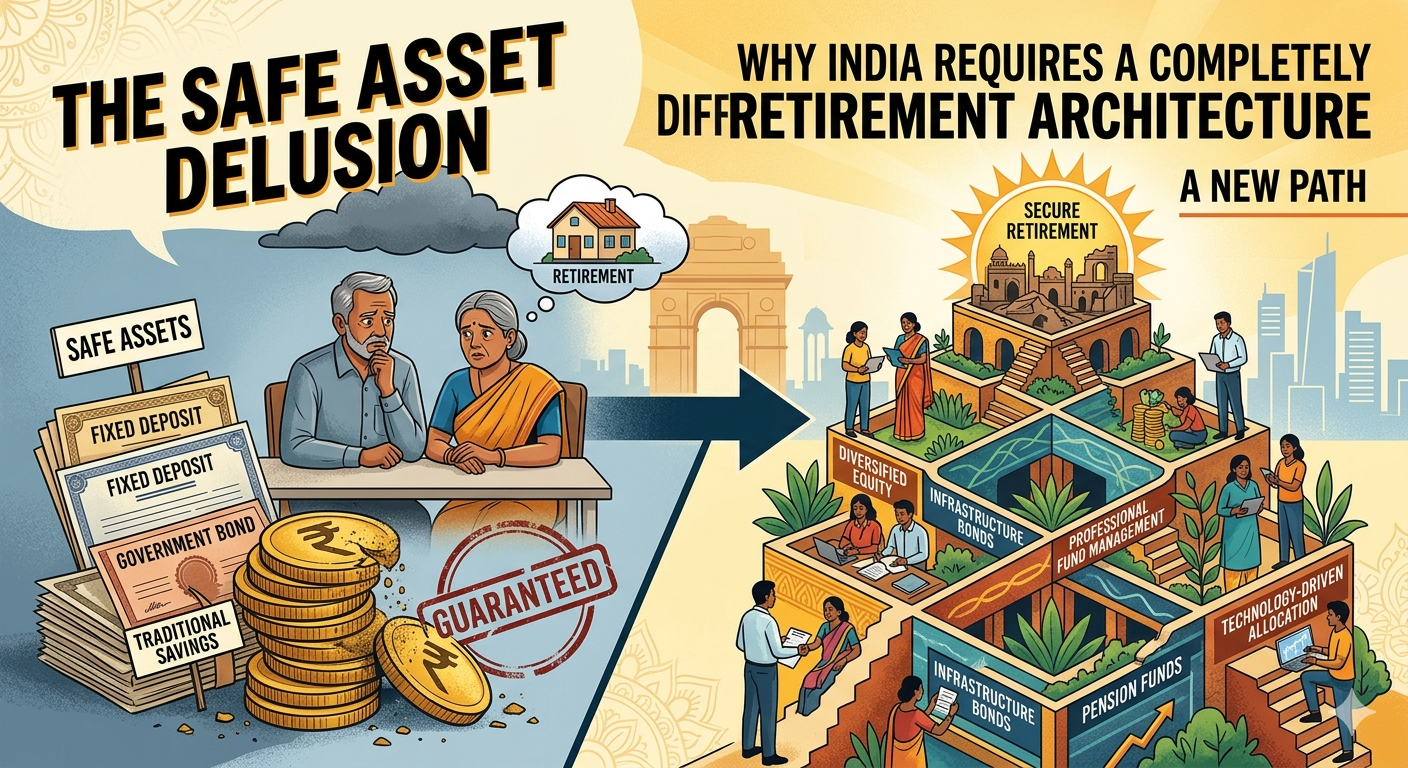
For decades, retirement planning advice in India has been a copy-paste job of Western financial models. We are told to follow static rules like the “4% withdrawal rule,” pile money into traditional fixed-return instruments, and assume a modest, steady rate of inflation. But in 2026, building a truly resilient nest egg requires understanding why traditional frameworks collapse under local pressures. To navigate this landscape, we must tackle the Twin Engines of Inflation, adapt to the Collapse of the Multi-Generational Safety Net, acknowledge the Absolute Absence of a State Cushion, and break free from the “Safe Asset” Delusion. By mastering this custom architecture, you can transition from a passive saver to a confident engineer of your own financial freedom.
Planning for retirement in India is a fundamentally different beast. It is a high-stakes engineering problem defined by unique structural pressures, shifting cultural dynamics, and fiscal realities that Western models completely ignore. To build a corpus that actually outlasts you, you have to understand the specific forces working against the Indian retiree—and how to outmaneuver them.
1. The Twin Engines of Inflation: Lifestyle vs. Medical
Most retirement calculators use standard Consumer Price Index (CPI) numbers—usually hovering around 5% to 6%—to project future expenses. This is a catastrophic math mistake. Urban retirees face two distinct, hyper-compounding inflation tracks:
- Lifestyle Inflation: As India’s economy modernizes, the baseline cost of maintaining a dignified, upper-middle-class urban lifestyle outpaces basic commodity inflation.
- The Healthcare Inflation Monster: Medical inflation in India consistently tracks at a brutal 12% to 14% annually. A healthcare procedure that costs ₹5 Lakh today will comfortably breach ₹20 Lakh in fifteen years. If your retirement math treats medical costs the same as grocery bills, your capital will likely be depleted decades too early.
2. The Collapse of the Multi-Generational Safety Net
For generations, India’s unwritten social security system was built into the structure of the family. The joint-family model ensured that children served as the primary emotional and financial cushion for aging parents.
Today, that structural net has largely dissolved. Hyper-urbanization, the shift toward nuclear households, and global career migration mean that modern retirees can no longer treat family as a default insurance policy. Self-reliance is no longer a choice; it is an operational requirement.
3. Absolute Self-Reliance: The Missing State Cushion
In many Western economies, a retirement portfolio is a supplement to state-sponsored infrastructure—such as structured social security payouts, pensions, or comprehensive state healthcare (like Medicare).
In the Indian private sector, there is no cushion. Private professionals, independent consultants, and entrepreneurs receive zero state-funded social security. Every single rupee required for housing, daily bread, major surgeries, and long-term diagnostic care post-age 60 must be hand-built, entirely from scratch, out of your own personal savings and investments.
4. The “Safe Asset” Delusion
The traditional Indian response to risk is to seek the absolute comfort of Fixed Deposits (FDs), traditional insurance policies, and post office schemes.
While these instruments offer psychological comfort, they deliver negative real returns after adjusting for taxation and true inflation. If an FD yields 7% but you sit in the 30% tax slab, your net return is 4.9%. If actual urban inflation is 7%, you are actively losing purchasing power every single year. Relying purely on traditional debt to fund a 30-year retirement cycle is a slow, guaranteed path to running out of money.
The Tactical Blueprint: How to Build an Inflation-Proof Pipeline
To beat these structural challenges, your retirement cannot be a static pool of cash. It must be structured as an interconnected multi-bucket pipeline:
- The Immediate Cushion (Years 1–3): Stored in absolute safety and high liquidity. This bucket uses Systematic Withdrawal Plans (SWPs) from arbitrage funds, sweep-in FDs, and dedicated emergency cash reserves to fund your predictable, day-to-day living expenses without market stress.
- The Income Guard (Years 4–7): Focused on near-term inflation defense. This utilizes low-volatility fixed-income instruments like Banking & PSU debt funds or short-duration corporate debt to act as a defensive buffer.
- The Compounding Engine (Years 8+): Parked cleanly in broad-market equities (such as low-cost Nifty 50 Index funds and high-quality flexi-cap funds). This is the only asset class capable of outrunning a 14% healthcare inflation rate over a multi-decade horizon.
Summary Checklist for the Modern Indian Retiree
| Challenge | Strategic Operational Fix |
|---|---|
| 14% Medical Inflation | Secure comprehensive, standalone Senior Health Insurance early; do not rely on corporate policies that vanish when you exit. |
| Negative Real Yields | Shift your growth capital out of the “FD trap” and deploy it systematically into low-cost equity index funds. |
| Zero State Support | Calculate your target corpus assuming a 30-year alternative income lifecycle where you are 100% self-funded. |
| Execution Risk | Set a strict, non-automated 3-year schedule to manually rebalance assets from growth to liquid buckets based on market valuations. |
While navigating India’s unique retirement landscape requires shifting away from outdated models, it also unlocks an extraordinary opportunity. By taking a proactive, engineered approach to your wealth today, you are doing more than just protecting your future—you are building an empowering, unshakeable foundation for your golden years. With clear execution, deliberate asset routing, and the right compounding engines in place, you can look forward to a retirement filled with absolute independence, peace of mind, and the freedom to live exactly on your own terms.
Also read: Young and planning retirement, know about Asset Allocation
Also read: Medical Inflation Vs Lifestyle Inflation: Impact on households




Start the conversation
Share a helpful experience, ask a thoughtful question, or add another perspective for fellow readers.