
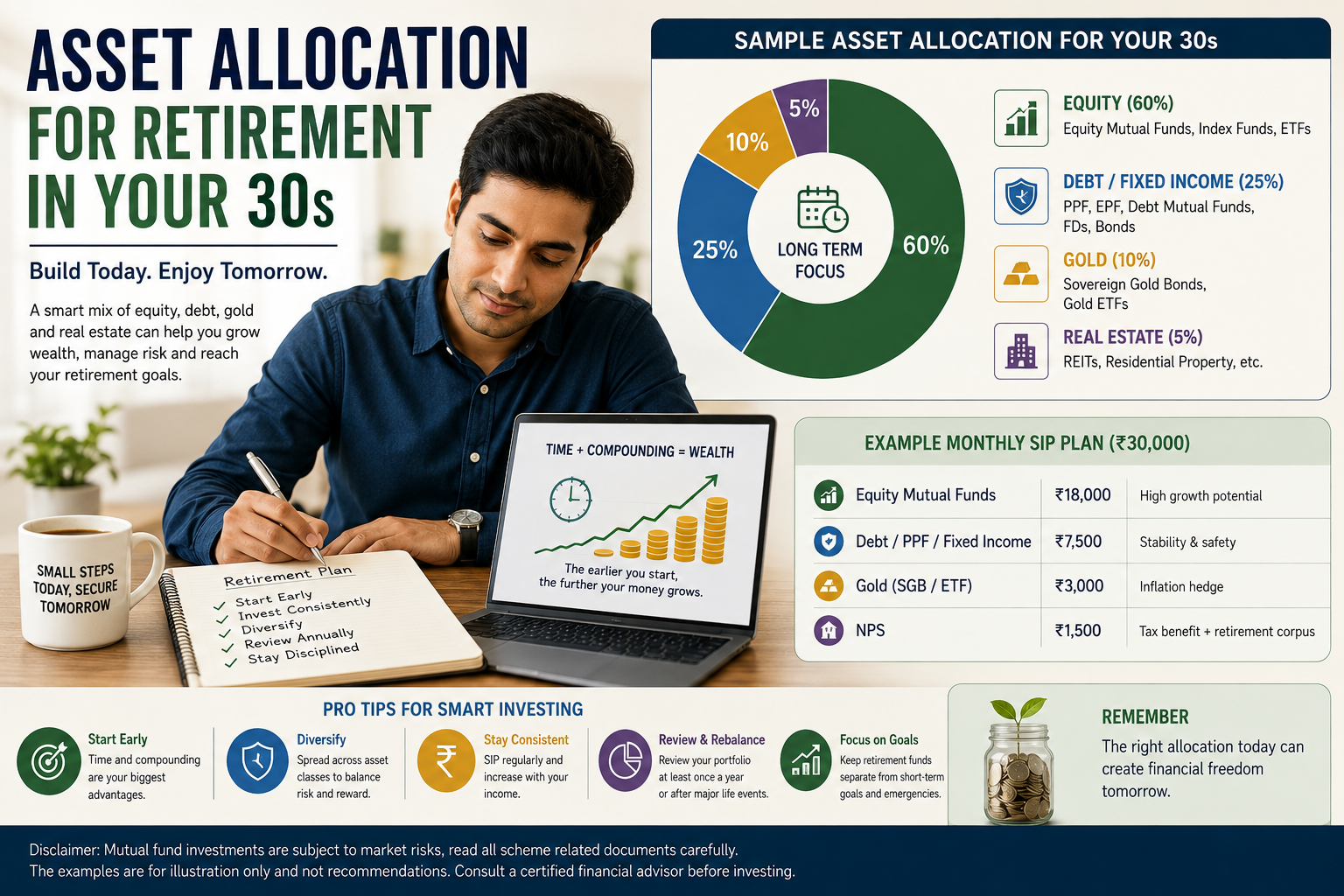
Planning for retirement in your 30s is a crucial financial step, and one of the most important aspects of this journey is how you allocate your investments—known as asset allocation. Asset allocation is the process of spreading your investments across various asset classes such as equities, debt, gold and real estate. This approach helps balance risk and reward according to your financial goals, time horizon and risk tolerance.
For young professionals in India, the right asset allocation strategy can lay a solid foundation for long-term wealth creation. With several decades potentially available before retirement, you can take a measured approach to growth while gradually building financial stability. The key is not to find one “perfect” percentage, but to build an allocation you can actually stick with through market ups and downs.
In this article, we’ll explore the options available and provide a sample asset allocation and SIP illustration to help you think about retirement planning more confidently.
1. Sample Asset Allocation for Someone in Their 30s
Your allocation depends on your risk appetite, financial responsibilities and retirement horizon. The following is a moderate-risk illustration, not a recommendation for every investor:
| Asset Class | Illustrative Allocation | Possible Instruments |
|---|---|---|
| Equity | 60% | Equity mutual funds, index funds, ETFs |
| Debt / Fixed Income | 25% | PPF, EPF, debt mutual funds, FDs, bonds |
| Gold | 10% | Gold ETFs and other suitable gold products |
| Real Estate | 5% | Optional exposure such as REITs or property |
Remember: This is only a sample. A conservative investor may prefer more debt and less equity, while someone with a long horizon and higher risk capacity may be comfortable with greater equity exposure. Your emergency fund and short-term goals should also be kept separate from your long-term retirement portfolio.
Asset allocation should also evolve with age. Someone in their 30s may have greater capacity to tolerate equity volatility than someone approaching retirement. What matters is not simply your age, but how long the money can remain invested and how much risk you can genuinely tolerate.
2. Understanding the Main Investment Options
A. Equity Mutual Funds – For Long-Term Growth
Equity mutual funds can provide long-term growth potential but can also be volatile over shorter periods. For a retirement goal several decades away, categories such as index funds, large-cap funds and flexi-cap funds may be considered depending on your risk profile and investment approach.
Examples that have previously been considered by Indian investors include:
- Large-cap funds: Axis Bluechip Fund, HDFC Top 100 Fund
- Index funds: Nippon India Nifty 50 Index Fund, UTI Nifty 50 Index Fund
- Flexi-cap funds: Parag Parikh Flexi Cap Fund, SBI Flexi Cap Fund
- ELSS: Mirae Asset Tax Saver Fund and other eligible ELSS funds
Important: These are examples from the original article, not recommendations. Fund names, performance, expense ratios, portfolio composition and suitability can change. Always check current scheme information and the SEBI Riskometer before investing.
B. Debt and Fixed Income
Debt and fixed-income investments can provide stability and help balance the volatility of equity. Options may include EPF, PPF, fixed deposits, bonds and debt mutual funds.
PPF can be useful for investors seeking a long-term government-backed savings product, while EPF can be a significant retirement asset for salaried employees. Debt mutual funds offer different maturity and credit-risk profiles, so they should not automatically be treated as equivalent to bank deposits or guaranteed-return products.
C. Gold
Gold can provide diversification and may behave differently from equities during some market cycles. Investors can consider regulated forms such as gold ETFs or other suitable gold investment products.
Note on Sovereign Gold Bonds: SGBs have historically offered a fixed interest component along with gold-linked returns, but investors should not assume a new issue is always available. Check the latest government/RBI announcements and the applicable terms before considering them.
D. Real Estate
Real estate can be part of a household’s overall wealth, but it should not automatically be counted as a retirement investment. A property may be valuable but illiquid, expensive to maintain and difficult to convert into regular retirement income.
REITs can provide another way to obtain exposure to income-generating real estate without purchasing a property directly. Examples include listed REITs such as Embassy Office Parks REIT and Mindspace Business Parks REIT, subject to current availability and suitability.
3. Example SIP Investment Plan
Suppose you are 35, have a long retirement horizon and can invest ₹30,000 a month. One illustrative structure could look like this:
| Investment | Monthly Amount | Purpose |
|---|---|---|
| Equity MF / Index / Flexi-cap | ₹18,000 | Long-term growth |
| Debt / PPF / other fixed income | ₹7,500 | Stability and diversification |
| Gold | ₹3,000 | Diversification |
| NPS | ₹1,500 | Retirement-focused investing and possible tax benefits, depending on applicable rules |
| Total | ₹30,000 |
This is only an illustration. Your actual allocation should reflect your income, existing investments, family responsibilities, debt, retirement age and risk tolerance.
4. Corpus Calculation Example
Suppose you want to accumulate ₹1 crore over 25 years. At an assumed annual return of 10%, a monthly SIP of roughly ₹7,500 would mathematically grow to around ₹1 crore, before considering taxes, costs and variations in actual returns.
For a ₹2 crore target under the same assumptions, the monthly contribution would be roughly ₹15,100.
These numbers are only illustrations. A 10% return is an assumption, not a promise, and actual market returns will vary.
More importantly, ask whether ₹1 crore or ₹2 crore will actually be enough for your retirement. If your target is expressed in today’s purchasing power, inflation must also be built into the calculation. A future ₹1 crore will not have the same purchasing power as ₹1 crore today.
5. Pro Tips for Retirement Asset Allocation
- Start simple: If you are new to investing, a diversified index fund can be easier to understand than owning numerous funds.
- Don’t collect funds: Five or six overlapping equity funds do not necessarily mean better diversification.
- Use ELSS for tax saving only when appropriate: ELSS deductions depend on the tax regime and applicable rules. Under the current new tax regime, most Chapter VI-A deductions are not available, subject to specified exceptions.
- Use PPF for its role, not simply because it is “safe”: Understand its tenure, liquidity and current interest rate before deciding how much it should represent in your portfolio.
- Review annually: Rebalance when your allocation moves materially away from your intended mix.
- Increase SIPs as income rises: A yearly SIP increase can make a substantial difference to the eventual corpus.
Also read: What are Mutual Funds for Retirement?
Also read: Common Emotional Mistakes to Avoid With Your Retirement Fund
6. Don’t Forget the Rest of Your Financial Plan
Asset allocation is only one part of retirement planning. Before investing ₹30,000 a month, make sure you are also dealing with the basics:
- an adequate emergency fund;
- appropriate health insurance;
- term insurance where dependants require income protection;
- high-cost debt;
- children’s education and other major financial goals;
- adequate retirement savings through EPF, NPS or other suitable investments.
Your retirement portfolio should not be so aggressive that a medical emergency forces you to sell investments at the wrong time.
7. Action Steps
- Calculate your current net worth: List savings, investments, EPF/NPS, property and outstanding loans.
- Set a retirement target: Estimate your future expenses rather than simply choosing a round number.
- Choose an asset allocation: Decide how much belongs in equity, debt, gold and other assets based on your circumstances.
- Automate your investments: Begin SIPs and other regular contributions according to your plan.
- Use a regulated platform or intermediary: Examples include direct AMC platforms or established mutual fund platforms/brokers. Compare costs and understand whether you are choosing a direct or regular mutual fund plan.
- Review once a year: Rebalance and update the plan after major life events such as marriage, children, a home purchase, career changes or a move abroad.
8. The Most Important Rule: Your Allocation Must Be One You Can Live With
There is no magic asset allocation for everyone in their 30s.
A 32-year-old with a stable job, no dependants and a 30-year retirement horizon may have a very different risk capacity from a 38-year-old supporting parents, paying a large home loan and raising two children.
The best portfolio is not necessarily the one with the highest expected return. It is the one that gives you a reasonable opportunity for long-term growth without making you abandon your plan when markets become uncomfortable.
As retirement approaches, the portfolio can gradually become more conservative, depending on the individual’s circumstances and retirement-income strategy.
Frequently Asked Questions
What is asset allocation in retirement planning?
Asset allocation means dividing your investments among different asset classes such as equity, debt, gold and other assets. The aim is to balance growth, risk, liquidity and your investment horizon.
What is a good asset allocation for someone in their 30s?
There is no universally correct allocation. A long-term investor may be able to hold a higher equity allocation, while someone with lower risk tolerance or greater financial obligations may prefer more debt. The 60% equity, 25% debt, 10% gold and 5% real estate example in this article is illustrative only.
Should I invest mostly in equity for retirement in my 30s?
Equity can play an important role in a long-term retirement portfolio because of its growth potential, but it also carries market risk. Your allocation should reflect your time horizon and ability to tolerate losses without abandoning the plan.
Is PPF enough for retirement?
PPF can be a useful component of a retirement portfolio, particularly for investors seeking long-term fixed-income exposure, but it may not be sufficient on its own. Retirement planning usually requires considering multiple assets and future expenses.
Is NPS suitable for someone in their 30s?
NPS can be considered as one component of retirement planning. Its investment choices, withdrawal rules, tax treatment and suitability should be evaluated alongside EPF, mutual funds, PPF and other retirement assets.
How often should I rebalance my retirement portfolio?
Reviewing your portfolio at least annually is a reasonable starting point. You may also need to review it after major life events or when market movements cause your allocation to move significantly away from your intended mix.
Final Thoughts
Retirement planning in your 30s is not about finding the perfect mutual fund or predicting which asset class will perform best next year.
It is about building a system that works for decades.
Start early. Diversify. Invest regularly. Keep an emergency fund. Protect yourself with appropriate insurance. Increase your investments as your income rises. And review your asset allocation as your life changes.
The objective is not to maximise returns at any cost. It is to arrive at retirement with enough money, enough flexibility and enough peace of mind to enjoy the life you have spent decades preparing for.
Disclaimer: This article is for general educational purposes and is not personal investment, tax or financial advice. Mutual fund and market-linked investments are subject to market risks. Fund examples are illustrative and should not be treated as recommendations. Tax rules, investment regulations, interest rates and product availability can change. Verify current information from official sources and consider professional advice based on your individual circumstances.




Start the conversation
Share a helpful experience, ask a thoughtful question, or add another perspective for fellow readers.