
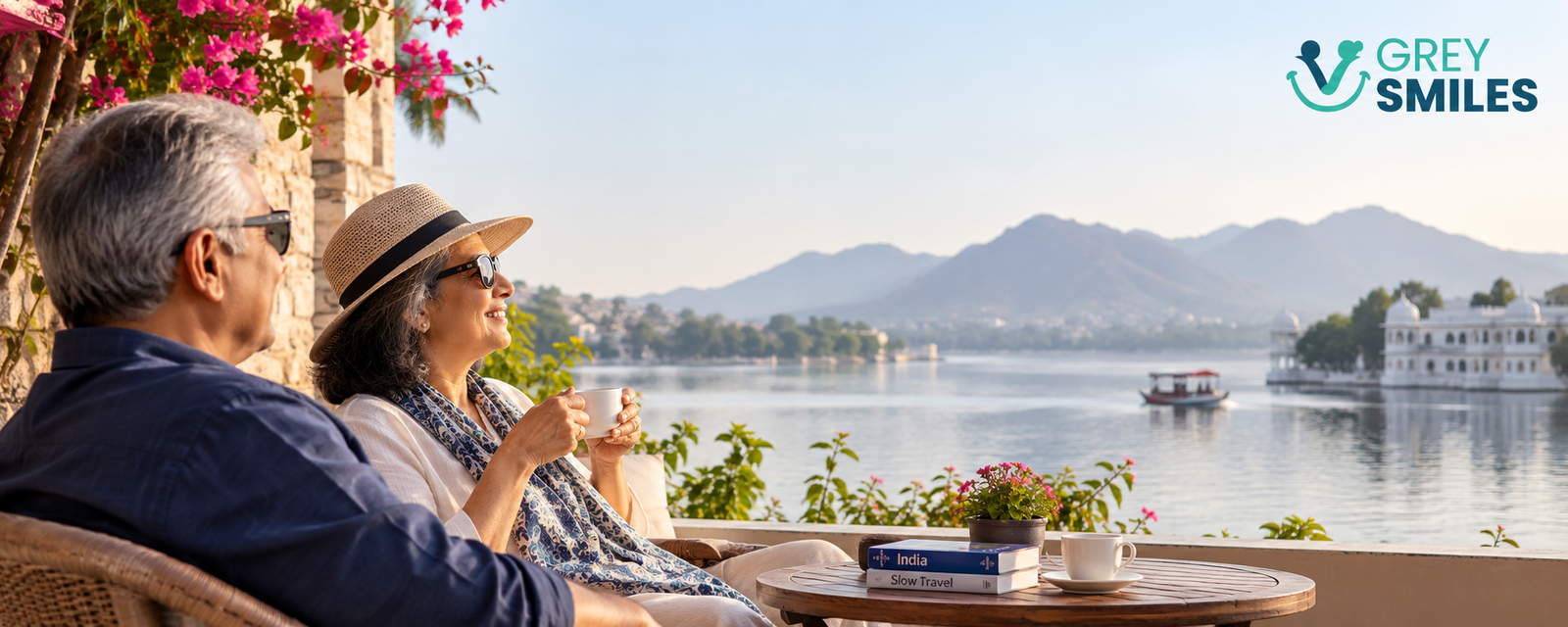
Have you ever returned from a holiday feeling that you saw a lot but experienced very little? The itinerary may have looked impressive when you booked it: several cities, different hotels, famous attractions, long drives and a carefully planned list of things to do. Yet somewhere between packing another suitcase and checking what time the next transfer leaves, the holiday itself can become secondary to getting through the schedule.
Slow travel takes a different approach. Instead of asking how many destinations you can fit into a week, it asks whether you would enjoy the trip more by staying somewhere longer. For retirees, this can be particularly appealing because retirement changes one of the biggest constraints on travel: time. You may no longer need to squeeze an entire holiday into a few days of annual leave.
That makes slow travel a natural extension of the changing experience of travel after 60, where comfort, flexibility and the quality of an experience can matter as much as the number of places visited. It also sits alongside the broader travel trends emerging among senior citizens in India, including longer stays and more interest led journeys. If travel is going to become a meaningful part of life after work, it is worth considering alongside the wider question of what retirement will actually cost.
At a Glance
- Slow travel is about spending more time in fewer places rather than trying to cover everything in one trip.
- A longer stay can reduce the time and energy spent packing, changing hotels and moving between destinations.
- For retirees, having more control over time can make slower, more flexible travel easier to consider.
- The right pace depends on the traveller. Slow travel is an option, not a rule.
- Choosing fewer bases can leave more time for local food, culture, neighbourhoods, rest and experiences that are difficult to plan in advance.
Why do we feel the need to see everything?
Part of the answer is that time used to be scarce. When you were working, a ten day holiday may have been your only opportunity for months to visit a particular part of India or travel abroad. It was natural to try to make the most of it.
There is also a modern pressure to collect experiences. Travel websites publish lists of must see attractions, social media constantly presents another destination worth visiting, and a holiday can gradually become a checklist. If you have travelled all that way, why not add one more fort, one more museum or one more city?
That approach is understandable. Retirement can change the calculation. You may be able to travel outside peak periods, stay for longer and return to a place another year rather than trying to see everything in one trip. You have the opportunity to use time differently.
The question becomes less about how much you can fit into a holiday and more about what you actually want to take away from it.
What changes when you stay somewhere longer?
The first day in a new destination is usually spent figuring things out. Where is the hotel? Which road is easiest to walk? Where can you get breakfast? How does the local transport work? Which parts of town are convenient?
Stay for several more days and the experience starts to change. You recognise streets and shops. You discover a restaurant because it looks inviting rather than because it appeared on a tourist list. You can return to a market, spend longer at a museum or simply sit somewhere without wondering whether you should already be moving on.
That is one of the quiet advantages of slow travel. The destination gradually stops feeling like a list of attractions and starts feeling like somewhere you are temporarily living.
There is also a practical benefit. Every hotel change consumes time and energy. Packing, checking out, travelling to the station or airport, waiting, finding the new accommodation, checking in and unpacking again can take up a surprising part of a short holiday. One comfortable base removes much of that friction.
Is slow travel really better, or is it simply slower?
Slow travel should not be presented as a universal rule. Some travellers genuinely enjoy fast itineraries. They like waking up somewhere new, covering several cities and making the most of a limited number of days. If that style energises you, there is nothing wrong with it.
The more useful question is whether the pace matches the traveller.
A retired couple who enjoys long walks and changing scenery may be perfectly happy with a busy itinerary. Another couple may prefer comfortable mornings, good food, one main activity a day and enough time to rest. Neither is travelling incorrectly.
What changes after retirement is that you may have more freedom to choose the second approach if it suits you. You no longer have to organise every holiday around the date on which you have to return to work.
GreySmiles Take
The best pace of travel is the one that suits your energy, interests and time. Retirement gives you more freedom to choose that pace for yourself.
Could one destination really keep you interested for a week?
That depends on the destination and on what you enjoy doing. A place does not need twenty famous attractions to justify a longer stay. It needs enough variety to let you experience it in different ways.
Food, neighbourhoods, markets, museums, nature, local culture, walking routes and nearby day trips can all provide variety without requiring another hotel. The destination becomes a base from which you explore rather than another item to tick off before moving on.
Kerala: a natural fit for a slower itinerary
Kerala is one example where choosing a good base can make more sense than trying to cover the entire state. Backwaters, food, village experiences, nature and local communities can create very different days without constant packing and unpacking.
The Kerala Responsible Tourism Mission also highlights community linked experiences and destinations that can take travellers beyond conventional sightseeing.
Goa: beyond the three day checklist
Goa can work in much the same way. A short trip can become a sequence of beaches and restaurants, while a longer stay gives you time to explore local neighbourhoods, markets, food and quieter areas without feeling that every morning has to produce another major attraction.
Goa Tourism’s #LiveTheFeeling initiative has encouraged visitors to look beyond conventional sightseeing and engage more closely with local experiences.
Rajasthan: fewer bases, more depth
Rajasthan offers another possibility. Instead of trying to cover Jaipur, Jodhpur, Udaipur and Jaisalmer in one tightly packed journey, choosing one or two bases can leave more time for architecture, markets, food, crafts and the atmosphere of the cities themselves.
The objective is not to see less for the sake of seeing less. It is to avoid spending so much time getting from one place to another that you have little energy left to enjoy the places themselves.
What might a slower seven day holiday actually look like?
Slow travel does not mean leaving every day completely empty. It means giving yourself enough space that one delayed train, unexpected rain shower, long lunch or particularly enjoyable conversation does not destroy the itinerary.
| Day | Possible rhythm |
|---|---|
| Day 1 | Arrive, settle in and explore the immediate neighbourhood. |
| Day 2 | Visit one major attraction and leave the rest of the day flexible. |
| Day 3 | Explore local food, markets, culture or a neighbourhood away from the main tourist route. |
| Day 4 | Keep the day open for rest or something you discovered after arriving. |
| Day 5 | Take a manageable day trip if there is somewhere nearby you genuinely want to see. |
| Day 6 | Return to something you enjoyed or try another local experience. |
| Day 7 | Keep the day light before the journey home. |
The empty spaces are important. If every hour is committed before you leave home, there is little opportunity for the destination itself to influence the trip. One of the pleasures of staying longer is being able to change your mind.
Could staying longer make travel easier after 60?
This is where slow travel becomes more than a lifestyle idea. It can also be a practical choice.
Every hotel change requires some physical and mental effort. There is luggage to manage, transport to arrange, directions to work out and another room to settle into. One or two transfers may be perfectly manageable. Repeated transfers can become tiring when combined with sightseeing and long travel days.
A slower itinerary gives you room to work around your own energy. You can have an active morning and return to your accommodation in the afternoon. If you wake up tired, you can change the plan without having to abandon an entire day’s schedule.
This is consistent with the broader idea behind travel after 60: comfort does not mean giving up adventure. It means being more deliberate about where your energy goes.
What should you look for in accommodation?
A hotel that works perfectly for two nights may not be the right place for a ten day stay. Once you are staying longer, practical details become part of the travel experience.
Think about the location first. Can you walk to a café, grocery shop or pharmacy? Is public transport convenient? Can you get a taxi easily? Is there a lift if you need one? Would you be comfortable spending an afternoon there if you decide not to go sightseeing?
For older travellers, also consider stairs, bathroom access, local weather, walking distances and the proximity of healthcare that may be relevant to you. A beautiful property in an inconvenient location can become much less attractive after several days.
Does slow travel cost less?
It can, but there is no guarantee. Staying ten nights will obviously cost more than staying three nights in the same hotel. The financial advantage, when it exists, comes from reducing some of the costs associated with constantly moving: additional transport, transfers, taxis, meals on the move and the incidental expenses that come with changing locations.
The bigger question for retirees is whether travel has been included in the retirement lifestyle you are planning to fund.
If you expect to spend several weeks travelling each year, that should not sit outside your retirement calculations as an occasional luxury. It is part of the life you are choosing to fund. GreySmiles’ guide to retirement spending takes this broader approach by asking what your life will actually cost after work.
Where do retirement calculators fit into the travel decision?
A travel article does not need a calculator inserted simply because one exists. There is a genuine connection between the two when travel is an important part of your retirement lifestyle.
The GreySmiles Retirement Corpus Calculator can help you explore the wider question of how much money may be needed to support your expected retirement spending. Travel can then be treated as one component of the lifestyle rather than something added after the calculation is finished.
If you are already retired and drawing income from investments, the SWP Sustainability Calculator can help you examine how withdrawals interact with the spending you expect to maintain.
Neither tool can predict the future. Their value is in helping you test assumptions and understand how changes in spending, inflation, returns and other variables affect the overall picture.
How do you know whether a destination deserves a longer stay?
Ask yourself what you would do there after the main sightseeing is finished. If the answer is another long distance excursion every day, perhaps the destination is better suited to a shorter visit. If you can imagine spending a morning exploring a market, an afternoon reading or resting, an evening trying local food and then taking an occasional day trip, you may have found a better slow travel base.
It is also worth asking whether you enjoy the place itself or simply want to see its famous attractions. The first can sustain a longer stay. The second may not.
What should you leave out of the itinerary?
Start by removing the things you added because you felt you “should” see them.
That does not mean ignoring famous attractions. If a particular fort, temple, museum or landscape is one of the reasons you chose the destination, put it on the plan. There is no requirement to visit every attraction that appears on a top ten list.
The same applies to day trips. A nearby destination may look tempting on a map, but if reaching it requires four hours in a car for two hours of sightseeing, it may not add much to your holiday.
Slow travel is partly about deciding what deserves your time.
What if you actually prefer travelling fast?
That is completely fine. There is no universal rule that says a retired traveller should spend two weeks in one town. Some people get their energy from movement and variety. Others find constant change exhausting.
The value of slow travel is that it gives you another option. You do not have to change hotels simply because the itinerary says you should, and you do not have to add another attraction because there happens to be an empty afternoon.
Travel can be active without being rushed.
Could familiarity actually be part of the holiday?
One of the unexpected pleasures of staying longer is becoming familiar with a place. On the first morning, you are working out where everything is. Several days later, you know the easiest route to breakfast. You may recognise a shopkeeper or have a favourite table at a café. You start noticing ordinary life rather than simply looking for the next attraction.
For someone who has spent decades managing work schedules, family commitments and deadlines, there can be something particularly enjoyable about having a morning in which nothing needs to be achieved.
Is the best holiday the one where you saw the most?
Perhaps a better question is what you remember.
You may remember a famous monument, but you may just as easily remember the restaurant you found by accident, the walk you took after dinner or the conversation you had with someone who lived there. Those experiences are difficult to schedule in advance. They emerge when you leave enough room for them to happen.
That is one of the strongest arguments for staying longer. You are not simply giving yourself more time to see the destination. You are giving the destination more opportunity to surprise you.
GreySmiles Take
Retirement can give you something that working life rarely does: control over your time. Slow travel is one way to use that freedom. More destinations do not automatically create a better trip. Sometimes giving one place more time can create the richer experience.
You do not have to abandon ambitious journeys or decide that every holiday should involve one destination. The point is simply to recognise that more destinations do not automatically create a better trip. Sometimes the best thing you can do for a holiday is remove one or two stops and give the places that remain enough time to become more than photographs.
One place for ten days may sound less impressive than five places in ten days. If you return home feeling that you actually knew where you had been, had enough energy to enjoy it and still remember the small things that happened between the major attractions, the slower trip may have given you much more.
There will always be another destination. Retirement gives you the luxury of not having to see them all at once.
Further Reading on GreySmiles
- How Travel Changes After 60: Travel Smarter, Enjoy More
- Top Travel Trends for Senior Citizens in India
- Senior Travel Trends: Best Domestic and International Destinations for Indian Retirees
- How Much Will I Actually Need to Spend in Retirement?
- How to Calculate Your Retirement Corpus in India
- How Should You Withdraw From Your Retirement Corpus?
Sources & References
The article draws on destination information from the official tourism resources referenced within the article:
Travel planning is personal. Consider your mobility, health needs, budget, insurance, destination conditions and access to appropriate services before booking a longer trip.




Start the conversation
Share a helpful experience, ask a thoughtful question, or add another perspective for fellow readers.