
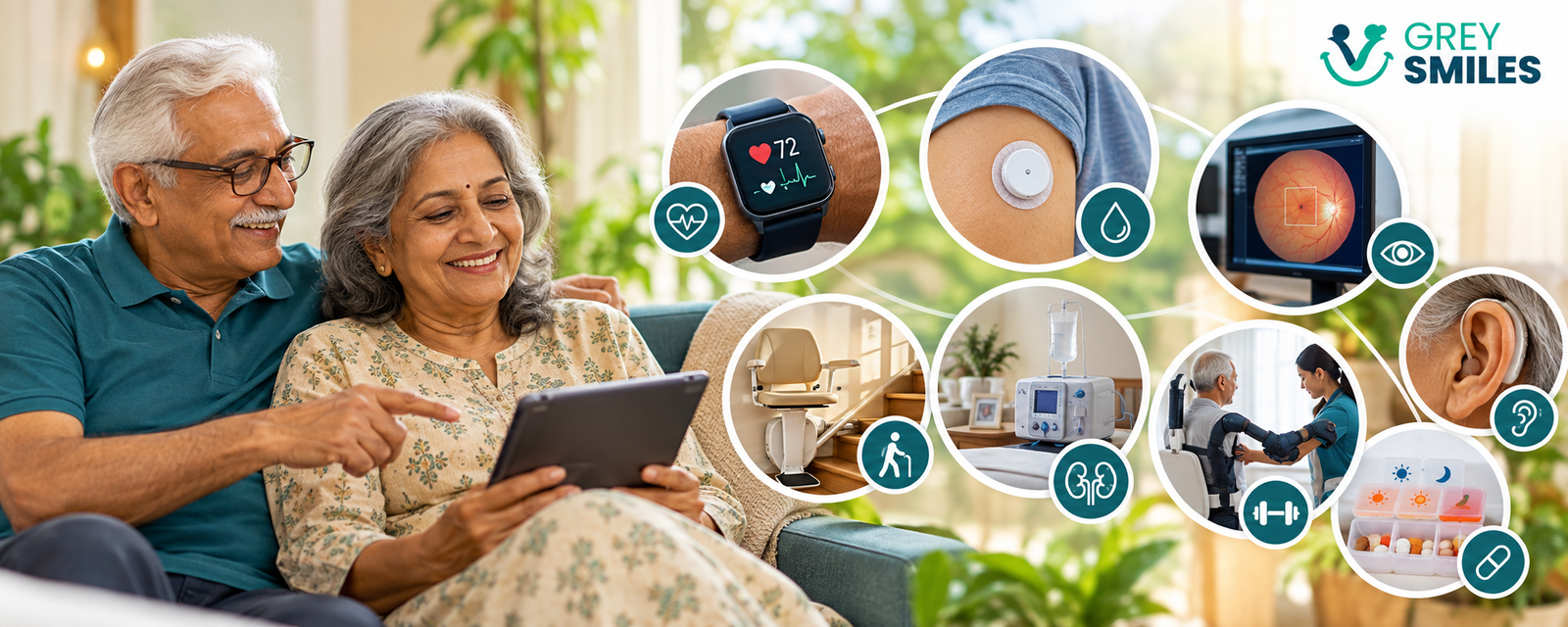
What if one of the biggest improvements in healthcare after 60 is not another medicine or another hospital, but something that allows you to avoid a hospital trip, monitor your health at home, climb the stairs safely or continue rehabilitation after a stroke?
Healthcare for older people is changing in ways that are easy to miss because many of the most useful innovations are not dramatic. They are small devices, home-based services, assistive technologies and diagnostic tools that remove a particular difficulty from everyday life.
For India’s older population, that matters. Families are increasingly spread across cities and countries, while longer life expectancy also means more years of managing chronic conditions, mobility limitations and rehabilitation. Healthcare technology is beginning to make it possible to monitor, diagnose, treat and rehabilitate people without every interaction requiring a trip to a hospital or clinic.
At a Glance
Healthcare innovation for older people is increasingly moving beyond treatment and towards monitoring, early detection, rehabilitation, accessibility and independence.
Some of the most interesting developments include continuous glucose monitoring, connected blood-pressure and cardiac monitoring, fall detection, portable diagnostics, AI-assisted retinal screening, home dialysis, robotic rehabilitation, hearing technology, medication-management systems and accessibility solutions such as stair lifts and home elevators.
The common thread is not the technology itself. It is what the technology can help an older person continue doing: living safely, managing a condition, moving around, staying connected and remaining independent for longer.
Healthcare Is Moving Closer to Home
For much of modern healthcare, the hospital has been the centre of the system. You develop a problem, travel to a doctor, undergo a test, receive treatment and return home. If the problem is chronic, the cycle repeats.
Technology is beginning to change that pattern. Monitoring can happen at home. Some diagnostics can be performed closer to the patient. Rehabilitation can continue outside the clinic. Certain treatments can be delivered at home. Family members can receive alerts or updates even when they live elsewhere.
The Government of India’s National Programme for Health Care of the Elderly also includes rehabilitation and home-based care within its approach to older people. Learn more about the NPHCE
The bigger change: healthcare is increasingly becoming something that can happen around an older person’s life, rather than requiring the person’s life to be organised around healthcare.
Smart Monitoring: Knowing When Something Has Changed
One of the most useful applications of technology for older people is surprisingly simple: keeping track of what is happening between doctor visits.
Wearables and connected monitoring devices can measure parameters such as heart rate, blood oxygen levels, activity, sleep and, depending on the device, ECG or heart rhythm. Digital blood-pressure monitors can make regular readings at home easier, while connected systems can allow readings to be shared with a caregiver or healthcare professional.
NITI Aayog’s work on senior care has identified wearables, blood-pressure and heart-rate monitors, continuous glucose monitoring devices, emergency alarm systems, fall detectors and medication reminders among technologies that can support older people.
The benefit is not that every older person needs a smartwatch or a connected medical device. It is that some conditions can be understood better when measurements are collected over time rather than captured in isolation.
For a family whose children live in another city, this can also create a useful layer of visibility. It does not replace a doctor or turn a wearable into a diagnostic tool, but it can help identify a change that deserves attention.
GreySmiles Take
Monitoring is valuable when it helps people act appropriately. A device should not create anxiety by turning every unusual reading into a medical emergency. Its role is to provide useful information that can be interpreted in the right clinical context.
Diabetes Monitoring Is Becoming Continuous
For someone living with diabetes, checking glucose can become one of the most repetitive parts of daily life. Traditional finger-prick testing provides individual readings, but it does not always show what happens between those readings.
Continuous glucose monitoring, or CGM, changes the picture by using a small sensor to measure glucose over time. Instead of looking only at individual numbers, the user and healthcare professional can see patterns around meals, sleep, activity and treatment.
This can be particularly relevant for older adults who experience fluctuating glucose levels or episodes of low blood sugar. CGM is increasingly being studied and used as part of more continuous diabetes management, although cost, access, usability and clinical suitability remain important considerations.
The important point is not that every person with diabetes should move to continuous monitoring. It is that diabetes management is moving from occasional measurement towards a much more detailed understanding of how glucose behaves through the day.
For anyone planning for healthcare costs in retirement, the technology also raises another question: what will increasingly sophisticated chronic-disease management cost over a long retirement? GreySmiles has explored the broader issue in planning for healthcare costs in retirement
Falls, Mobility and a Safer Home
A fall can be much more than a temporary accident for an older person. It can lead to a fracture, hospitalisation, fear of falling again and a gradual loss of confidence in living independently.
Fall-detection systems use movement sensors to identify patterns that may indicate a fall and can, in some cases, alert a family member or emergency response service. More sophisticated approaches are beginning to look beyond the fall itself, using movement and gait patterns to identify possible deterioration in balance.
This is particularly relevant to independent living. The objective should not be to surround an older person with technology and remove every element of risk. It should be to understand which risks genuinely matter and make the environment safer without unnecessarily reducing independence.
That is why the question of where and how an older person lives is becoming as important as the medical condition itself. The GreySmiles Independent Living Test looks at independence more broadly, including the home environment, practical support, access to healthcare and the support network around the individual.
When the Home Becomes Part of the Solution
Not every important healthcare innovation looks like medical equipment. For someone who has difficulty climbing stairs, a stair lift can restore access to part of the home. For someone using a wheelchair, a platform lift or home elevator can remove a major physical barrier. Grab rails, accessible bathrooms, better lighting, ramps and other modifications can similarly change what an older person can safely manage.
An older person may still be perfectly capable of preparing meals, managing money, taking medicines and looking after themselves. The problem may simply be that the physical environment has become harder to navigate. In that situation, adapting the home may preserve independence more effectively than increasing the amount of care provided.
Think of it this way: if the only thing stopping someone from using the upper floor is the staircase, the solution may not be more caregiving. It may be a safer way to use the staircase.
This is also why home adaptation deserves to be part of the conversation when families think about care at home for an ageing parent
Home Dialysis: When Treatment Moves Out of the Hospital
Dialysis can dominate the life of someone with advanced kidney disease. Travelling to a dialysis centre several times a week can involve transport, waiting, physical exhaustion and considerable dependence on family members.
Home peritoneal dialysis provides an alternative for selected patients. Depending on the clinical situation, treatment can be performed at home through established peritoneal dialysis approaches, including automated systems. An Indian Journal of Nephrology review describes home peritoneal dialysis as an important part of renal replacement therapy in India and discusses its evolution and future potential.
Home dialysis is not appropriate for everyone. Patient selection, training, infection prevention, supplies, monitoring and ongoing nephrology supervision remain essential. For an appropriate patient, however, moving treatment into the home can fundamentally change the rhythm of everyday life.
Portable Diagnostics: Bringing the Test to the Patient
For older people with mobility limitations, the journey to healthcare can sometimes be harder than the healthcare itself.
Portable diagnostic technology is beginning to address that problem. Compact systems can perform selected tests outside conventional laboratories or bring diagnostic capability closer to the patient’s home or community.
This is particularly relevant in India, where distance and access can still determine whether someone receives a diagnostic test promptly.
The idea is not to replace a full laboratory or specialist centre. Rather, it is to make certain types of screening and measurement possible closer to where people live. The result could be a healthcare system in which the patient does not always have to travel to the technology. In some situations, the technology can travel to the patient.
AI-Assisted Eye Screening Can Take Diagnostics to Smaller Communities
Diabetic retinopathy is a good example of how portable imaging and artificial intelligence can work together.
Retinal imaging traditionally requires access to appropriate equipment and trained professionals. Portable fundus cameras can capture images in community settings, while software can help identify images that may need specialist review.
A study conducted in rural India demonstrated the feasibility of combining portable fundus photography with offline AI-assisted screening for diabetic retinopathy. The researchers screened people in village eye camps and identified cases requiring referral.
The significance is not that AI can replace an ophthalmologist. It cannot. The more useful point is that technology can help extend the first stage of screening to places where specialist access may be limited.
Hearing Technology Can Help Preserve Participation
Hearing loss is often treated as something that comes with age and therefore something that simply has to be accepted. That can be a mistake.
Difficulty hearing conversations can affect family interactions, social participation, communication with doctors and confidence in everyday situations. Modern digital hearing aids can adapt to different sound environments, amplify speech and connect with phones and other devices.
Indian research has also highlighted the potential quality-of-life benefits. A recent Indian Health Technology Assessment examined hearing-aid use among older adults with hearing impairment and found important quality-of-life and economic implications.
The broader lesson is simple: assistive technology can protect participation. Sometimes the objective is not to treat a disease but to help someone continue taking part in family and social life.
Rehabilitation Is Becoming More Technology-Assisted
Stroke recovery, neurological rehabilitation and recovery after major injuries often depend on repetition. The challenge is that intensive rehabilitation can be difficult to sustain when every session requires travelling to a clinic.
Robotic rehabilitation is opening up another possibility. Devices can assist repetitive, controlled movements while measuring the patient’s effort and progress. India is also developing its own rehabilitation technology. IIT Delhi’s CARE-DAT programme
describes an upper-limb robotic rehabilitation system developed for stroke, spinal injury and other neurological deficits. The system is designed to be portable and usable in clinical as well as home-based rehabilitation settings.
Research from India has also explored the feasibility of home-based robotic hand rehabilitation after stroke. Early studies are encouraging, although larger controlled studies are still needed before drawing broad conclusions about effectiveness.
The important development is not that robots are replacing physiotherapists. It is that technology can potentially allow more supervised repetition between therapy sessions.
Home Physiotherapy and Tele-Rehabilitation
Sometimes the innovation is not a machine at all. It is changing where rehabilitation happens.
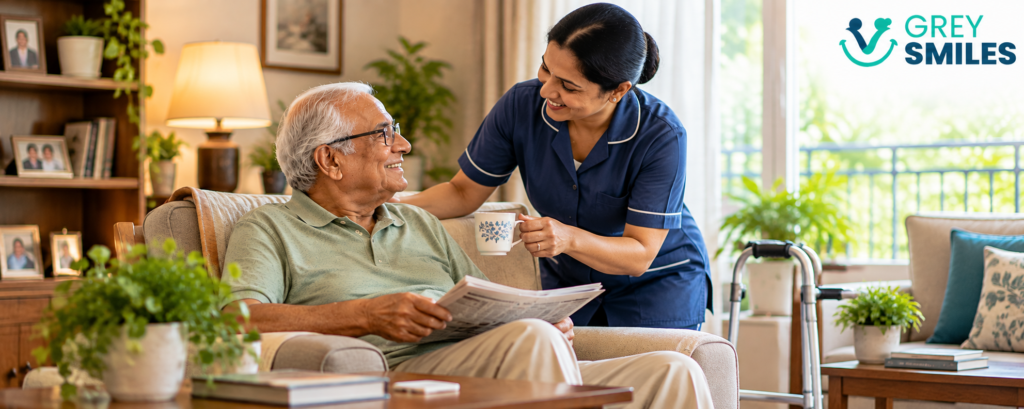
Home physiotherapy can be particularly useful after a stroke, joint replacement, fracture, prolonged hospitalisation or a period of significant weakness. For someone who finds travel difficult, receiving therapy at home can remove a major practical barrier.
Tele-rehabilitation can add another layer by allowing therapists to review exercises, follow progress and provide guidance remotely where clinically appropriate. The goal is not to turn every home into a mini-hospital. It is to make recovery less dependent on how easily a person can repeatedly travel to one.
Respiratory Care Can Also Move Home
For older people living with chronic respiratory conditions, equipment such as oxygen concentrators, nebulisers, CPAP and BiPAP systems can support treatment and symptom management at home when appropriately prescribed.
This can be especially important when mobility is limited or when repeated travel to a hospital is physically exhausting.
However, respiratory equipment illustrates an important principle that applies to almost every technology in this article: the device is only one part of the solution. Correct diagnosis, prescription, fitting, training and follow-up remain essential.
Medication Technology Can Reduce One Everyday Burden
For families caring for older parents, one question can become almost routine: “Did you take your medicines?”
Medication-management systems range from simple organisers and reminders to connected dispensers that can schedule doses, provide alerts and, in some cases, notify a caregiver when a scheduled dose has been missed.
These tools are particularly relevant where several medicines have to be taken at different times. They are not a substitute for medication review by a doctor or pharmacist, but they can reduce the everyday memory burden involved in following an established treatment plan.
Home-Based Palliative and Supportive Care
One of the most meaningful healthcare innovations may not involve advanced technology at all. It may simply be the ability to provide appropriate clinical, nursing and palliative support in the home.
For an older person living with advanced cancer, neurological disease or another life-limiting condition, repeated hospital visits can become exhausting. Home-based palliative care can bring symptom management, nursing support, medical input and caregiver guidance closer to the patient.
In this context, innovation is not about doing more medicine. Sometimes it is about delivering the right care in a place where the person is more comfortable.
The Common Thread: Independence
At first glance, continuous glucose monitors, stair lifts, hearing aids, retinal cameras, home dialysis and robotic rehabilitation appear to have very little in common.
They are solving different medical and practical problems. Yet there is a common thread. Each can remove a barrier that might otherwise make an older person’s life more dependent on hospitals, caregivers or family members.
The traditional question
How do we treat this condition?
The broader question
How do we help this person continue living well despite the condition?
That second question is becoming increasingly important as India ages. The challenge is not simply to add years to life. It is to help people retain as much capability, dignity and independence as possible during those years.
GreySmiles Take
The most useful healthcare innovation for an older person may not be the most sophisticated technology. It may be the one that removes a very specific obstacle from everyday life.
A stair lift may mean someone can continue using their home. A hearing aid may make family conversations easier. A glucose sensor may reveal patterns that occasional testing misses. Home rehabilitation may make recovery more practical. Portable screening may bring a diagnostic test closer to someone who would otherwise struggle to travel.
The real measure of these innovations is therefore not simply whether they are technologically impressive. It is whether they help an older person do more, worry less, depend less and remain independent for longer.
What Could Come Next?
The next generation of senior healthcare in India is likely to sit at the intersection of medicine, technology and everyday living.
We could see more monitoring that happens passively, more diagnostics that move closer to the patient, more rehabilitation that continues at home and more technology designed around the needs of people living with multiple chronic conditions.
The most interesting developments may also be those that connect different pieces of the puzzle. A sensor detects a change. A healthcare professional reviews it. A diagnostic test is arranged at home. Treatment is adjusted. Rehabilitation follows. The person’s progress is then monitored again.
That is a very different model from simply waiting for the next hospital visit.
For families planning for later life, this also changes the conversation. Healthcare planning is not only about health insurance or setting aside money for hospitalisation. It can also involve thinking about where care will happen, how the home can be adapted, what assistive technology may be useful and how independence can be protected.
If you are thinking about this for yourself or an ageing parent, the GreySmiles Independent Living Test is one place to start. It looks beyond medical conditions and asks a broader question: how prepared are you to remain independent as circumstances change?
One Final Thought
The future of healthcare for older Indians will not be defined only by new medicines, hospitals or medical procedures.
It will also be defined by thousands of smaller innovations that make everyday life easier: seeing clearly, hearing conversations, moving safely, taking medicines on time, monitoring a chronic condition, recovering after an illness and receiving appropriate care without always having to leave home.
That is where healthcare technology becomes something more than healthcare.
It becomes a tool for independence.
Sources & References
Government of India: National Programme for Health Care of the Elderly
NITI Aayog: Senior Care Reforms in India
Indian Journal of Nephrology: Home Peritoneal Dialysis in India
Portable fundus camera and AI-assisted diabetic retinopathy screening in rural India
IIT Delhi CARE-DAT: Robotic Rehabilitation Technology
PubMed: Hearing-aid use and quality of life in older adults in India
Health information disclaimer: This article is intended for general awareness and education. It does not constitute medical advice, diagnosis or treatment. The suitability of any device, treatment or home-based service depends on the individual’s medical condition and should be assessed with an appropriately qualified healthcare professional.

Start the conversation
Share a helpful experience, ask a thoughtful question, or add another perspective for fellow readers.