
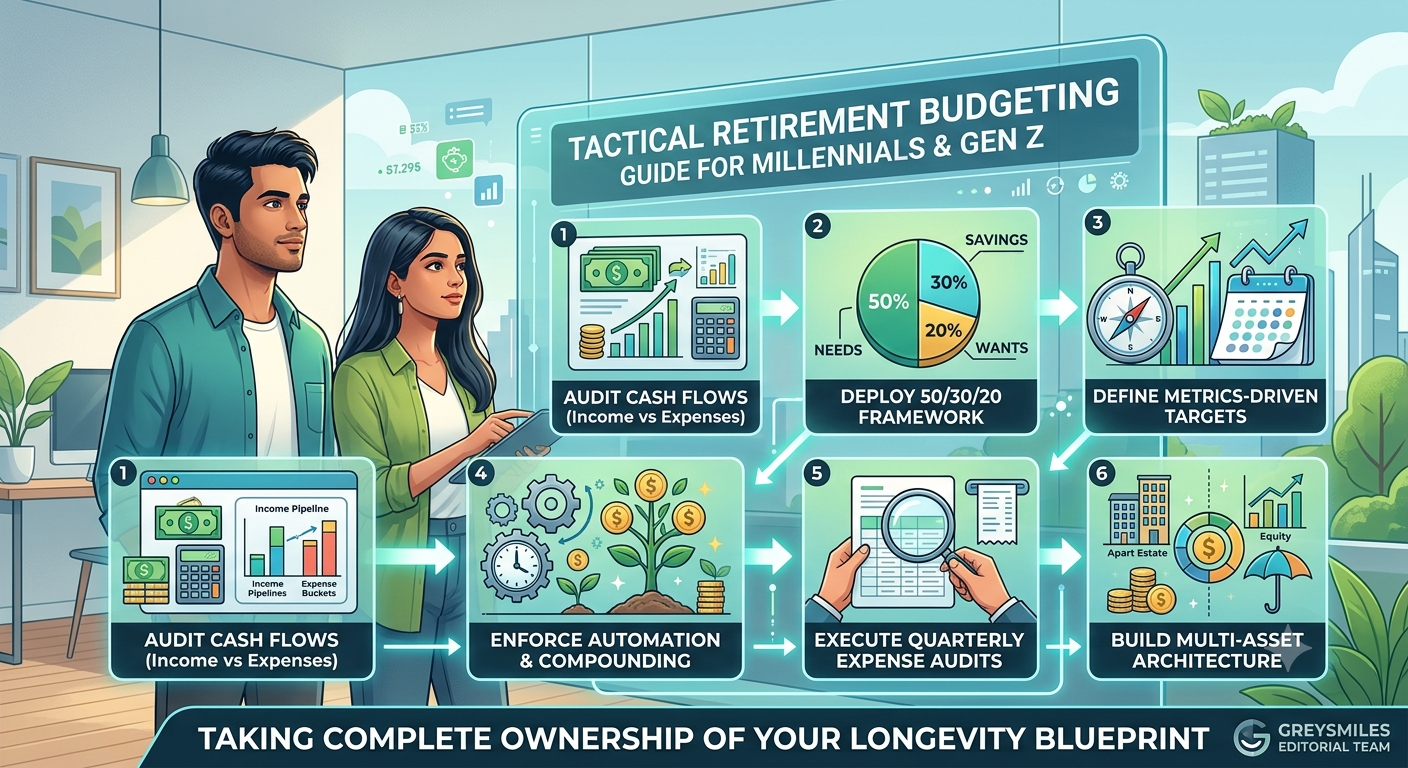
Retirement can feel like a problem for another decade when you are in your 20s or 30s. There are usually more immediate priorities: rent or a home loan, family responsibilities, travel, education, insurance and simply enjoying the income you have worked hard to earn.
But retirement savings do not have to compete with every other financial goal. The more useful approach is to give retirement a defined place in your monthly budget and then increase that contribution as your income and circumstances change.
At a Glance
- Start with your actual monthly cash flow. A retirement budget has to work alongside today’s essential expenses and other goals.
- Start early rather than waiting for the “right” income. Time gives retirement savings a longer period to grow.
- Do not sacrifice essential financial protection. Emergency savings and appropriate insurance belong in the wider plan.
- Increase retirement savings as income rises. Your first contribution does not have to remain your contribution forever.
- Review the budget when life changes. Marriage, children, a home loan, a career change or a major increase in income can all change the balance.
What Does a Retirement Savings Budget Actually Mean?
A retirement savings budget is simply a decision about how much of today’s income should be set aside for a future period when employment income may no longer be available.
It is different from deciding which mutual fund, NPS option or other investment to use. First decide how much you can reasonably commit. The investment decision comes after that.
This distinction matters because a good investment cannot compensate for a contribution that is too small or too inconsistent for the retirement goal.
Start With Where Your Money Goes Today
Before deciding how much to save, look at your actual spending rather than an idealised budget.
Separate your monthly outgo into broad groups: essential living costs, debt repayments, discretionary spending, protection and savings. You do not need a perfectly detailed expense tracker to begin. The objective is to understand what portion of your income is already committed and where there is realistic room for another long-term goal.
| Part of the Budget | Question to Ask |
|---|---|
| Essential expenses | What must be paid every month? |
| Debt | Which repayments are unavoidable, and when will they end? |
| Protection | Do I have appropriate emergency savings and insurance? |
| Other goals | What else am I saving for, and when will that money be needed? |
| Retirement | What amount can I commit consistently for the long term? |
Don’t Treat Retirement as Whatever Is Left Over
One of the easiest ways for retirement saving to disappear from a monthly budget is to leave it until the end of the month.
If retirement is an important long-term goal, give it a defined place in the budget. That does not mean putting an unrealistic amount aside. A smaller contribution that can be maintained and increased over time is more useful than a large contribution that repeatedly has to be stopped.
Automating the contribution can also remove some of the monthly decision-making. The amount can then be reviewed when income or circumstances change.
How Much Should You Save for Retirement?
There is no universal percentage of income that is correct for everyone in their 20s or 30s.
Someone starting their career with low expenses and no debt may have more room to save than someone supporting parents, repaying an education loan or saving for a first home. The right starting amount is therefore one that fits the person’s actual financial capacity while still giving retirement meaningful priority.
Rather than searching for a magic percentage, consider whether your contribution can increase as your income increases. A young earner may begin with a modest amount and progressively direct part of future salary increases, bonuses or improved cash flow towards retirement.
Your First Salary and Your Later Salary Are Not the Same
A retirement contribution that feels difficult at the beginning of a career may become much easier several years later.
Income often changes with experience, promotions and career moves. At the same time, some expenses may disappear. A loan may eventually be repaid, children may move into a different stage of education, or another financial goal may be completed.
The important habit is to revisit the retirement contribution when your financial capacity improves rather than automatically allowing every increase in income to become additional lifestyle spending.
Retirement Is One Goal Among Several
For someone in their 20s or 30s, retirement may be decades away while other goals are much closer.
Buying a home, building an emergency reserve, paying down expensive debt, funding education or supporting family can all be legitimate priorities. The answer is not to ignore those goals in the name of retirement.
Instead, separate the goals by time horizon. Money needed soon should not be treated in exactly the same way as money intended for a retirement that may be decades away.
This also helps prevent an investment intended for retirement from being repeatedly withdrawn for shorter-term expenses.
Emergency Savings Comes Before Long-Term Optimisation
A retirement portfolio can look impressive on paper but still be vulnerable if an unexpected expense forces you to liquidate long-term investments.
An emergency reserve provides a separate pool for events such as a temporary loss of income or an unexpected major expense. The appropriate size depends on employment stability, household responsibilities, insurance and other circumstances.
The objective is not to build every financial reserve simultaneously to some perfect number. It is to avoid making retirement investments carry every financial burden.
What About Insurance?
Retirement savings are only one part of financial security. Appropriate health insurance and life insurance, where relevant to the household, can protect the financial plan from risks that savings alone may not be designed to absorb.
This becomes particularly important when other family members depend on your income. A retirement plan that ignores today’s financial protection can be exposed even if the investment strategy itself is sound.
Use the Retirement Goal to Guide the Investment Decision
Once you have decided how much can be saved, the next question is where the money should go.
Someone with several decades before retirement may have a different investment approach from someone approaching retirement. Risk capacity, time horizon and the rest of the household portfolio all matter.
This is where retirement asset allocation in your 30s becomes relevant. The purpose is not to prescribe one fixed allocation for everyone, but to understand how different assets can play different roles in a long-term retirement portfolio.
Mutual funds may be one implementation option within that portfolio. They should follow the retirement plan rather than become the plan themselves.
Don’t Ignore the Retirement Number
A monthly savings amount becomes much more meaningful when you have some idea of what you are trying to build.
Your eventual retirement requirement will depend on factors such as when you retire, what you expect to spend, inflation, other dependable income and how long the money may need to last.
GreySmiles’ retirement corpus guide explains how these factors fit together. You can also use the Retirement Corpus Calculator for an indicative starting estimate.
GREYSMILES CALCULATOR
Retirement Corpus Calculator
If you are still decades away from retirement, the exact number will naturally change over time. An indicative corpus estimate can nevertheless help you understand the scale of the goal and whether your current savings habit needs attention.
Estimate Your Retirement Corpus
Illustrative planning tool. Results depend on the assumptions entered and should not be treated as a guaranteed retirement requirement.
What If You Cannot Save Much Right Now?
A tight budget does not mean retirement planning has to wait completely.
Start by understanding why the available amount is small. High-cost debt, an unstable income, a major family responsibility or a temporary career stage may explain the constraint. The solution may therefore be to improve cash flow rather than simply cutting another expense.
Even when the initial contribution is modest, creating the habit can make future increases easier. The important thing is to avoid turning “I cannot save enough today” into “I will start sometime later.”
What If You Are Already in Your 30s and Have Not Started?
There is no benefit in spending more time worrying about the years that have already passed.
Instead, establish your current financial position, estimate the retirement requirement and work backwards to understand what needs to change. The answer may involve a higher savings rate, a later retirement date, different spending expectations, additional income or a combination of these.
The important thing is to make the gap visible while there is still time to respond to it.
A Retirement Budget Should Change With Life
Your 20s and 30s are not one long financial stage. The budget that works for a single 25-year-old may be completely inappropriate after marriage, children, a home purchase or a career change.
Review the retirement contribution when a major financial event occurs. A change does not necessarily mean increasing savings immediately; sometimes it means temporarily adjusting the contribution while another priority is handled.
What matters is returning to the retirement goal rather than allowing a temporary change to become a permanent abandonment of it.
A Simple Way to Think About Your Monthly Budget
Instead of trying to optimise every rupee from the beginning, divide your financial capacity into three broad questions:
- What must I fund today? Essential living costs, debt and immediate responsibilities.
- What must I protect against? Emergencies, health risks and financial responsibilities to dependants.
- What am I building for later? Retirement and other long-term goals.
The balance between these categories will change over time. A useful retirement budget is therefore not a rigid formula. It is a framework that gets adjusted as your financial life changes.
The Most Valuable Part May Be the Habit
Starting retirement savings early is valuable not because a particular investment return can be guaranteed, but because time gives your savings a longer period to remain invested and potentially compound.
Just as importantly, starting early gives you more opportunities to increase the contribution gradually. A retirement plan does not have to be perfect at 25. It needs to become progressively more meaningful as your income, responsibilities and understanding of the goal develop.
GreySmiles Take
A retirement savings budget should not make today’s life impossible in the name of a future number. It should make retirement a deliberate financial priority alongside the other goals that matter now. Start with what is sustainable, increase it when your financial capacity improves, and keep checking whether the retirement goal still makes sense as life changes.
Frequently Asked Questions
How much should I save for retirement in my 20s?
There is no single percentage that applies to everyone. Your income, expenses, debt, family responsibilities, other financial goals and retirement expectations all matter. The key is to establish a sustainable contribution early and increase it as your financial capacity improves.
Is it too late to start retirement savings in my 30s?
No. Starting earlier generally gives your savings more time, but someone starting in their 30s can still build a meaningful retirement plan. The appropriate response is to assess the current gap and adjust savings, investment strategy, retirement timing or spending expectations as necessary.
Should I prioritise buying a house over retirement savings?
There is no universal answer. A home, retirement, emergency savings and other goals all have different purposes and time horizons. The important thing is to recognise the trade-off rather than allowing one major goal to automatically consume all available savings.
Should I increase retirement savings every time my salary increases?
It can be a useful habit to direct at least part of an income increase towards long-term savings. The amount will depend on other financial priorities and changes in household expenses.
Should I invest my retirement savings in mutual funds?
Mutual funds can be one part of a retirement portfolio, but the choice should follow your time horizon, risk tolerance and wider asset allocation. The first decision is how much you need to save and what role the investment needs to play.
Further Reading
- Retirement Planning Guide: How to Plan for Retirement in India
- Retirement Asset Allocation in Your 30s
- Retirement Corpus Calculation: How Much Do You Need?
Sources & References
- Securities and Exchange Board of India (SEBI) — investor education material on financial planning and investment decisions.
- Pension Fund Regulatory and Development Authority (PFRDA) — retirement and pension education resources.
Disclaimer: This article is for educational purposes only and does not constitute financial or investment advice. Retirement requirements and appropriate savings levels vary according to individual circumstances, goals, income, expenses, risk tolerance and other assets.




Start the conversation
Share a helpful experience, ask a thoughtful question, or add another perspective for fellow readers.