
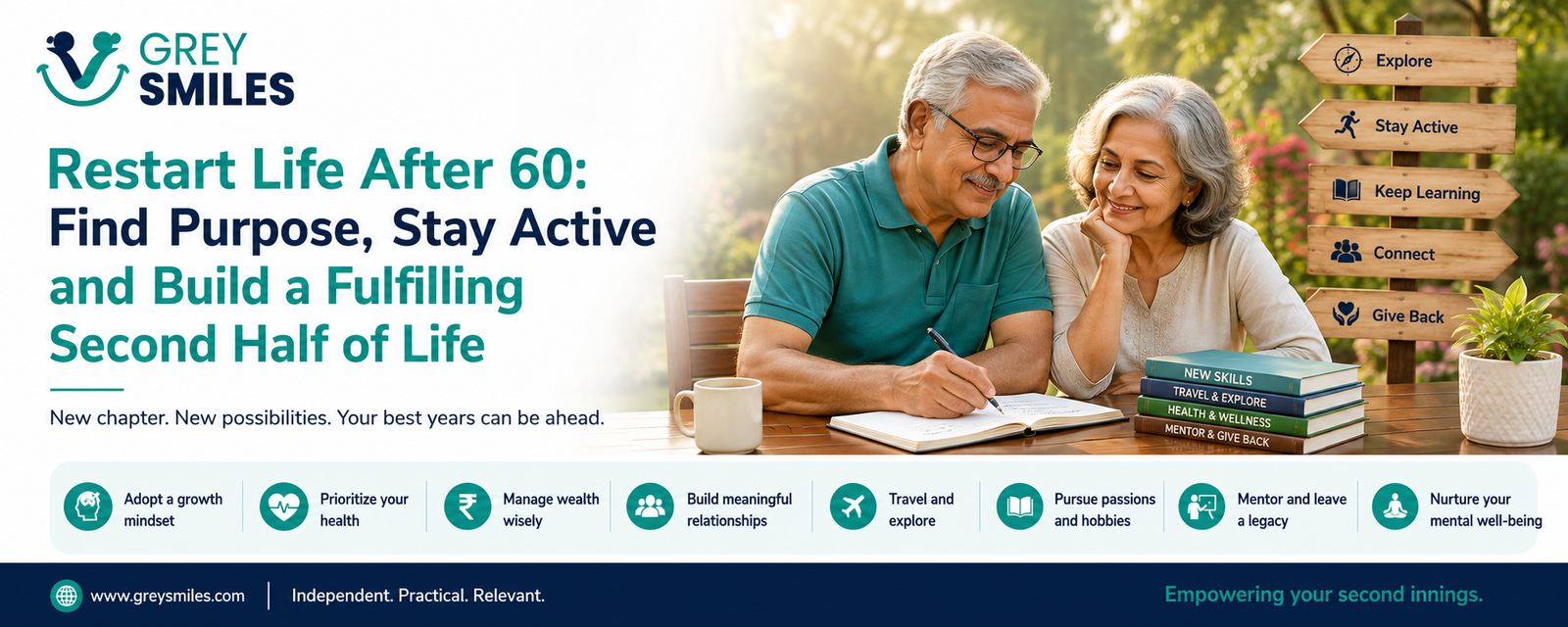
Turning 60 can feel like a milestone, but it does not have to feel like a full stop. After decades of work, family responsibilities and financial commitments, you may suddenly have something that was in short supply for years: time to decide what comes next.
Restarting your life after 60 does not necessarily mean starting another career, travelling the world or launching a business. It can mean working differently, learning something new, becoming more active, reconnecting with people, contributing to others, pursuing an old interest or simply creating a life that feels more like your own.
At a Glance
- Life after 60 does not have to be a withdrawal from an active life.
- Your experience, skills and relationships remain valuable even when your formal career ends.
- A second chapter can involve work, learning, travel, creativity, family, contribution, spirituality or simply a different pace of life.
- Financial security matters because it gives you the freedom to make choices without putting your retirement at unnecessary risk.
- You do not need a grand reinvention. Small experiments can help you discover what actually works for you.
- The right question is not only “What should I do after 60?” but also “What kind of life feels meaningful to me now?”
Restarting Your Life After 60: What Does It Really Mean?
For many people, retirement has traditionally followed a familiar script: work until around 60, retire, spend more time with family, travel occasionally and slow down.
There is nothing wrong with that life if it is what you want.
But it is not the only option.
Longer lives, better connectivity, easier access to learning and new forms of flexible work mean that life after 60 can contain several distinct chapters. You may have another 20 or 30 years in which to learn, contribute, travel, work, create, mentor, build friendships or simply enjoy a different rhythm.
Retirement from a job does not have to mean retirement from curiosity.
1. Start With a Growth Mindset
The first step in restarting your life after 60 is not financial. It is psychological.
It is easy to absorb the idea that certain things are “for younger people”: learning technology, starting something new, making new friends, travelling independently or changing direction.
That mindset can quietly become a limitation.
A growth mindset means remaining open to learning and accepting that your next chapter may look different from the life you imagined when you were younger.
- Learn something new: Take a course, learn a language, explore digital tools, study history, music, photography or anything that genuinely interests you.
- Stay open to change: Your interests at 60 do not have to be the same as they were at 40.
- Use your experience: You are not starting from zero. Your judgement, relationships, skills and life experience can become the foundation for something new.
GreySmiles Thumb Rule: Don’t ask, “Am I too old to start this?” Ask, “Is this worth trying at this stage of my life?”
2. Your Experience Does Not Retire With Your Job
One of the biggest mistakes people make when they retire is assuming that their professional identity disappears along with their job title.
It doesn’t have to.
A retired finance professional might teach financial literacy. An HR professional might mentor younger managers. A teacher might tutor or create educational content. A business owner might advise smaller enterprises. Someone who spent years managing a household might turn a lifelong skill into a small venture or simply share it with others.
Your experience can be useful even when you no longer want the responsibilities of a full-time career.
You can change the way you work without giving up the value of what you know.
3. Take Care of Your Physical Well-Being
A meaningful second chapter is easier to enjoy when your physical health supports the life you want to live.
This does not mean trying to become 30 again. It means maintaining the strength, mobility, balance and energy needed for everyday independence.
- Stay physically active: Choose activities appropriate to your health and fitness level, such as walking, swimming, yoga, strength training or other forms of exercise recommended for you.
- Protect mobility and balance: These become increasingly important for maintaining independence as you age.
- Eat for long-term health: Focus on a balanced diet and discuss specific nutritional requirements with an appropriate professional where necessary.
- Keep preventive healthcare on the agenda: Regular check-ups and appropriate screening can help you identify issues before they interfere with the life you want to lead.
Your health plan should be part of your broader retirement plan, not something you start thinking about only when a problem appears.
4. Revisit the Things You Never Had Time For
Working life can leave a surprisingly long list of unfinished ambitions.
Perhaps you wanted to learn an instrument. Write. Paint. Travel alone. Study philosophy. Take photographs. Read more. Garden. Cook. Volunteer. Learn about history. Reconnect with an old friend.
Retirement can give you something you rarely had during your working years: unclaimed time.
You don’t have to turn every interest into a business or a measurable achievement. Some things are worth doing simply because they make your days richer.
5. Find Purpose — But Don’t Turn Retirement Into Another Performance
Purpose is often discussed as though everyone needs to find a grand mission after retirement.
They don’t.
Purpose can come from many places:
- helping your family;
- mentoring someone younger;
- volunteering;
- learning;
- creating something;
- working part-time;
- spending meaningful time with friends;
- travel and exploration;
- spiritual or reflective practices; or
- simply being present for the people and activities that matter to you.
There is also nothing wrong with wanting to earn some money after retirement. Consulting, teaching, freelancing, mentoring or a small business can provide both income and purpose.
But income is not the only measure of a worthwhile second chapter.
A GreySmiles Thought: Your second chapter does not have to be bigger than your first. It just needs to be more suited to the person you are now.
6. Build New Connections — and Rekindle Old Ones
Work provides an automatic social network. When work disappears, some people discover that their social world becomes much smaller than they expected.
That is why relationships deserve deliberate attention after retirement.
- Reconnect with old friends: A simple message can reopen a relationship that faded because of work and family commitments.
- Join communities: Walking groups, hobby clubs, professional associations, cultural organisations and volunteering groups can create opportunities to meet people.
- Stay connected across generations: Mentoring younger people can be valuable for both sides.
- Make room for new friendships: You are never too old to meet someone new.
For more on maintaining social connections later in life, explore GreySmiles’ guide to making new friends in your 50s and beyond.
7. Travel, Explore and Change Your Environment
Travel after 60 does not have to mean an exhausting bucket-list marathon.
It can mean travelling differently.
- Take slower trips rather than trying to see everything in one week.
- Explore places within India that you have never visited.
- Spend more time in one location rather than constantly moving.
- Consider travelling with friends or family when that makes the experience more enjoyable.
- Try short solo trips if independent travel appeals to you.
And travel does not necessarily mean leaving home. Exploring your own city, discovering local history, trying new restaurants, visiting museums or spending a day somewhere unfamiliar can also make life feel larger.
8. Think About Where You Want to Live
Retirement can be an opportunity to reconsider your living environment.
You may want to remain in the home where you raised your family. You may prefer a smaller, easier-to-maintain home. You may want to move closer to your children while maintaining your independence. Or you may want to explore an active senior-living community.
The important point is to make the decision around your future lifestyle, not simply around the house you have always owned.
If senior living is part of your thinking, see our guide on what to look for in a senior living community.
9. Protect the Financial Foundation of Your Second Chapter
Financial security gives you freedom. But restarting your life after 60 should not mean putting your retirement security at unnecessary risk.
Before spending heavily on a new business, speculative investment, property venture or major lifestyle change, understand what money you can comfortably afford to use.
Keep your essential retirement resources separate from money allocated to experiments or discretionary projects.
- Know your regular retirement expenses.
- Keep an adequate emergency and healthcare reserve.
- Understand where your retirement income will come from.
- Keep investments aligned with your risk capacity and time horizon.
- Don’t use essential retirement money to fund an experiment simply because it sounds exciting.
If you want to assess whether the financial side of retirement is on track, start with the GreySmiles Retirement Readiness Test.
GreySmiles Advice: Reinvention should add to your life, not put the retirement you worked for at unnecessary risk. Experiment with the part of your money and time you can afford to experiment with.
10. Start Small Rather Than Reinventing Everything at Once
You do not need a five-year master plan for your life after 60.
Try something.
- Teach one class.
- Take one consulting assignment.
- Join one course.
- Volunteer for a few hours.
- Take a short trip.
- Attend a local group.
- Start writing.
- Try a hobby you have postponed.
Then ask yourself:
Did this give me energy, meaning or enjoyment?
If yes, do more of it. If not, try something else.
Start small enough that you can change your mind.
11. Your Family May Need Time to Adjust
Sometimes the person who needs to adjust to your new life is not you — it is your family.
Children may be surprised if you suddenly want to work again. They may worry if you want to travel independently. They may not understand why you want to spend time on something that seems unconventional.
These concerns often come from affection, but your retirement is also your life.
Talk openly about what you want to do, why it matters to you and how you are managing the financial and practical implications.
Independence does not mean ignoring the people who love you. It means remaining part of your own decisions.
12. Reinvention Can Also Be Quiet
Not every restart needs to be visible.
You may decide that your second chapter is about spending more time with your spouse, reading, walking, gardening, prayer, music, friendships or simply slowing down.
You may discover that you don’t want another business, another job or another achievement.
That is perfectly valid.
After decades of deadlines and responsibilities, choosing your own pace can itself be a meaningful form of reinvention.
Three Questions Before You Decide What Comes Next
Before filling your calendar with new activities, ask yourself three simple questions:
| Question | What to think about |
|---|---|
| What do I enjoy? | What makes you curious, energised or genuinely happy? |
| What can I contribute? | Which skills, experience or values could still help someone else? |
| What does my life need now? | Income, structure, companionship, rest, challenge, service, learning — or some combination? |
Your answers may point towards a very different second chapter from the one you imagined at 40.
FAQs
Can you really restart your life after 60?
Yes. Restarting does not have to mean changing everything. It can mean taking up a new interest, working differently, travelling, making new friends, volunteering, mentoring, learning or simply creating a more intentional daily routine.
What should I do after retirement if I don’t know what I want?
Start with small experiments rather than trying to find one perfect answer. Try an activity, course, trip, volunteer role or part-time project and see whether it gives you energy and meaning. Your next direction can emerge gradually.
Is it a good idea to work after 60?
It can be, if you want to and your health and circumstances support it. Consulting, teaching, mentoring, freelancing or part-time work can provide income, structure, social connection and purpose. But working after 60 is a choice, not an obligation.
How can I stay active after 60?
Build activity into your normal routine through walking, exercise appropriate to your abilities, hobbies, travel, social activities, volunteering or learning. The objective is sustainable activity that supports your health and independence rather than an unrealistic fitness target.
How do I make new friends after 60?
Look for environments where you will meet people repeatedly: hobby groups, walking groups, volunteering organisations, professional networks, cultural activities and community programmes. Repeated interaction is often more useful than simply attending a one-off event.
Should I start a business after retirement?
You can, but treat it as an experiment rather than automatically putting your retirement corpus at risk. Set a clear budget for the venture and keep essential retirement money separate from capital you can afford to lose.
What if my family does not support my plans after retirement?
Talk to them about what you want to do and why. Concerns about health, money or safety may be reasonable and can often be addressed through planning. At the same time, retirement is also your stage of life and you should remain part of decisions about how you spend it.
Does restarting life after 60 have to involve work or income?
No. A meaningful second chapter may involve work, but it can just as easily centre on family, friendship, travel, creativity, learning, volunteering, spirituality, health or simply having more control over your time.
The GreySmiles Take
GreySmiles Thumb Rule
Don’t try to recreate the life you had before retirement. Build the life that makes sense for who you are now.
Retirement can close one professional chapter without closing the book.
Your experience remains. Your relationships remain. Your curiosity remains. And, importantly, you still have choices.
Maybe your next chapter involves work. Maybe it involves travel. Maybe it involves family, contribution, learning or a quieter life.
It does not have to impress anyone else.
It just has to feel meaningful to you.
If you are still working through the financial side of retirement, explore the 6 Stages of Retirement Planning or use the GreySmiles Retirement Readiness Test to identify the areas that deserve attention.
Important: This article is for educational and informational purposes. It is not personalised financial, investment, medical, legal or mental-health advice. Individual circumstances vary, and professional advice should be sought where appropriate.




Start the conversation
Share a helpful experience, ask a thoughtful question, or add another perspective for fellow readers.