
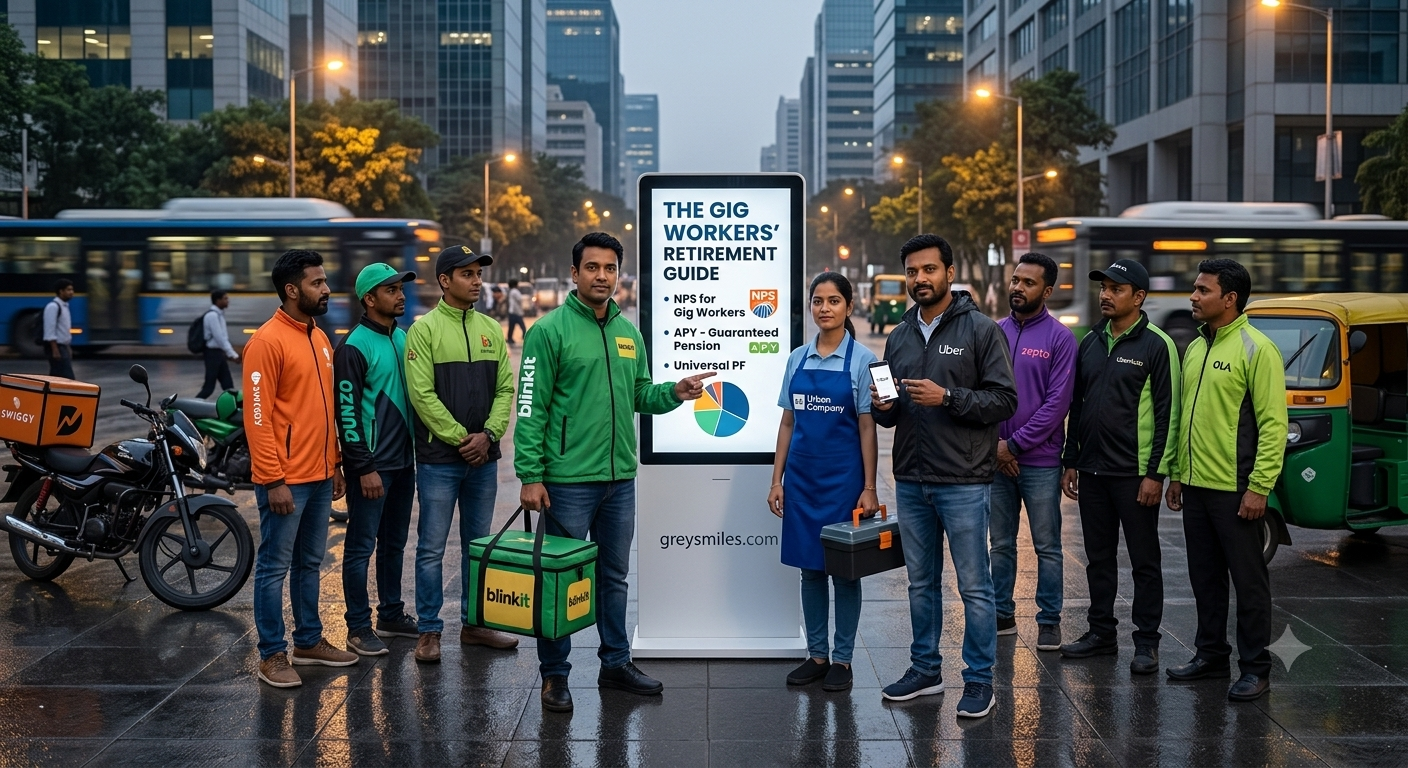
Empowering India’s independent workforce: Delivery partners, drivers, and home-service professionals exploring modern, flexible retirement pathways.
Retirement planning is relatively straightforward when your employer contributes to a formal retirement system and you know that a pension or provident fund will form part of your future income.
For gig workers, freelancers and many self-employed professionals, the situation can be very different.
Income may change from month to month. There may be no employer contribution, no fixed retirement age and no automatic retirement benefit waiting at the end of a career. A person may earn well for several years and still reach their 50s without having built a dedicated retirement corpus.
That does not mean retirement planning is impossible. It means the responsibility for creating the system sits more directly with the individual.
At a Glance
- Irregular income does not make retirement planning optional. It makes flexibility more important.
- Separate retirement money from operating money. Your business or gig income should not be your only retirement plan.
- Use good-income months to build reserves. Saving only what is left at the end of each month may not work with variable earnings.
- NPS can be one option. Eligible individuals can use the All Citizen Model as part of long-term retirement savings.
- Do not depend on a single product. Retirement security may need a combination of savings, investments, insurance and future income sources.
- Start with the retirement income you will need. The investment products come after the goal is understood.
Why Retirement Planning Is Different for Gig Workers
A salaried employee may have several retirement-related advantages built into employment: employer contributions, provident fund benefits, paid leave, group insurance and a relatively predictable monthly income.
A gig worker may have to create many of these protections independently.
That creates three separate challenges.
Income is unpredictable
A freelancer may have a strong month followed by a weak one. A driver, delivery worker or platform worker may experience changes in earnings because of demand, health, location or platform conditions.
There may be no automatic retirement contribution
If nobody is deducting money from your income and putting it aside for retirement, the contribution has to be created deliberately.
Working longer is not the same as being financially prepared
Self-employed people often assume that they can continue earning for as long as they need to. That may be possible, but health, market conditions, family responsibilities or simply a desire to stop working can change that assumption.
A retirement plan should therefore create choices rather than depend on the ability to work indefinitely.
Start With Income, Not Investment Products
The first step is to understand what your income actually looks like.
If your earnings vary, looking only at your best month can give you a misleading picture of your financial capacity.
A better approach is to review at least the last 12 months and identify:
- average monthly income;
- lowest-income months;
- regular household expenses;
- business or work-related expenses;
- tax obligations;
- existing savings and investments; and
- debt repayments.
This gives you a more realistic base from which to decide how much can be committed to long-term retirement savings.
Create a Retirement Contribution System
For someone with variable income, a fixed monthly SIP or contribution can sometimes be difficult to maintain.
That does not mean the saving habit should disappear.
Instead, you can design a contribution system around the way your income arrives.
For example, you could establish a minimum retirement contribution that is manageable even during weaker months and add additional contributions during stronger periods.
Another approach is to set aside a defined percentage of income whenever a payment is received.
The exact percentage is less important than creating a system in which retirement saving happens before discretionary spending absorbs the available cash.
Build an Emergency Reserve Separately
One of the biggest dangers for a gig worker is having to withdraw retirement investments whenever income temporarily falls.
That can repeatedly interrupt long-term wealth creation.
An emergency reserve serves a different purpose from retirement savings. It is there for periods when income falls, unexpected expenses arise or work becomes temporarily unavailable.
The appropriate size depends on the stability of your income, household obligations and access to other resources. Someone whose income can disappear for several months may need a larger accessible reserve than someone with relatively predictable freelance contracts.
The important point is simple: do not make your retirement corpus your emergency fund.
NPS Can Be One Retirement Option
The National Pension System can be relevant for eligible gig workers and self-employed individuals because the All Citizen Model is available beyond traditional salaried employment.
PFRDA currently states that eligible Indian citizens, NRIs and OCIs can join the All Citizen Model between ages 18 and 85, subject to the applicable conditions. NPS provides investment choices across different asset classes and is designed for long-term retirement savings.
For a gig worker, this can provide a useful structure for putting retirement money aside independently of an employer.
But NPS should not automatically become the entire retirement portfolio. Its investment choices, liquidity, withdrawal provisions, taxation and eventual income structure all need to be considered alongside your wider financial situation.
Current NPS rules and features should be checked with PFRDA before making a decision.
What About EPF?
If you have previously worked in formal employment, you may already have an EPF balance.
Leaving salaried employment does not mean that the accumulated retirement money should suddenly be treated as available spending money.
For someone moving into freelance or gig work, an existing EPF balance can remain an important part of the retirement picture, subject to the applicable rules.
The bigger question is what you do about retirement contributions after the employer contribution stops.
Mutual Funds Can Play a Role Too
Mutual funds may be useful for long-term wealth creation, depending on the investor’s goals, time horizon and risk capacity.
For a younger gig worker with a long period before retirement, appropriately selected equity-oriented investments may have a role in the growth portion of a retirement portfolio.
As retirement approaches, the portfolio may need to evolve as the importance of liquidity and income increases.
The important distinction is that a mutual fund is not itself a retirement plan. It is an investment vehicle that can be used within one.
Do Not Forget Insurance
A retirement plan can be seriously damaged by an event that has nothing to do with investment returns.
For a gig worker, the loss of earning ability because of illness or an accident can be particularly significant because there may be no employer-provided safety net.
Health insurance and appropriate protection against major financial risks should therefore be considered alongside retirement investing.
The purpose is not to buy every available insurance product. It is to prevent one major event from forcing you to liquidate long-term retirement investments.
Use Good Years Differently From Weak Years
Variable income requires a different relationship with savings.
When income is unusually strong, it can be tempting to increase lifestyle spending permanently. That can make the next weak period much harder to manage.
A better approach may be to treat unusually strong income as an opportunity to strengthen the financial base.
Extra income can be directed towards:
- building or restoring the emergency reserve;
- catching up on retirement contributions;
- reducing expensive debt;
- paying taxes and other known future obligations; or
- making additional long-term investments.
This creates greater resilience without requiring every month to look the same.
What If You Are Already in Your 40s or 50s?
Starting late does not mean retirement planning is pointless.
It does mean that the trade-offs become more visible.
If the existing corpus is small and retirement is approaching, there are usually only a few broad levers available: save more, retire later, reduce expected spending, increase dependable retirement income or reconsider the combination of these.
Trying to solve a large retirement shortfall simply by taking substantially more investment risk can make the situation worse.
The first priority is to understand the size of the gap.
See How to Calculate Your Retirement Corpus in India for a deeper look at the factors that determine the retirement corpus you may need.
Do You Need a Fixed Retirement Age?
Not necessarily.
One advantage of self-employment or gig work can be the ability to reduce working hours rather than stopping work completely.
Someone might move from full-time work to fewer assignments, consulting, teaching, freelancing or another flexible income source.
This can reduce the amount that has to be withdrawn from the retirement corpus in the early years.
But part-time work should be treated as a potential source of flexibility, not as guaranteed retirement income.
Your retirement plan should still work if your ability or willingness to work changes.
The Retirement Income Problem Comes Later
Building a corpus is only the first half of the problem.
Once you retire, the money has to support actual spending.
That means deciding how much to withdraw, which investments to sell, how much liquidity to keep and how to balance current income against the possibility of living for many more years.
A gig worker who has spent decades accumulating wealth without a retirement-income strategy can face a new set of decisions immediately after stopping work.
It is worth thinking about the transition before retirement rather than waiting until the first month without active income.
For that stage, see How to Withdraw From Your Retirement Corpus.
A Simple Retirement System for Gig Workers
The exact products will vary, but the financial system can be kept relatively simple.
- Separate work income from household spending.
- Set aside taxes and unavoidable obligations.
- Maintain an emergency reserve.
- Make a regular minimum retirement contribution.
- Use strong-income periods to make additional contributions.
- Invest according to a long-term asset allocation rather than chasing recent returns.
- Review the retirement corpus periodically.
- Plan how accumulated wealth will eventually produce income.
This system matters more than finding a single “best” pension product.
Common Mistakes Gig Workers Should Avoid
Using the business as the retirement plan
A successful business or freelance career may generate wealth, but its future value is uncertain. Retirement assets should not depend entirely on being able to sell the business or continue working.
Saving only when income is high
Strong months are useful for additional contributions, but a minimum saving habit should continue during ordinary periods wherever possible.
Using retirement investments as a cash buffer
Without an emergency reserve, long-term investments can become the first source of money whenever income falls.
Taking excessive investment risk to compensate for late saving
A large retirement gap cannot safely be solved simply by assuming higher returns.
Ignoring health insurance
A major medical expense can destroy years of retirement saving if there is no adequate protection.
Assuming you will work forever
Continued work can be valuable, but it should be a choice rather than the only reason the retirement plan works.
What a Gig Worker’s Retirement Plan Should Ultimately Provide
The goal is not necessarily to recreate the retirement structure of a salaried employee.
The goal is to build enough financial independence that your future does not depend on having a good month on a platform, finding the next client or continuing to work because you have no alternative.
That may require a combination of retirement savings, investments, insurance, emergency reserves and eventually dependable retirement income.
The earlier you start separating these functions, the more flexibility you have later.
The Bottom Line
Gig work gives people flexibility in how they earn, but that flexibility can come with a less predictable path to retirement.
There is no employer automatically creating the retirement system for you. You have to create it yourself.
That does not require a complicated collection of financial products. It requires a repeatable system: protect against income shocks, save consistently, invest for the long term, review the retirement gap and gradually prepare for the point when investment income needs to replace active earnings.
The most valuable thing a gig worker can build is not simply a large investment account. It is the financial freedom to stop working when continuing to work is no longer the only option.
Sources & References
- PFRDA – NPS for All Citizen Model
- EPFO – Employees’ Provident Fund Organisation
- SEBI Investor – Retirement Planning
Disclaimer: This article is for educational and informational purposes only and should not be treated as personalised financial or investment advice. Investment values can rise or fall, and retirement outcomes depend on individual circumstances, savings, investment performance, inflation, taxation, healthcare costs and longevity. Scheme rules, tax provisions and product features can change. Verify current information with the relevant official authority before making financial decisions.




Start the conversation
Share a helpful experience, ask a thoughtful question, or add another perspective for fellow readers.