
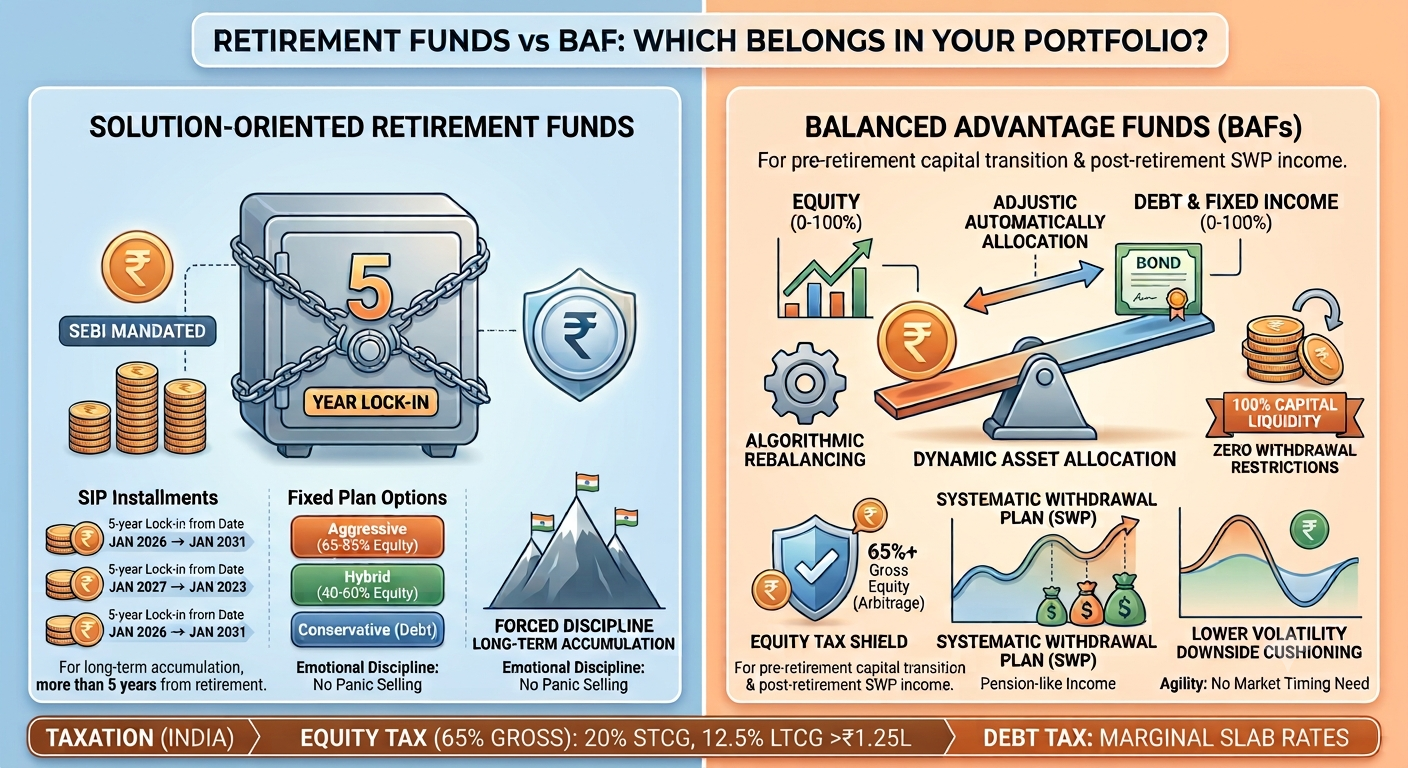
Quick Take: Retirement Funds vs BAF
If you are more than 5 years away from retirement and struggle with staying invested during severe market downturns, a Solution-Oriented Retirement Fund provides built-in discipline through its mandatory 5-year lock-in.
However, if you are within 5 years of retiring or plan to start a Systematic Withdrawal Plan (SWP) soon, a Balanced Advantage Fund (BAF) is superior. BAFs offer full capital liquidity, dynamically hedge downside risk by trimming equity at market highs, and retain equity taxation under Section 112A of the Income Tax Act.
Retirement Funds vs BAF: Which Belongs in Your Portfolio?
When investors hit their 40s and 50s, evaluating retirement funds vs BAF (Balanced Advantage Funds) becomes a critical decision for protecting accumulated wealth. Mutual fund houses frequently present these two distinct choices: solution-oriented schemes with mandatory lock-in periods and dynamic asset allocation schemes designed for market agility.
While both aim to secure your money for life after work, they run on completely different operational rules, tax setups, and liquidity terms. Picking the wrong one can trap your capital right when you need it most. Here is how they stack up against each other in real-world Indian market conditions.
Comparison Breakdown: Retirement Funds vs BAF
| Feature | Solution-Oriented Retirement Funds | Balanced Advantage Funds (BAFs) |
|---|---|---|
| SEBI Classification | Solution-Oriented Scheme | Dynamic Asset Allocation / Hybrid Scheme |
| Liquidity & Lock-In | Mandatory 5-year lock-in (or until age 60, whichever comes first) | 100% Liquid (standard exit load applies only for 1–12 months) |
| Asset Allocation Strategy | Static or target-based depending on the variant chosen (Aggressive, Hybrid, Conservative) | Dynamic shifting (0%–100% equity exposure) driven by valuation models |
| Portfolio Rebalancing | Rigid within selected scheme parameters | Automated, algorithmic rebalancing between equity, derivatives, and debt |
| Tax Efficiency | Debt variants get taxed at marginal slab rates; equity variants get equity LTCG rates | Most retain equity tax status (12.5% LTCG above ₹1.25 Lakh) via derivative arbitrage |
| Best Used For | Long-term wealth accumulation with enforced emotional discipline | Pre-retirement capital transition and immediate post-retirement SWP income |
1. Solution-Oriented Retirement Funds: The Behavioral Lock-In
Under regulations established in the Securities and Exchange Board of India (SEBI) Master Circular for Mutual Funds, retirement funds fall into a dedicated solution category. Their primary job is helping investors accumulate a dedicated retirement pot without jumping ship during market corrections.
How Solution-Oriented Funds Work
- Statutory Lock-In Period: Every rupee you invest—whether through lump sums or monthly SIPs—is locked for 5 years or until you turn 60, whichever happens earlier. During this period, you cannot execute redemptions, switches, or Systematic Transfer Plans (STPs).
- Fixed Plan Options: AMCs generally offer three flavors: Aggressive (65%–85% equity), Hybrid (40%–60% equity), and Conservative (debt-heavy).
- Post-Lock-In SWPs: Once the lock-in expires, you can set up a Systematic Withdrawal Plan to receive regular monthly income, simulating a monthly pension.
Where They Excel
The lock-in acts as a forced behavioral check. When broader markets drop 15–20%, retail investors routinely stop their SIPs or panic-sell at market bottoms. The lock-in forces you to stay invested through the recovery phase. It also keeps this money distinct from short-term financial demands, like buying a car or upgrading a house.
The Downsides
Inflexibility is the trade-off. If your selected retirement fund underperforms its benchmark over a 3-year stretch, you cannot move your money to a better-managed scheme until the 5-year window closes. Furthermore, these funds don’t automatically reduce equity exposure when markets become overpriced unless you manually switch variants after the lock-in period.
2. Balanced Advantage Funds: How BAFs Handle Market Volatility
Balanced Advantage Funds belong to the dynamic hybrid category. Rather than sticking to a fixed equity-to-debt ratio, BAFs shift capital between stocks and fixed income based on proprietary valuation models (tracking parameters like P/E, P/B, or trend indicators).
How BAF Schemes Work
- Automatic Downside Cushioning: When equity markets rally and valuations stretch, the fund manager automatically trims net equity exposure and moves capital into debt or arbitrage. When markets crash, the fund buys equities at discounted valuations.
- Arbitrage Tax Shielding: To ensure investors benefit from lower equity tax rates, BAFs use equity derivatives (arbitrage) to maintain gross equity exposure above 65%, even if net unhedged equity falls much lower.
- Zero Withdrawal Restrictions: Capital remains accessible. Aside from a small exit load during the first 12 months, you can redeem or restructure your portfolio whenever your financial goals change.
Where They Excel
BAFs take market timing out of human hands. By cutting net equity during market highs, they deliver smoother risk-adjusted returns with much smaller drawdowns during market drops. This stability makes BAFs an excellent foundation if you plan to start a Systematic Withdrawal Plan within the next 1 to 3 years.
For guidance on setting up cash flows during retirement, read our guide on generating steady monthly income after retirement.
The Downsides
Because BAFs actively reduce equity exposure during bull runs to manage risk, they often trail pure equity funds in sustained market rallies. Additionally, because the fund is completely liquid, investors who lack discipline might be tempted to withdraw money prematurely for non-essential expenses.
Taxation Realities: Avoid Unpleasant Surprises
When deciding between retirement funds vs BAF, how your gains are taxed depends heavily on the fund’s internal asset allocation, as mandated by the Association of Mutual Funds in India (AMFI) guidelines:
- Equity Classification (≥ 65% Gross Equity Exposure): Most BAFs and aggressive retirement fund variants fall here.
- Short-Term Capital Gains (STCG): Units held for 12 months or less are taxed at 20%.
- Long-Term Capital Gains (LTCG): Units held for over 12 months are exempt up to ₹1.25 Lakh per financial year. Gains above this threshold are taxed at 12.5% without indexation benefits.
- Non-Equity / Debt Classification (< 65% Gross Equity): Conservative retirement fund variants fall under this rule. All gains are added directly to your taxable income and taxed at your applicable **Income Tax Slab Rate**.
Decision Framework: Retirement Funds vs BAF Selection
Before allocating fresh capital, evaluate where you stand in your retirement timeline:
Choose a Solution-Oriented Retirement Fund if:
- You are in your 30s or early 40s with more than 7–10 years left before retirement.
- You tend to make impulsive portfolio decisions during market crashes.
- You want a strictly segregated account earmarked solely for your long-term nest egg.
Choose a Balanced Advantage Fund if:
- You are within 3 to 5 years of retiring and need portfolio stability without locking up your money.
- You plan to set up an SWP to cover regular living expenses in the near future.
- You want an automated system that trims equity during market bubbles and buys during market sell-offs.
The Smart Hybrid Strategy
You don’t necessarily have to pick just one. Many successful financial plans combine both categories as investors progress through their careers:
During your prime earning years (ages 30 to 45), run SIPs in an Equity-Oriented Retirement Solution Fund to build locked-in core wealth. As you approach retirement (ages 50 to 58), start directing new surpluses into Balanced Advantage Funds. This gradually lowers overall portfolio volatility while keeping your money liquid and accessible for your upcoming retirement cash flows.
To calculate how much total capital you will need before starting an SWP, check out our step-by-step breakdown on calculating your actual retirement corpus requirements in India.
Frequently Asked Questions (FAQs)
1. Can I break or prematurely redeem my Retirement Solution Fund before the 5-year lock-in?
No. SEBI mandates a strict lock-in period of 5 years or until you reach retirement age (whichever is earlier). Unlike standard equity mutual funds, you cannot pay an exit load to withdraw early, nor can you execute Systematic Transfer Plans (STPs) out of the fund during this period.
2. How does a monthly SIP work with a 5-year lock-in fund?
In a Solution-Oriented Retirement Fund, each individual SIP installment is treated as an independent transaction with its own 5-year lock-in period. For example, the SIP installment made in January 2026 will unlock in January 2031, while the February 2026 installment will unlock in February 2031.
3. Are Balanced Advantage Funds safe for a retiree’s lump sum investment?
While BAFs are not risk-free like fixed deposits, they carry significantly lower risk than pure equity funds. Because they automatically cut net equity exposure during market peaks, they offer smooth risk-adjusted returns and drawdown protection, making them one of the most reliable mutual fund choices for retirement SWPs.
4. How are withdrawals from Balanced Advantage Funds taxed under current Indian tax laws?
Most BAFs maintain gross equity exposure of 65% or higher using derivative arbitrage to qualify for equity tax rates. Gains held for more than 12 months qualify as LTCG and are taxed at 12.5% on annual gains exceeding ₹1.25 Lakh. Units held for 12 months or less are taxed as STCG at 20%.
5. Which fund category is better for running a Systematic Withdrawal Plan (SWP)?
Balanced Advantage Funds are generally superior for running SWPs. They offer 100% liquidity without lock-in constraints, and their valuation-driven hedging helps prevent “sequence-of-returns risk” (the risk of selling equity units during a severe market crash to generate income).




Start the conversation
Share a helpful experience, ask a thoughtful question, or add another perspective for fellow readers.