
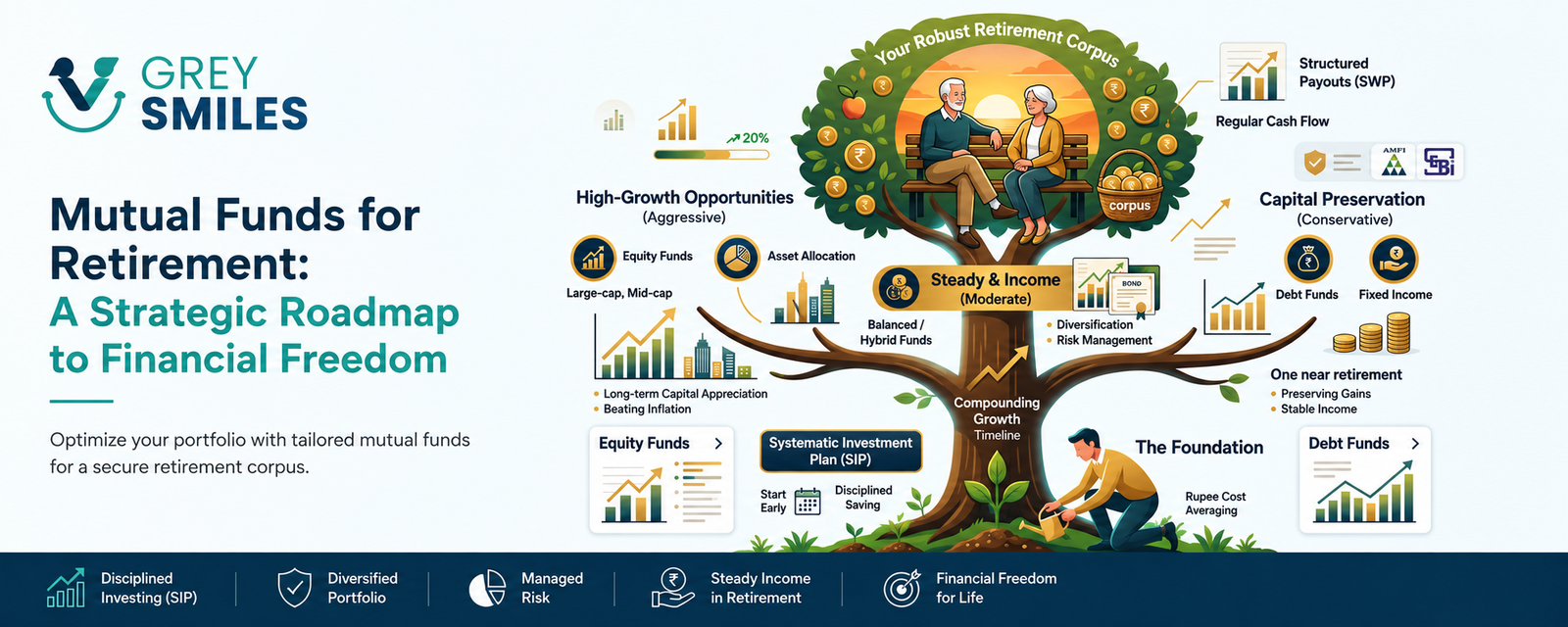
A retirement portfolio can use different mutual fund categories for growth, diversification, stability and income.
For some people, mutual funds may be primarily a way to build long-term wealth. For others, they may form one part of a wider portfolio that includes EPF, PPF, NPS, fixed-income investments, pensions and other assets. As retirement approaches, the priorities can change from accumulation to managing risk, liquidity and future withdrawals.
This guide explains how mutual funds fit into a retirement plan, which categories may serve different purposes, and what to consider as you move from building a retirement corpus to using it.
At a glance
- Mutual funds are a tool within a retirement plan, not a substitute for planning your overall retirement needs.
- There is no universally best mutual fund for retirement. Suitability depends on your goals, time horizon, risk capacity and existing assets.
- Equity, debt, hybrid and passive funds can play different roles in a portfolio.
- A Systematic Investment Plan (SIP) encourages regular investing but does not guarantee returns or remove market risk.
- As retirement approaches, liquidity, diversification and the ability to meet near-term expenses become increasingly important.
- A Systematic Withdrawal Plan (SWP) may support retirement cash flow, but it is not a guaranteed pension.
What Are Mutual Funds for Retirement?
A mutual fund pools money from investors and invests it according to the scheme’s stated objective. Depending on the scheme, its portfolio may contain equities, bonds, government securities, money-market instruments or a combination of assets.
For retirement planning, the important distinction is between the investment product and the financial goal. Your retirement needs should determine the role of the investment, not the other way around.
Mutual funds can sit alongside EPF, PPF, NPS, deposits, annuities, pensions and other investments. They do not necessarily need to replace these assets or become the sole source of retirement income.
The GreySmiles perspective
Do not choose a mutual fund merely because its name sounds appropriate for retirement. First establish what your retirement finances need: long-term growth, diversification, stability, liquidity or a combination of these. Then assess which investments may fulfil those roles.
Where Do Mutual Funds Fit in a Retirement Plan?
Retirement planning involves a series of connected decisions. Choosing mutual funds is only one part of that process.
| Retirement question | What it helps determine |
|---|---|
| How much will I spend? | Your expected retirement expenses. |
| How much money will I need? | Your target retirement corpus. |
| Where will my income come from? | Pensions, investments, annuities and planned withdrawals. |
| How should my assets be distributed? | Your overall asset allocation and exposure to different risks. |
| What role should mutual funds play? | The purpose of each mutual-fund holding within your portfolio. |
Begin with your expected retirement spending rather than selecting a mutual fund or deciding on a monthly SIP amount in isolation. Once you understand your likely expenses and other sources of income, you can estimate the corpus you may need.
Use the GreySmiles guide on retirement corpus calculation in India to explore the next step.
Which Mutual Fund Categories Can Play a Role?
No single mutual-fund category is automatically right for every retirement investor. Different categories have different investment objectives, risks and potential uses.
| Fund category | Possible role | What to consider |
|---|---|---|
| Equity funds | Long-term growth potential. | Market volatility, investment horizon and ability to withstand losses. |
| Debt funds | Fixed-income exposure and diversification. | Interest-rate, credit and liquidity risks. |
| Hybrid funds | A combination of equity and debt exposure. | Actual asset allocation, investment mandate and risk profile. |
| Index and passive funds | Exposure to a specified market index or investment segment. | Index tracked, tracking difference, diversification and costs. |
| Retirement-oriented schemes | A retirement-focused investment framework where offered by the scheme. | Investment mandate, lock-in, asset allocation and withdrawal conditions. |
A fund category alone cannot tell you whether an investment is suitable. Two schemes in the same broad category can have different portfolios, risks, costs and investment approaches.
Equity funds can fall sharply during market downturns. Debt funds can be affected by interest rates and credit events. Hybrid funds can also lose value. The objective is to understand these risks in the context of your complete financial situation.
How Should Mutual Funds Fit Your Retirement Timeline?
The role of your investments may change as you move through different stages of life. Your age is one consideration, but your financial circumstances, other assets, retirement date and capacity to withstand losses also matter.
| Stage | Main question | What deserves attention |
|---|---|---|
| Early accumulation | How can I build wealth over the long term? | Growth potential, diversification and investing discipline. |
| Mid-career | Am I on track for my retirement goal? | Corpus progress, savings rate and asset allocation. |
| Approaching retirement | How much market risk can I afford? | Near-term expenses, liquidity and exposure to market declines. |
| Retirement | How will my assets support my spending? | Cash flow, withdrawal levels, taxes and portfolio sustainability. |
The portfolio that makes sense when retirement is decades away may not be appropriate when you are about to stop earning a salary. Equally, moving all investments into one asset class simply because retirement has begun may not suit every household.
What matters is whether your overall asset allocation matches the financial demands you expect to face. Explore GreySmiles’ guide to retirement asset allocation for a deeper look at this decision.
How to Select Mutual Funds for Your Retirement Portfolio
Once your retirement goals, corpus requirement and broad investment approach are clear, the next task is to evaluate individual schemes. That requires more than comparing recent returns or selecting a fund with a retirement-related name.
For a practical, step-by-step approach to comparing fund categories, reviewing portfolios, understanding costs and checking important scheme features, read our companion guide: How to Select Mutual Funds for Your Retirement Planning.
As a starting point, make sure every investment has a clear purpose. Ask whether it provides the exposure you need, how much risk it adds, what it costs and how it fits alongside your other retirement assets.
SIP: A Method of Investing, Not a Retirement Strategy
A Systematic Investment Plan (SIP) allows you to invest a fixed amount into a mutual-fund scheme at regular intervals. It can make investing more disciplined by reducing the need to make a fresh investment decision every month.
However, a SIP is a method of investing, not a guarantee of retirement success. It does not guarantee returns, eliminate market risk or make an unsuitable fund appropriate. The risk and potential outcome still depend on the underlying investment.
The amount you invest should be considered alongside your retirement target, existing savings, investment horizon and other financial commitments. A monthly contribution is useful only when it forms part of a realistic plan.
What Changes When You Retire?
During your working years, the focus is generally on accumulating wealth. Once regular employment income stops, your investments need to work alongside your actual spending requirements and other sources of income.
You may need to consider:
- How much money you will need to withdraw for monthly and annual expenses.
- Which assets can meet near-term spending needs.
- How much of the portfolio can remain exposed to growth assets.
- What income will come from pensions, annuities, deposits or other sources.
- How taxes and transaction costs may affect withdrawals.
- What could happen if markets fall early in retirement.
A major concern is the possibility of having to sell investments after a market decline to meet living expenses. The combination of withdrawals and unfavourable market conditions can put pressure on the remaining portfolio. This is one reason to consider near-term cash needs, diversification and a withdrawal approach before retirement begins.
Can an SWP provide retirement income?
A Systematic Withdrawal Plan (SWP) allows you to redeem a specified amount from a mutual-fund investment at regular intervals, subject to the scheme’s terms. It can be one component of a retirement cash-flow strategy, but it is not a guaranteed pension.
Withdrawals reduce the units you hold, and the value of the remaining investment continues to fluctuate with the market. Whether a withdrawal level is sustainable depends on the size of your corpus, spending, other income, investment returns, taxes and the length of retirement.
Read the GreySmiles guide on how to withdraw from your retirement corpus for a more detailed discussion of withdrawal planning.
What About Taxation?
The tax treatment of mutual-fund investments depends on the type of scheme, the date of acquisition, the holding period and the tax provisions applicable to the investment. Different categories may receive different treatment, and tax rules can change.
Do not rely on an old article, social-media post or fund comparison as a permanent statement of tax law. Before investing or redeeming a substantial amount, verify the current rules through the Income Tax Department or consult a qualified tax professional.
Tax should be considered as part of the overall retirement plan rather than in isolation. A decision that appears attractive before tax may have a different outcome after applicable taxes and charges.
Common Mistakes When Using Mutual Funds for Retirement
- Choosing a fund before defining the goal: Start with your retirement needs and then decide how investments can help meet them.
- Chasing recent performance: Strong recent returns do not guarantee future performance or establish that a fund suits your retirement needs.
- Assuming more funds mean more diversification: Multiple schemes can hold similar securities and create complexity without adding meaningful diversification.
- Treating debt funds as risk-free: Debt-oriented mutual funds carry their own interest-rate, credit and liquidity risks.
- Taking more equity risk simply because retirement is far away: Time horizon matters, but so do financial capacity, other assets and your ability to tolerate losses.
- Ignoring the transition into retirement: Your portfolio may need to serve a different purpose once salary income stops.
- Assuming a SIP guarantees safety: Regular investing does not remove the risks of the underlying scheme.
- Ignoring costs and taxes: Both can affect the money ultimately available for retirement spending.
- Buying a product because it contains the word “retirement”: A label does not establish suitability for your circumstances.
A Practical Retirement Mutual-Fund Checklist
| Question | What you need to establish |
|---|---|
| What will retirement cost? | Expected essential, lifestyle, healthcare and irregular expenses. |
| What corpus might I need? | A target based on spending, other income and personal circumstances. |
| How long will the money remain invested? | Your time horizon and likely timing of withdrawals. |
| How much risk can I take? | Your financial capacity to withstand losses as well as your risk tolerance. |
| What does each fund contribute? | A clear role such as growth, diversification or a specific type of exposure. |
| Can I access the money when needed? | Liquidity, exit loads, lock-ins and scheme conditions. |
| How will I fund retirement spending? | A withdrawal approach that considers other income, taxes and market risk. |
Retirement Readiness Is Bigger Than Mutual Funds
A substantial mutual-fund portfolio does not automatically mean you are ready to retire. Your expected expenses may be too high, healthcare costs may be inadequately planned, dependable income may be insufficient or your investments may carry more risk than you can comfortably manage.
Someone with a smaller investment portfolio may be in a stronger position if they have lower expenses, a pension, other assets and a more manageable retirement-income requirement.
Retirement readiness therefore requires a view of the whole picture: spending, corpus, income, investments, healthcare and the risks you may face as you age. Mutual funds should be assessed within that broader context.
The GreySmiles Take
There is no magical mutual fund that can guarantee a comfortable retirement. What matters is having a retirement plan in which every investment has a reason for being there.
The right investment is not necessarily the one with the highest recent return, the lowest cost or the most popular name. It is an investment that performs a role you need, within a portfolio you understand and can live with through different market conditions.
That role can change over time. Someone building wealth in their 30s may be solving a very different problem from someone in their 50s preparing for the first retirement withdrawal.
The Bottom Line
Mutual funds can help build retirement wealth and may also form part of a retirement-income strategy. Their usefulness, however, depends on how they fit into your overall financial plan.
Start with the life you want to fund. Estimate what that life may cost. Work out the corpus and income you may need. Then determine what role mutual funds should play alongside your other assets.
Instead of asking only, “How much can my investments grow?”, consider the larger question: “Can my overall retirement resources support the life I want, for as long as I may need them?”
If you are ready to examine the next step, read our companion guide: How to Select Mutual Funds for Your Retirement Planning.
Sources and References
- SEBI Investor — investor education and securities-market resources.
- AMFI Investor Corner — mutual-fund investor education and resources.
- Income Tax Department — current tax information.
Disclaimer: This article is for general educational purposes and is not personalised investment, tax or financial advice. Mutual-fund investments are subject to market risks, and returns are not guaranteed. Scheme characteristics, costs, taxation and regulatory requirements can change. Read the latest scheme documents and verify current information from official sources before investing. Consider consulting a SEBI-registered Investment Adviser where appropriate.




Start the conversation
Share a helpful experience, ask a thoughtful question, or add another perspective for fellow readers.