
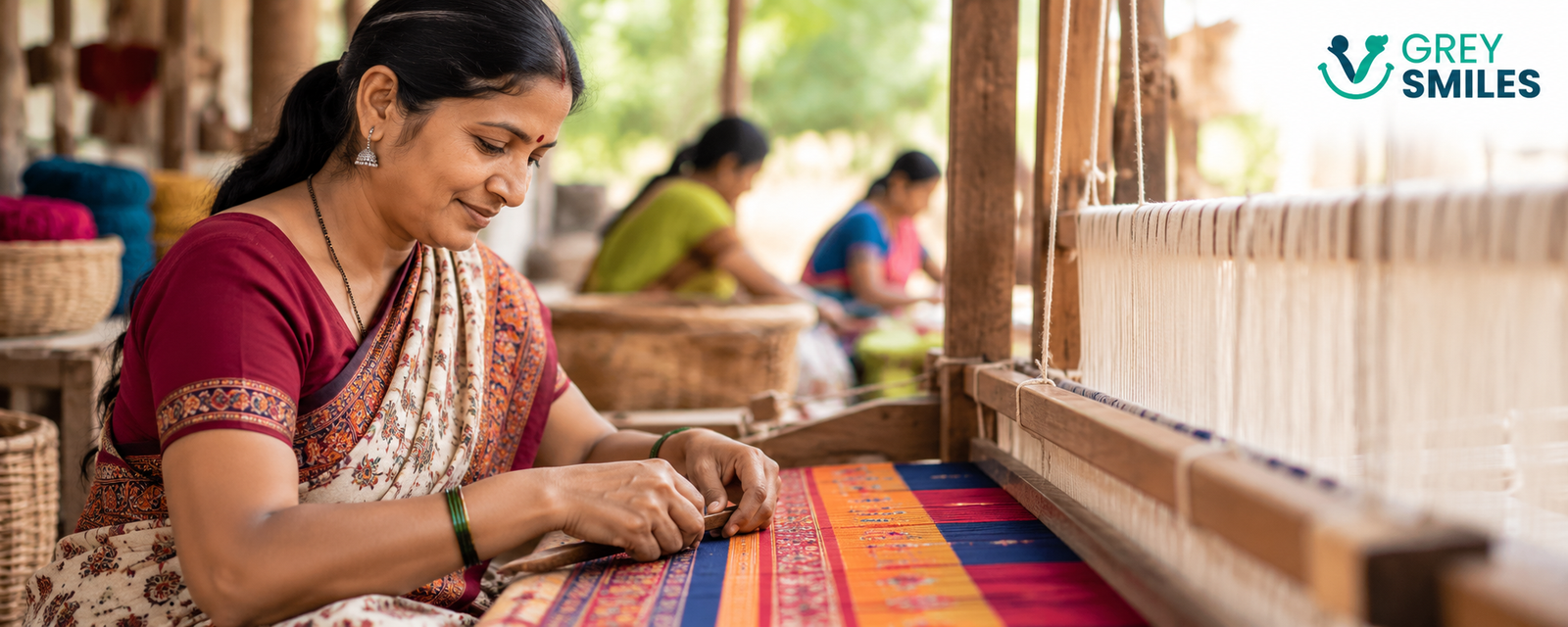
Traditional skills can create earning opportunities when artisans have access to fair prices and dependable markets.
Traditional Indian crafts carry generations of skill and knowledge, but the women who practise them do not always earn a dependable income from their work. Through my work with Weavehand, I have seen how access to markets and fair compensation can influence women’s financial independence. For me, this is about more than preserving traditional crafts. It is about creating opportunities for women to earn, make financial decisions and build livelihoods on their own terms.
At a Glance
Traditional crafts can offer women a route to earning, but possessing a skill does not automatically translate into financial independence. Fair pricing, access to customers, regular work and the ability to manage money all matter. Drawing on her experience as the founder of Weavehand, Ridhima Srivastava explores what it takes to turn traditional skills into more sustainable livelihoods, why buyers and businesses have a role to play, and how earning opportunities can support women at different stages of life.
The Conversation That Stayed With Me
When we look at a handmade product, we often notice its colours, patterns and craftsmanship. We admire the time and patience that go into weaving a textile, creating a traditional motif or making something by hand but how often do we think about the person who made it.
Does she receive a fair price for her work? Does she have access to regular orders? Does she know how to calculate the cost of her product? And does she see a future in the skill she has spent years learning?
These questions became increasingly important to me through my work with artisan communities.
During one of my visits to an artisan community, I encountered a moment that has stayed with me. The artisans spoke emotionally about their experiences. They described how people would visit their communities, take photographs and leave, without creating meaningful opportunities for work.
One sentiment was particularly difficult to forget: people come, take pictures and leave, but nobody gives us work.
That statement made me reflect on the difference between appreciating artisans and actually supporting them.
A photograph can document a tradition. An exhibition can introduce a craft to new audiences. A conversation can bring attention to a community. All these things have value, but none automatically guarantees an income for the person making the product.
For artisans, recognition becomes meaningful when it is accompanied by opportunities to work, fair payment and relationships that continue beyond a single visit.
The experience strengthened my belief that artisan communities need more than occasional attention. They need a system that recognises their skills and connects those skills with genuine economic opportunities.
When Traditional Skills Are Not Enough
Across India, traditional crafts are closely connected to local identities, family histories and cultural heritage. Many artisans learn their skills within their communities, passing knowledge from one generation to the next.
However, having a valuable skill does not automatically guarantee a sustainable income. An artisan may produce beautiful work but struggle to find buyers. She may spend hours creating a product without knowing how to price it appropriately. She may receive an order but have little clarity about delivery expectations, payment timelines or whether more work will follow.
I have become particularly concerned about traditional looms falling silent. When craftwork offers limited economic opportunities, younger generations may choose other forms of employment. This does not necessarily mean they no longer value their heritage. They may simply need work that offers a more viable future.
We cannot expect people to preserve traditions while ignoring the economic conditions in which those traditions survive.
Through Weavehand, I have worked with artisan communities across seven villages. My experience has reinforced the importance of strengthening the ecosystem around their skills rather than focusing only on the products they create.
This includes helping artisans understand pricing, providing practical training and developing professional practices such as following agreed deadlines and understanding buyer expectations.
Knowing how to calculate a product’s cost can help an artisan understand whether the price offered adequately accounts for materials, time and labour. Understanding production timelines can help establish clearer expectations between artisans and buyers.
The purpose is not to replace traditional knowledge with corporate processes. It is to connect existing expertise with the practical systems needed to make the work commercially viable.
Traditional Crafts and Women’s Financial Independence.
For women artisans, earning from traditional skills can create an important opportunity for greater financial independence. However, the journey is different for every woman, and progress must be understood in the context of her circumstances.
In my work with artisan communities, I have observed changes in how some artisans think about their work and its economic possibilities. I have also seen improvements in the earning levels of some artisans.
Some artisans who previously earned very little or had limited opportunities to work have reached earning levels of around ₹5,000–₹6,000, while a few have reached around ₹15,000. These are observations from my experience, not a claim that every artisan earns these amounts or that the same results are guaranteed across all communities.
What matters to me is the wider change that can accompany these experiences. When artisans begin to understand the value of their skills, learn how to calculate prices and engage with buyers more confidently, they can start exploring possibilities that may previously have seemed out of reach.
Financial independence, however, involves more than earning money. It also requires opportunities to understand income and expenses, participate in financial decisions and have a meaningful say in how one’s work is organised.
Revenue is not the same as profit. Money received from customers may need to cover materials, transport, packaging and other expenses before anything can be treated as earnings. Keeping a simple record of sales, expenses and payments can help women understand whether their work is financially worthwhile.
For a wider perspective on women’s financial choices later in life, read Women, Money and Independence After 50.
The goal is not to suggest that craftwork will solve every financial challenge. It is to make earning from a traditional skill a more realistic and worthwhile opportunity for women.
Why Regular Work Matters More Than Occasional Attention
One of the most important lessons I have taken from working with artisan communities is that attention and opportunity are not the same thing.
A visitor may admire a craft. A customer may appreciate a product. An organisation may want to document a traditional technique. But what happens after that interaction? Does the artisan receive an order? Is the price clear? Will the work be paid for on time? Is there a possibility of continuing the relationship?
The official Indian Handicrafts portal provides information about the wider handicrafts sector and related initiatives. This broader context reinforces the importance of looking beyond the finished product to the skills, market connections and livelihood opportunities that sustain craft communities.
For artisans, irregular work makes planning difficult. They need to consider the cost of materials, the time required to complete a product and their other responsibilities. When orders are uncertain, investing further time and effort in craft production can become difficult to justify.
Regular work does not mean promising unlimited orders regardless of demand. It means building realistic relationships with buyers, communicating clearly and working towards continuity wherever possible.
Businesses can contribute by understanding customer needs before commissioning products, planning orders carefully and recognising the labour involved in handmade production. They can agree on clear specifications, set realistic deadlines and make timely payments.
At the same time, fair pricing cannot be the artisan’s responsibility alone. Buyers must also be willing to pay prices that make the work economically viable.
This is the kind of change I want to see: not attention that disappears after a visit, but relationships that create meaningful work.
Preserving Tradition Without Limiting Its Future
The future of traditional crafts depends partly on whether younger generations see a reason to continue them.
UNESCO’s guidance on traditional craftsmanship highlights the importance of the skills and knowledge involved in making traditional crafts and passing them on. Preserving these traditions also requires attention to the people who carry that knowledge forward.
Creating opportunities may involve developing new product formats, exploring different customer groups, improving product presentation or connecting artisans with buyers beyond their immediate communities. But innovation must be approached thoughtfully. Adapting a craft to contemporary markets should not mean losing the knowledge, techniques and cultural identity that make it distinctive.
Artisans should be part of decisions about how their work is developed, represented and sold. Their knowledge is not simply a resource for businesses to use; it is an important part of the value being created.
Traditional skills and modern business practices can complement each other. An artisan should not have to choose between preserving a traditional skill and learning how to price it fairly. Both can contribute to a stronger livelihood.
When economic opportunity becomes more realistic, continuing a traditional craft can become a choice supported by livelihood prospects rather than an expectation placed on the next generation.
Could This Be a Second Act?
The opportunity to earn from an existing skill is relevant beyond artisan communities. Women at different stages of life may have the ability to create, teach, advise, produce or provide a service, yet face barriers that prevent them from earning sustainably.
A woman approaching retirement may want to supplement her income. Someone who has spent years managing family responsibilities may want to return to paid work or explore a small enterprise. A former professional may wish to offer consulting or training, while someone with a long-standing interest in crafts may consider whether there is a realistic market for her work.
Work after 50 can also be about identity, contribution and personal choice, not just income. Our article Women, Work and Purpose: Rethinking Retirement After 50 explores these questions in greater detail.
These possibilities deserve attention, but they also require realistic expectations. Starting a business can involve financial risk, learning new systems and finding customers in unfamiliar markets. It may not be suitable for everyone, and women should not feel obliged to monetise their interests simply because they have more time available.
Before investing money, it helps to ask a few basic questions:
- What can I offer that people genuinely need or want?
- Who is likely to pay for it, and how will I reach those customers?
- What will it cost to get started and deliver the product or service?
- How much time will the activity require?
- What could I realistically earn after expenses?
- Can I test demand on a small scale before committing more money?
Starting small can limit financial exposure and help establish whether customers are willing to pay a price that makes the activity worthwhile.
The aim is not to turn every hobby into a business. An activity that brings enjoyment can be valuable in its own right. When earning is the objective, however, it is important to distinguish between an enjoyable pursuit and a commercially viable opportunity.
For some women, supplementary income may make retirement finances more comfortable. For others, work may offer a sense of contribution or a way to use skills developed over many years. Some may prefer paid employment, while others may choose a small business, part-time work or no additional work at all.
The important thing is to preserve choice. Opportunities to earn, learn and make financial decisions can remain relevant at different stages of life.
What Needs to Change?
There is no single solution that will work for every artisan community. Different crafts have different production requirements, market opportunities and challenges. However, several practical priorities can help strengthen the ecosystem around traditional crafts.
- Fair and transparent pricing: Artisans need to understand how prices are calculated and how their time, labour, materials and other costs are accounted for.
- Training linked to real opportunities: Technical skills matter, but so do costing, quality standards, production planning and communication with buyers.
- Better market connections: Artisans need access to buyers who value their work and are willing to establish clear, responsible working relationships.
- Reliable orders and timely payments: Clear expectations and dependable payment practices help artisans plan their work and manage their earnings.
- Recognition and participation: Women artisans should have opportunities to contribute to decisions about their work, product development and future livelihood choices.
- Measuring meaningful progress: Success should not be judged only by the number of products sold or people reached. It should also consider whether artisans have better access to work and receive fairer, more dependable compensation.
These changes take time and require collaboration among artisans, enterprises, designers, institutions and buyers. Strengthening an artisan ecosystem is not a one-time intervention. It is an ongoing process of building trust, improving practices and creating better connections between skills and markets.
Beyond the Loom: Building Opportunities That Last
When I think about the artisans I have met through my work with Weavehand, I think about their skills, the traditions they carry and the difficulty of finding consistent value for their work. I also think about the conversation that has stayed with me: people come, take pictures and leave, but nobody gives us work.
A traditional craft cannot survive on admiration alone. It needs opportunities for the people who practise it to earn fairly, develop their skills and see a future in their work.
For women artisans, this can be an important part of building financial independence. It can create possibilities for earning, participating in economic decisions and choosing how they want to develop their livelihoods.
There is no single definition of success that should be imposed on every artisan. Some may want to build their own businesses, while others may prefer working through collectives or established enterprises. What matters is that they have meaningful choices and access to fair opportunities.
I believe we need to move beyond asking how we can preserve traditional crafts and start asking how we can build systems that make these crafts worth continuing.
For me, the future of traditional Indian crafts is not just about keeping a loom running. It is about creating an environment in which the woman behind that loom has a fair opportunity to earn, grow and decide what comes next.
That is the change I hope to contribute to through Weavehand: a stronger ecosystem in which traditional skills can continue to thrive and the people who carry them forward can build more sustainable livelihoods.
GreySmiles Take
Women’s financial independence can begin in many ways: understanding the value of a skill, finding a paying customer, returning to work or building a supplementary income stream. What turns these possibilities into meaningful opportunities is not enthusiasm alone, but fair compensation, realistic economics and the freedom to make informed choices.
Traditional crafts offer one powerful example. When we want to support women’s livelihoods, we must look beyond the product or the story and ask whether the woman behind it has a fair opportunity to benefit.
Further Reading
About the author: Ridhima Srivastava founded Weavehand and works with artisan communities to connect traditional skills with livelihood opportunities.
Editorial note: This article draws on the author’s account of her work with Weavehand for the artisan experiences and income observations described. Individual income outcomes vary; the examples cited are not representative of all artisans and do not guarantee similar results.



Start the conversation
Share a helpful experience, ask a thoughtful question, or add another perspective for fellow readers.