
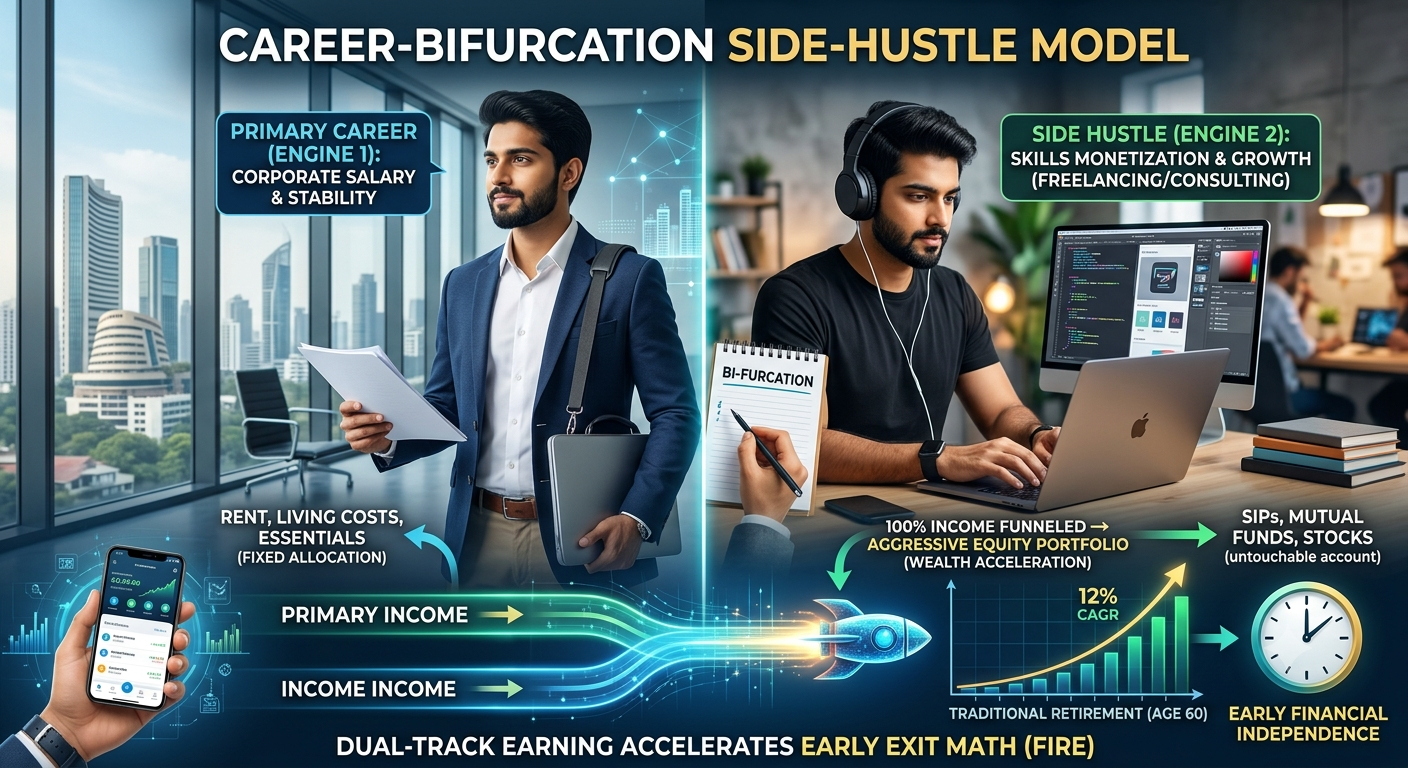
Break the single-paycheck cycle and redefine your wealth trajectory with the Career-Bifurcation Model. By splitting your focus—the primary salary anchors your present; the side hustle funds your future. Discover the math behind behavioral firewalling and aggressive equity investing to achieve financial autonomy years ahead of schedule. Your dual-track blueprint for an early exit starts here.
For most young Indian professionals, the traditional financial roadmap looks predictable: graduate, land a corporate job, climb the annual appraisal ladder, and slowly build a retirement corpus over 35 grueling years. But with urban inflation rising, housing costs skyrocketing, and lifestyle pressures mounting, waiting until age 60 to achieve financial freedom is becoming an outdated dream. Modern wealth creation requires breaking away from a single-paycheck dependency. By dividing your professional energy into a structured dual-track ecosystem, also known as Side Hustle. you can dramatically shift your financial velocity. Enter a fresh approach designed specifically for the digital economy: the career-bifurcation side-hustle model, a framework built to optimize your compounding timeline and help you implement passive wealth drivers without sacrificing your primary career stability.
The Broken Promise of the Single-Paycheck Lifecycle
For decades, personal finance advice relied on a linear equation: spend less than you earn, put away 10% into a provident fund or fixed deposit, and let time do the heavy lifting. While sound in theory, this model assumes a stable economic environment and stagnant living standards. Today’s young adults face a radically different reality:
- Compressed Career Lifespans: Rapid technological disruptions, AI automation, and shifting industry landscapes mean peak earning years are volatile and front-loaded, making traditional 40-year retirement planning obsolete.
- Aggressive Lifestyle Creep: As urban disposable incomes rise, the baseline cost of maintaining a modern lifestyle—from rentals in metropolitan hubs to social obligations—swallows up standard salary increments before they can be saved.
- The Compounding Delay: Relying purely on a 9-to-5 salary delays the point at which your investment portfolio can generate enough passive income to sustain your lifestyle, pushing financial independence further into the distance.
What is the Career-Bifurcation Side-Hustle Model?
Career bifurcation moves away from the traditional scarcity mindset of cutting out every small pleasure to save pennies. Instead, it focuses entirely on multiplying your income streams while creating an unyielding structural wall between your day-to-day survival and your long-term wealth.
This framework splits your professional life into two distinct financial engines:
- Engine 1 (The Primary Salary): Your corporate anchor. This income is strictly allocated to fixed living expenses, rent, groceries, debt servicing, and baseline security. It keeps your life stable without requiring high-risk moves.
- Engine 2 (The Side Hustle): A monetized secondary skill—such as technical consulting, content creation, specialized design, or fractional execution—built completely outside office hours. This engine is dedicated exclusively to wealth creation.
This isn’t just a fringe theory; it is becoming a macroeconomic reality. According to the Deloitte Gen Z and Millennial Survey, nearly 46% of Gen Zs and 37% of millennials have taken on either a part-time or full-time paying job in addition to their primary job, largely driven by the need to secure their long-term financial futures against inflation.
The Mathematics of Dual-Track Compounding
The true magic of this model doesn’t just stem from bringing in extra cash—it is driven by behavioral firewalling. When your side hustle cash flow is structurally separated from your daily checking account, lifestyle inflation cannot touch it. You never “upgrade” your apartment or buy a luxury car using side hustle revenue.
Consider a practical projection: If a 26-year-old software developer, marketer, or product manager earns an extra ₹30,000 a month from a specialized freelance side hustle and channels 100% of it into an aggressive, diversified equity mutual fund portfolio, the mathematical trajectory alters completely. Assuming a conservative long-term equity compounding rate of 12% to 14% CAGR, that secondary stream alone can build a multi-crore corpus within 15 years.
Historical data models published by ET Wealth frequently illustrate this principle: increasing your monthly investment by just 20% to 30%—a gap easily bridged by a side hustle—can reduce a traditional 35-year retirement timeline down by nearly 7 to 10 years, allowing professionals to achieve financial independence well before their 40s.
How to Implement It Without Burning Out
Transitioning into a dual-track earning model requires tactical discipline, strict time management, and a focus on sustainability rather than exhaustion. Follow this step-by-step framework to execute it successfully:
- Step 1: Audit and Package Your Existing Skills: Do not start a side hustle from scratch in an industry you know nothing about. Choose a monetization path that leverages your daily professional strengths—whether it is code auditing, financial modeling, UI/UX audits, or technical copywriting—so your learning curve remains minimal.
- Step 2: Establish the Absolute Firewall: Open a separate, dedicated bank account for all secondary income. Ensure your primary debit card has zero access to this account. Treat this money as if it belongs to your future self, entirely untouchable for everyday purchases.
- Step 3: Automate Your Wealth Engine: The moment your side hustle payout hits your secondary account, set up an automated SIP (Systematic Investment Plan) or direct equity transfer. Capital should be invested into growth assets before you even have a psychological chance to spend it.
- Step 4: Secure Your Base First: Before aggressively compounding your side income into volatile assets, make sure your foundation is rock-solid. Unexpected medical or professional shocks can derail your momentum. Read our guide on building a secure financial foundation to protect your investments from sudden life disruptions.
Managing Opportunity Costs and Energy Levels
Building a secondary income engine requires sacrificing leisure time, particularly during your mid-to-late 20s. However, viewing this sacrifice through the lens of time arbitrage changes the perspective. Trading leisure hours today for total financial autonomy in your 30s or 40s is one of the highest-ROI decisions a young professional can make.
To prevent burnout, cap your side hustle hours strictly (e.g., 8 to 10 hours per week max) and focus on high-ticket, asynchronous projects rather than low-paying, time-intensive hourly gigs. Efficiency is what separates a sustainable career-bifurcation model from corporate exhaustion.
Frequently Asked Questions
What is the Career-Bifurcation Side-Hustle Model?
It is a modern wealth-building framework where young professionals separate their professional life into two financial engines: a primary salary dedicated strictly to living expenses, and a dedicated side hustle whose revenue is 100% funneled into aggressive long-term investments.
How does dual-track earning accelerate early retirement?
By routing secondary income entirely into high-growth equity instruments while keeping lifestyle inflation at bay through behavioral firewalling, you bypass traditional saving limits and can potentially shave 10 to 12 years off a standard 35-year retirement timeline.
How can I avoid burnout while managing a full-time job and a side hustle?
To prevent burnout, cap your side hustle hours (e.g., 8–10 hours weekly), focus on high-ticket asynchronous projects that match your primary day-job skills, and automate your investments so manual tracking is minimized.
Final Thoughts: Buying Back Your Future
Retirement shouldn’t mean sitting in a rocking chair at age 60; it should mean having the absolute financial autonomy to choose how you spend your time, energy, and creativity. By treating your professional life as a dual-track ecosystem today, you stop waiting passively for time to compound your wealth and start forcing it to happen much faster.
To understand the baseline rules of how money grows exponentially over decades, brush up on the fundamentals with our comprehensive guide on understanding compound interest early.




Start the conversation
Share a helpful experience, ask a thoughtful question, or add another perspective for fellow readers.