
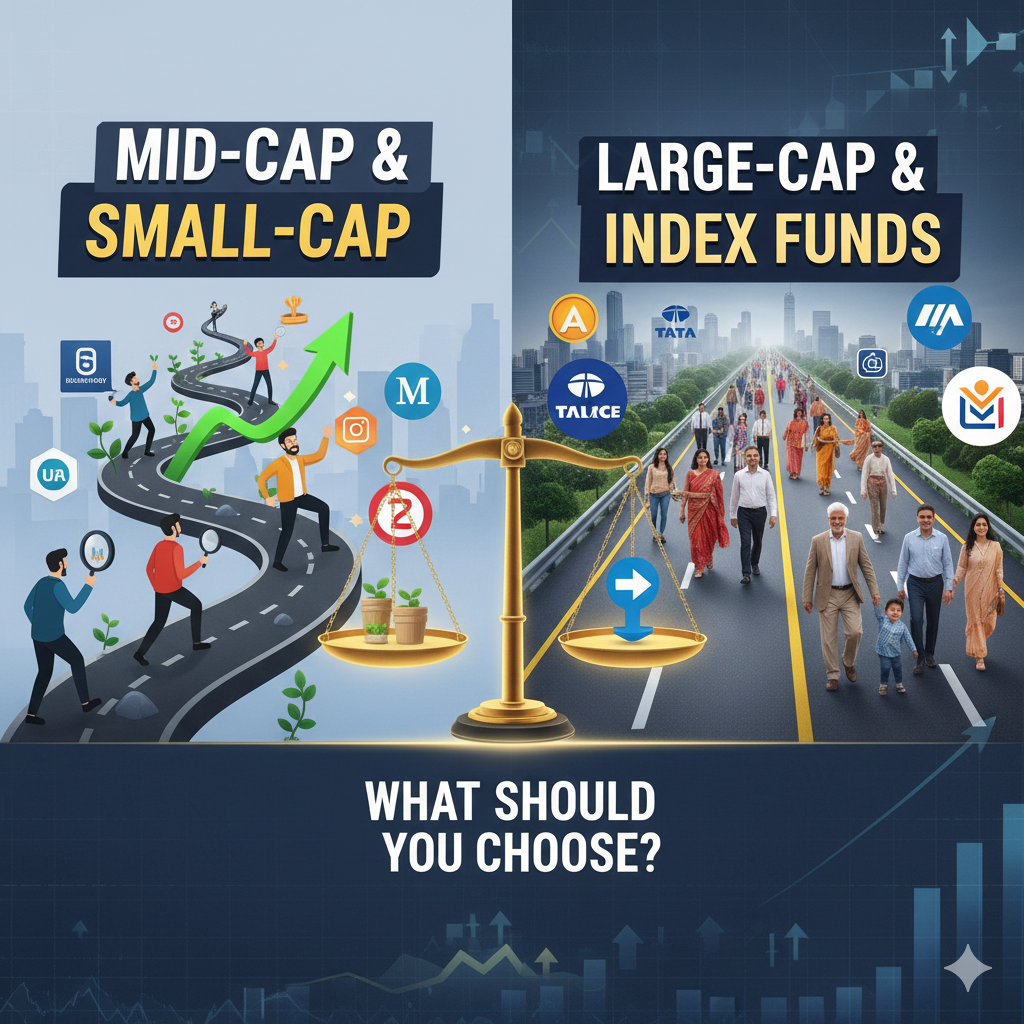
Balancing Stability and Growth: Choosing between the steady performance of Index Funds and the high-growth potential of Mid & Small Caps.
Mid-Cap & Small-Cap vs Large-Cap & Index Funds in India – What Should You Choose?
If you’ve been investing in mutual funds in India for a while, you’ve probably heard that mid-cap and small-cap funds can create more wealth over the long term compared to large-cap and index funds. But higher return potential usually comes with higher risk. So how do you decide what’s right for you?In this article, we’ll break things down in simple terms and compare these fund categories using historical performance, risk, and time horizon and then end with a practical framework to choose what may suit your profile.- Understanding Market Capitalization & Fund Types
- Historical Performance: How Have They Done in India?
- Volatility & Risk: The Flip Side of Higher Returns
- Time Horizon & Compounding: Why Duration Matters
- So, Which Should You Choose?
- Key Takeaways
1. Understanding Market Capitalization & Fund Types
Before comparing returns, it helps to be clear about what each category actually invests in. Mutual funds are often classified based on the market capitalization of the companies they hold.1.1 Large-Cap Funds
Large-cap funds invest mainly in well-established, blue-chip companies with a market capitalization of over ₹20,000 crores. These are typically market leaders with:- Stable earnings
- Relatively lower volatility
- Good liquidity and strong institutional participation
1.2 Mid-Cap Funds
Mid-cap funds invest in companies with a market capitalization between ₹5,000 crores and ₹20,000 crores. These companies:- Are usually in a growth phase
- Have higher return potential than large caps
- Come with moderately higher risk and volatility
1.3 Small-Cap Funds
Small-cap funds invest in companies with a market capitalization of below ₹5,000 crores. These are typically:- Emerging or niche businesses
- Under-researched and less discovered by big institutions
- Capable of delivering explosive growth over long periods
- More volatile
- More sensitive to economic cycles
- Prone to sharp drawdowns during market corrections
1.4 Index Funds
Index funds simply track a market index like the Nifty 50 or Sensex. They:- Invest in the same stocks as the index, in the same proportion
- Typically represent a diversified basket of large-cap companies
- Have lower costs (expense ratios) compared to actively managed funds
2. Historical Performance: How Have They Done in India?
Let’s look at how these categories have broadly behaved in the Indian market over longer periods like 5–10 years (numbers are indicative ranges, based on historical trends and commonly reported data; actual fund performance varies).2.1 Large-Cap Funds
Historically, large-cap funds in India have delivered average annual returns in the range of about 10–12% over the long term. Key characteristics:- Steady, relatively lower-risk growth
- More resilience during market corrections
- Underperformance versus mid- and small-caps in strong bull markets
2.2 Mid-Cap Funds
Mid-cap funds have generally delivered higher returns, often in the range of 12–15% per annum over long periods, depending on the phase of the market.Mid-caps in Bull Markets
During bullish phases, data from bodies like AMFI have often shown that mid-cap funds outperform large-cap funds, as mid-sized companies benefit more from improving economic conditions and sectoral tailwinds.2.3 Small-Cap Funds
Small-cap funds can be the top performers over long periods, with historical annual returns often crossing 15% and sometimes touching 18–20% during strong bull runs.Example: Post COVID-19 Rally
In the market recovery after the COVID-19 crash, small-cap indices significantly outperformed large-cap indices. Small-cap funds benefitted as investors started hunting for value and growth in smaller, more agile companies.2.4 Index Funds
Since most index funds track large-cap indices like Nifty 50 or Sensex, their long-term returns broadly mirror large-cap performance, typically in the 10–12% range. The key advantage here is:- Low cost
- No dependence on fund manager skill
- Simple, rule-based investing
3. Volatility & Risk: The Flip Side of Higher Returns
Higher return potential in mid- and small-caps doesn’t come free. It comes with higher volatility and risk.3.1 Volatility in Small & Mid Caps
Small-cap stocks are especially sensitive to:- Market sentiment
- Liquidity issues
- Economic slowdowns
- They can rise sharply in bull markets
- They can fall just as sharply in corrections or bear markets
3.2 Relative Stability in Large Caps & Index Funds
Large-cap and index funds tend to be more stable because they invest in:- Established businesses
- Companies with stronger balance sheets
- Stocks that are widely tracked and owned
3.3 Risk Management Through Diversification
One way to manage risk is to diversify across market caps instead of betting everything on one category. For instance:- A conservative investor might keep a higher allocation to large-cap and index funds, with a smaller exposure to mid-caps.
- An aggressive, long-term investor might tilt more towards mid- and small-caps, but still keep some allocation to large caps for stability.
4. Time Horizon & Compounding: Why Duration Matters
Compounding works best when you combine higher returns with a long holding period.4.1 Long-Term Investing in Mid & Small Caps
If you invest in mid-cap and small-cap funds and stay invested for a long time (say, 7–10 years or more), you give yourself a better chance to:- Ride out short-term volatility
- Benefit from business growth and re-rating
- Allow higher returns to compound meaningfully
4.2 Reinvesting Gains
When you reinvest dividends and capital gains from your mutual funds:- Your returns start earning returns
- Even a small difference in annual return (e.g., 12% vs 15%) can lead to a big difference in corpus over a decade or more
5. So, Which Should You Choose?
There’s no one-size-fits-all answer. The “best” category for you depends on your risk tolerance, time horizon, and comfort with volatility.5.1 If You Prefer Stability & Lower Volatility
You might lean more towards:- Large-cap funds
- Index funds (Nifty 50, Sensex, etc.)
- You’re closer to your financial goal
- You don’t like big swings in portfolio value
- You’re just starting out and want a simple, low-maintenance portfolio
5.2 If You Can Handle Volatility & Have a Long Horizon
You could consider a higher allocation to:- Mid-cap funds
- Small-cap funds (with caution and proper diversification)
- Your investment horizon is 7–10+ years
- You can tolerate short-term drawdowns
- You’re aiming for higher long-term wealth creation
5.3 A Balanced, Practical Approach
Many investors prefer a blended strategy, for example:- 40–60% in large-cap and index funds for stability
- 20–40% in mid-cap funds for growth
- –20% in small-cap funds for aggressive wealth creation
6. Key Takeaways
6.1 Summary of the Comparison
- Large-cap & Index funds: Stability, lower volatility, market-like returns (~10–12% historically).
- Mid-cap funds: Higher growth potential with moderate-to-high volatility (often ~12–15%).
- Small-cap funds: Highest potential returns but also highest risk and volatility (can exceed 15%+ in strong cycles).
6.2 How to Decide
- Understand your risk tolerance.
- Match your investments to your time horizon.
- Use diversification across market caps instead of chasing only the top-performing category.
- Consider taking the help of a SEBI-registered financial advisor if you’re unsure.




Start the conversation
Share a helpful experience, ask a thoughtful question, or add another perspective for fellow readers.