
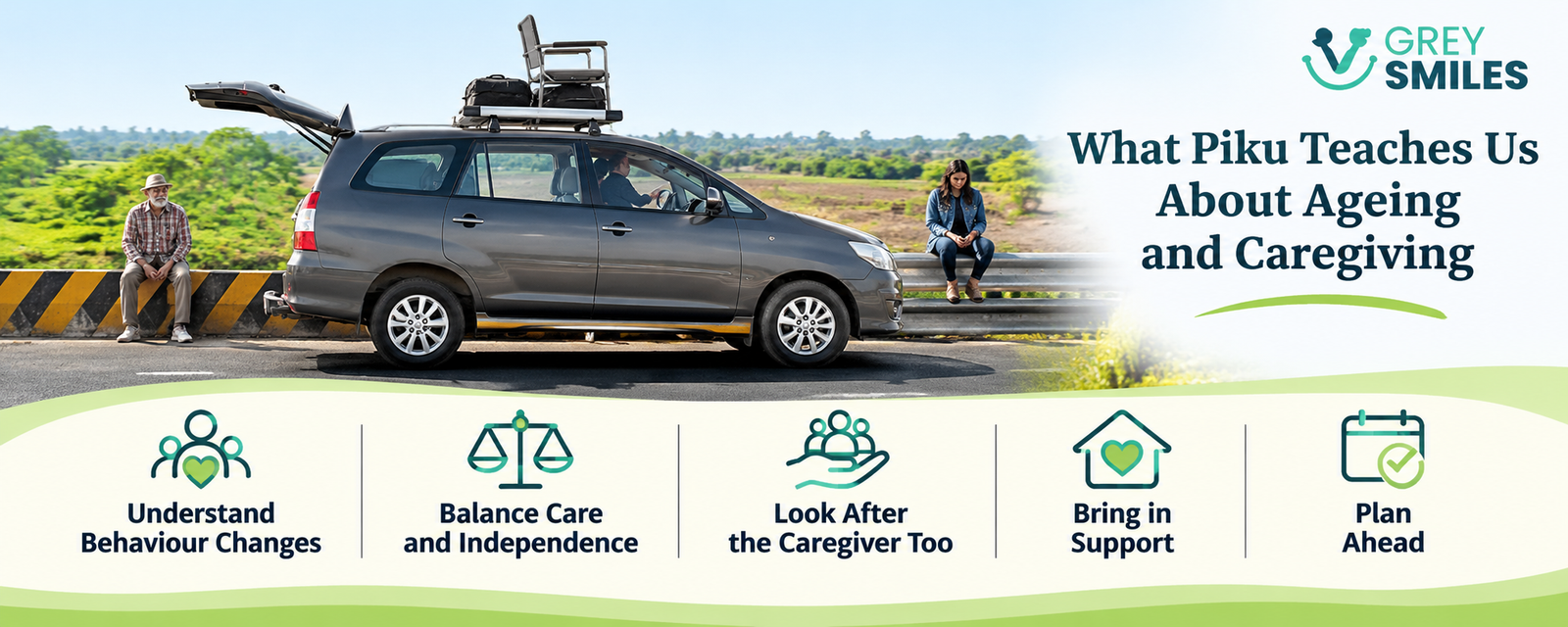
Piku captures the humour, frustration and affection involved in caring for an ageing parent, while reminding us that caregivers need support too.
Few films capture the everyday realities of ageing and caregiving quite like Piku. What appears to be a story about an eccentric father and his exasperated daughter is, beneath the humour, a surprisingly honest portrayal of family life as a parent grows older. The arguments, anxieties, changing behaviour, emotional dependence, desire for independence and the quiet burden that caregiving places on an adult child are all familiar to many Indian families, even if they rarely talk about them openly.
There are no dramatic caregiving milestones in much of the film. Instead, we see life unfolding at home. A father with strong opinions, routines and concerns. A daughter trying to balance her work and personal life with the demands of a parent. Their relationship is loving, although far from uncomplicated. They irritate each other, argue, worry, depend on each other and neither can quite imagine life without the other.
That is what makes Piku relevant to the conversation about eldercare in India. Ageing rarely arrives as one defining moment. It gradually changes routines, relationships, responsibilities and sometimes the way people behave. Families are often left learning to navigate these changes as they happen, without much preparation for what lies ahead.
At a Glance
- Ageing can change behaviour, routines, emotional needs and family dynamics, not just physical health.
- Parents may become more rigid, anxious, sensitive or dependent without necessarily losing their independence.
- Caregiving can be emotionally rewarding, but it can also bring exhaustion, frustration and guilt.
- Older parents need support without losing their identity, autonomy or right to make choices.
- Care responsibilities should not fall entirely on one family member.
- Planning and bringing in support early can make ageing at home more sustainable for everyone.
Ageing Doesn’t Change Everything About a Person
Bhaskor Banerjee may be ageing, but he is still very much himself. He has opinions, preferences, habits, fears and an extraordinary ability to irritate the people around him. His personality doesn’t disappear because he is 70. If anything, the film shows how deeply ingrained some of our habits and ways of thinking can become over the years.
Families often begin looking at their parents differently once physical limitations or health concerns become more noticeable. We become protective, start offering advice, question their choices and sometimes assume that we know what is best. What we see as concern can be experienced by the parent as interference or a loss of control.
Age does not automatically take away a person’s ability to make decisions. An older parent may need assistance with certain tasks and yet remain perfectly capable of deciding how they want to live, what they enjoy, where they wish to go and how they want their day to unfold. Supporting an ageing parent means recognising where help is genuinely needed without treating every aspect of their life as something that now requires supervision.
The aim is to help where necessary while allowing parents to retain as much independence as possible. They have spent a lifetime developing their own ways of doing things. Those habits may not always make sense to us, yet they are often part of the familiarity and control that make a person feel at home in their own life.
When Parents Begin to Behave Differently
One of the more difficult aspects of ageing for families is dealing with changes in a parent’s behaviour. Things that were once occasional quirks may become more pronounced. A parent who was always particular about household arrangements may become increasingly rigid. Someone who was reasonably relaxed may become irritable, anxious, suspicious or unusually sensitive to what family members say. Some may seek reassurance more frequently, repeat the same concerns or react strongly when routines are disturbed.
These changes can be difficult to understand, particularly when adult children feel their parents are becoming unreasonable or deliberately making things difficult. A request that seems unnecessary, an argument over something insignificant, repeated calls or resistance to accepting help can become a source of daily friction. The child may wonder why a parent is behaving this way when the situation seems straightforward to everyone else.
Sometimes these behaviours reflect personality, a desire to retain control or discomfort with the changes that ageing brings. The underlying reasons can also be less obvious. Loneliness, grief, anxiety, loss of confidence, poor sleep, hearing difficulties, medication effects, depression or cognitive changes can influence how an older person feels and responds to those around them.
Not every behavioural change is simply a normal part of ageing. Persistent or significant changes deserve attention, while sudden confusion, unusual behaviour or abrupt changes in personality require prompt medical assessment. What may appear to be stubbornness or irritability could sometimes be a sign that something else is happening.
For families, the first response need not always be an argument or an attempt to correct the behaviour. It may be more useful to pause and ask what could be behind the change. Has something become difficult for the parent? Are they worried about losing independence? Are they feeling isolated? Is there a health issue that has not been recognised? Understanding the reason may not resolve every disagreement, though it can change the way we respond to it.
Caring for a Parent Can Be Frustrating. That Doesn’t Make You a Bad Child.
Piku loves her father. There is never much doubt about that. She is also frustrated by him—his demands, anxieties, habits, refusal to see things from anyone else’s perspective and the way his concerns repeatedly become everyone else’s concerns. She gets irritated, loses patience, argues and wants to get away. Yet she continues to care.
This is perhaps one of the most honest portrayals of caregiving. We often speak about looking after parents in terms of duty, sacrifice, devotion and love. Rarely do we openly talk about irritation, resentment, exhaustion or the need for space. Caregivers can love their parents deeply and still feel overwhelmed by the responsibility. They can worry about their parents while simultaneously worrying about their own careers, marriages, children, finances and future.
These feelings do not make someone a bad son or daughter. They are human responses to a demanding situation. Real caregiving takes place in real households, where people are tired, working, worrying, arguing and trying their best. Expecting a caregiver to be endlessly patient and selfless is neither realistic nor fair.
The caregiver’s emotional wellbeing matters too. It is difficult to provide good care over an extended period when someone is constantly exhausted, feels trapped or has no time for themselves. The ability to step away occasionally, seek help, maintain relationships and continue living one’s own life is not selfishness. It is part of making caregiving sustainable.
The Caregiver Can Slowly Become Invisible
As the film progresses, we see how much of Piku’s life revolves around her father. She has a career, ambitions, relationships and a life outside the home, yet the demands of his everyday existence repeatedly intrude into those spaces. This is a familiar reality for many caregivers, particularly daughters, who often find themselves managing a disproportionate share of their parents’ care alongside their other responsibilities.
A phone call during a meeting, a health concern that cannot wait, an appointment that needs organising, a problem with domestic help or a parent who refuses to cooperate can gradually become the rhythm of everyday life. Over time, caregiving may begin to feel like a second full-time job, one that is neither formally recognised nor adequately supported. The caregiver’s own needs move down the priority list, social life gets restricted, career decisions are affected and personal plans are repeatedly postponed.
An eldercare arrangement that works only because one person keeps sacrificing their own life is not sustainable. The caregiver needs support, time off, emotional space and the ability to continue living their own life. We cannot build an eldercare system around the assumption that one child will always be available, no matter what else is happening.
For those who find themselves carrying much of this emotional weight, our article on anticipatory grief and the silent toll it takes on caregivers explores some of the feelings that can arise long before a loss, particularly when a parent’s health, personality or abilities begin to change.
An Elderly Parent Is Not a Project to Be Managed
There is a tendency, sometimes with the best of intentions, to start treating elderly parents as a set of tasks. Has the medicine been taken? Has the doctor been consulted? Did they eat? Is their blood pressure normal? Have they exercised? Are they following the instructions? These things may be important, particularly when health needs become more complex, but an older person’s life cannot become only a checklist of health and safety.
Parents still need enjoyment, conversations, interests, friendships, privacy, choices and things to look forward to. They may want to go out, meet friends, travel, eat what they enjoy, pursue hobbies or simply spend a day without being questioned about every decision. They may be perfectly happy with their routine, even if their children think it could be improved.
The objective of eldercare should not simply be to keep someone safe. It should be to help them continue living a life they find meaningful. This requires understanding what they can still do, what they genuinely need help with and what they would prefer to manage themselves.
Our article on care at home for elderly parents explores this balance between introducing help and preserving independence. The starting point should be what has actually changed in the parent’s life—not their age alone.
Independence and Dependence Can Exist Together
We often think of independence and dependence as two opposite states. Either a person is independent and manages everything themselves, or they are dependent and need someone else to take care of them. Real life is far more complicated. An elderly person may need help with certain physical tasks but remain completely capable of making decisions about their finances, lifestyle, relationships, travel or how they wish to spend their day.
They may need someone to accompany them to the hospital but not someone to decide everything on their behalf. They may need assistance at home but want their privacy respected. They may want their children close but not want to live with them. The need for assistance should not automatically mean the loss of autonomy.
Good caregiving is not about taking over. It is about understanding what a person can still do, what they need help with and where they want that help. The more we preserve the independence of an older person, the more likely we are to preserve their sense of self.
Care Cannot Always Be Delivered by Family Alone
Families are often uncomfortable bringing in outside help. There may be concerns about trust, cost, privacy, safety or whether a stranger can really care for a parent the way family can. Eldercare cannot always be delivered entirely by family members, particularly when care needs increase, children live in other cities or countries, or a caregiver is already stretched thin.
Depending on the needs of the older person, support may include companionship and regular interaction, help with daily activities and household chores, assistance with mobility and personal care, medication reminders, accompaniment to medical appointments, meal preparation, physiotherapy or respite care for family caregivers. Not every parent needs a full-time caregiver, and not every need requires a clinical professional. The important thing is to match support to the actual need.
Professional or paid assistance can allow family members to spend time with their parents as sons, daughters and companions, rather than being constantly occupied with every practical task. It can also provide some breathing space for the person who has been carrying the responsibility. Bringing in help should not be viewed as abandoning a parent. Sometimes it is what allows a family to continue caring well.
For families trying to understand what support is available, our guide on what eldercare means and the challenges Indian families face explains how care can extend beyond medical needs to include daily living, emotional support and assistance in maintaining independence. When outside support is needed, our practical guide on choosing eldercare services in India helps families understand what to look for and what questions to ask.
Loneliness May Be Hidden Behind Behaviour
Bhaskor can be demanding and difficult to live with, yet there is also a deeper emotional dimension to his character. He is a widower. His life has changed. His daughter is an adult with her own life, but he wants her attention, company and presence. Sometimes his behaviour seems less about the issue he is talking about and more about wanting someone to listen.
This is something families may overlook in real life. Repeated complaints, unnecessary calls, constant health concerns, irritability or insistence on being involved in everything may sometimes reflect anxiety, loneliness, a loss of purpose or the fear of becoming irrelevant. It does not mean every difficult behaviour should be explained away as loneliness, nor should genuine medical or psychological concerns be ignored. It is worth asking a question beyond the immediate complaint: what might my parent actually be trying to tell me?
Are they afraid of being alone? Do they feel they no longer matter? Have they lost the social connections that once gave their life structure? Is their world becoming smaller? Sometimes the conversation we need to have is not about the complaint itself, but about what is happening underneath it.
It is also worth recognising that emotional changes can affect both parent and child. An adult child may feel guilty for not visiting enough, while a parent may feel hurt by what they perceive as distance. Neither may be saying what they really feel. Our article on the conversations we need to have with ageing parents explores how families can approach subjects such as future care, living arrangements, money and independence without making parents feel that their lives are being taken over.
A Parent’s Right to Take Risks, Make Choices and Live
One of the most interesting aspects of Piku is Bhaskor’s desire to travel. The road journey becomes a reminder that older people do not necessarily stop wanting experiences, adventures or freedom. Families often become protective as parents age. We worry about falls, illness, travel, food, medication and emergencies. Understandably, we begin discouraging activities that appear risky.
There is a danger in making safety the only objective. A life in which every activity is discouraged because something might happen can become a life without much joy. Older people may still want to travel, go out, meet friends, pursue hobbies, visit places or simply do something spontaneous. Care involves managing risks sensibly rather than eliminating life in the name of protection.
The conversation should not always be, “You shouldn’t do this.” Sometimes it should be, “How can we help you do this safely?”
The Child’s Life Does Not Stop Because the Parent Is Ageing
Perhaps the most uncomfortable question Piku raises is one that many adult children never openly ask: how much of my own life am I expected to give up to care for my parents? In India, caregiving is often wrapped in notions of duty, sacrifice, morality and family honour. This can make it difficult for a son or daughter to admit that they are struggling.
Adult children today may live in different cities or countries. They may have demanding careers, young children, financial obligations, health issues of their own or no siblings with whom to share responsibilities. Caregiving can affect career growth, financial independence, marriage and relationships, parenting their own children, physical and emotional health, and personal identity. These consequences are real, and they deserve to be acknowledged.
Looking after a parent should not mean that the caregiver disappears as a person. We need family conversations in which responsibilities are discussed honestly. Who is doing what? Who can contribute financially? Who can visit? Who can coordinate medical care? What can be outsourced? What support is available? Care is not measured by how much one person suffers silently.
Eldercare Planning Should Begin Before There Is a Crisis
Families often begin planning for eldercare after something happens—a fall, a hospitalisation, a diagnosis, a parent living alone who can no longer manage daily activities, or a caregiver reaching a breaking point. By then, decisions have to be made quickly, often under stress, with little understanding of the options.
Ageing and care are not events. They are an evolving part of family life. The conversations need to begin earlier, while everyone is still capable of participating and choices remain open. Families should discuss where parents want to live, their healthcare needs, daily activities, social connections, financial preparedness, how caregiving responsibilities will be shared, what support services may be required and what happens if the current arrangement is no longer adequate.
These conversations may not be easy, and they need not all happen at once. Having them before a crisis can make a significant difference later. It also allows parents to express their wishes rather than having decisions made for them when they are at their most vulnerable.
Our article on talking to ageing parents about the future offers a starting point for these conversations, which are often postponed because nobody wants to make the other person uncomfortable.
What Piku Gets Right About Ageing That We Often Get Wrong
Perhaps the greatest strength of Piku is that it refuses to make its characters simple. Bhaskor is not merely an elderly man who needs care. He is annoying, funny, opinionated, protective, lonely, independent and deeply attached to his daughter. Piku is not simply a devoted daughter. She is caring, capable, frustrated, ambitious, impatient and entitled to her own life.
Both are right about some things. Both are wrong about some things. Both love each other. They also make life difficult for each other. That is what families are often like.
We need to move away from the idea that eldercare is about a perfect parent being cared for by a perfectly patient child. It is about imperfect people trying to live together, negotiate changing needs, preserve relationships and figure things out as they go. That may be a much more useful starting point for understanding ageing.
The GreySmiles Take
Piku leaves us with a question that is far bigger than how we look after our ageing parents. It asks us what it means to allow someone to age without taking away their identity. To care without controlling. To support without making them feel helpless. To recognise that a parent may need us more than before, but is still entitled to their own choices, their own habits and their own life.
The film also reminds us that the person providing care matters. We cannot expect families to manage eldercare through love alone. Love is important, but it cannot replace time, resources, support, professional care or planning. The responsibility cannot always fall on one child, and asking for help should never be treated as a failure.
Perhaps the best form of eldercare is not one in which a child does everything for a parent. It is one in which the parent continues to live with dignity and as much independence as possible, the caregiver continues to have a life of their own, and neither has to carry the entire burden alone.
We spend much of our lives learning how to care for our children. Very few of us are taught how to care for our parents when the relationship begins to change. Perhaps the answer isn’t to become more patient, more self-sacrificing or to do everything ourselves. It is to understand each other a little better, recognise when help is needed, and create a way of caring that leaves room for both the parent and the child to continue living their lives.
Because the real measure of care isn’t how much we take over. It’s how much of a person’s life, identity and dignity we help them retain.




Start the conversation
Share a helpful experience, ask a thoughtful question, or add another perspective for fellow readers.