
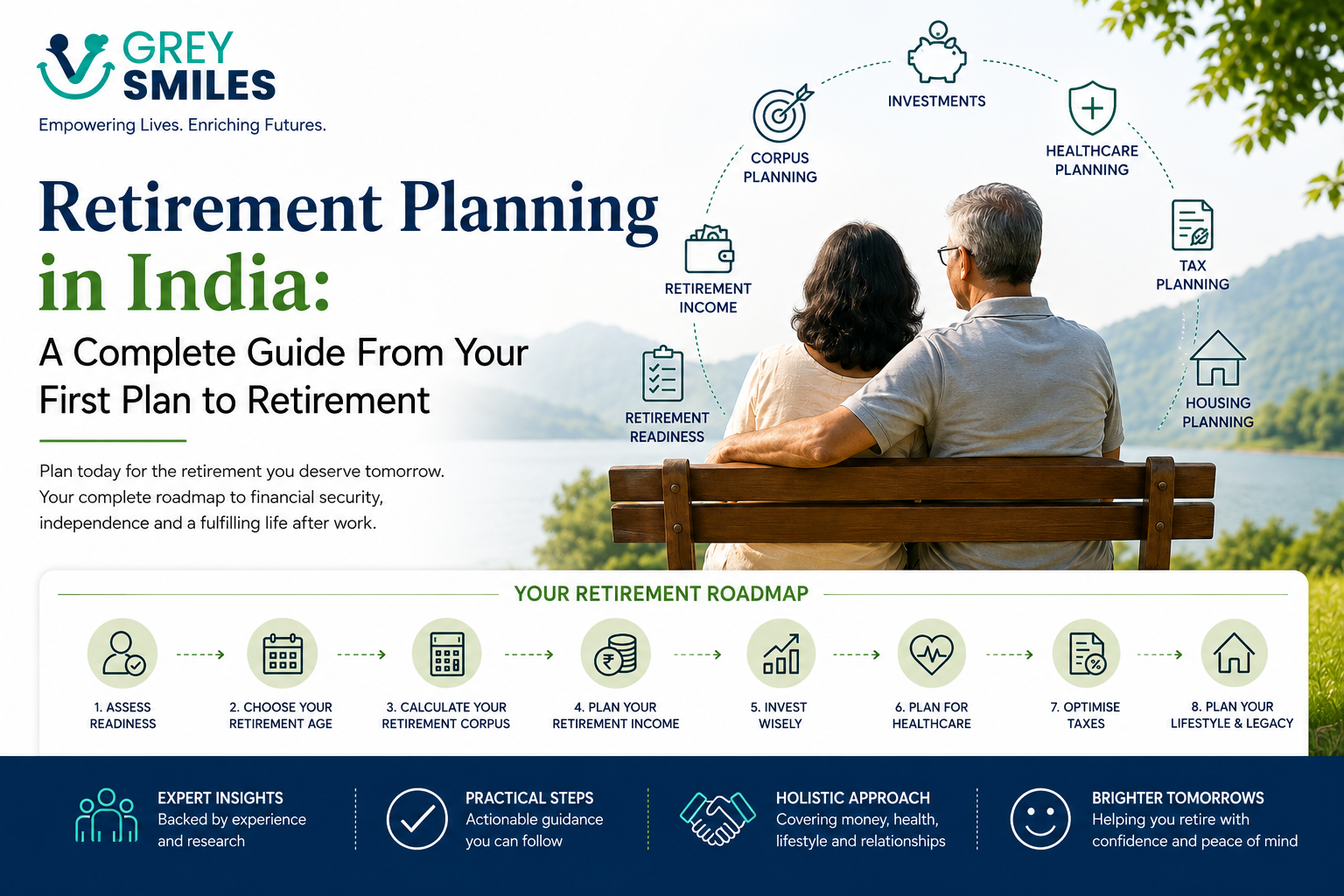
Retirement planning is not simply about building a large corpus. It is about making sure your money, healthcare, housing, family responsibilities and lifestyle can work together when your salary stops.
For salaried professionals in India, the planning journey usually starts years before retirement. EPF, NPS, PPF, mutual funds, insurance and other investments can all play a role—but the right combination depends on your age, income, expenses, responsibilities, risk tolerance and the kind of retirement you want.
This guide brings those decisions together in one place. Use it as your retirement-planning roadmap, then explore the specialist GreySmiles guides linked throughout the article when you need more detail.
At a Glance: What Does a Good Retirement Plan Need?
| Part of the plan | The question to answer |
|---|---|
| Retirement timing | When can I realistically afford to stop working? |
| Readiness | Am I financially and personally ready? |
| Retirement corpus | How much will I need to fund the life I want? |
| Retirement income | How will I generate income after my salary stops? |
| Healthcare | How will I handle routine and unexpected healthcare costs? |
| Tax & investments | How should my savings and investments be structured? |
| Life after work | What will give my retirement structure, purpose and connection? |
What Is Retirement Planning?
Retirement planning is the process of preparing financially and personally for the years when employment income reduces or stops.
It involves much more than choosing investments. A sensible plan considers your expected expenses, retirement age, existing savings, future income, healthcare needs, debt, housing, family responsibilities, taxes and the lifestyle you want to maintain.
For a salaried employee, retirement planning can also mean making the most of workplace-linked benefits such as EPF while building additional savings outside them.
Think of retirement planning as a system, not a product.
No single investment can solve every retirement need. Your job is to build a combination of assets, income sources, protection and contingency reserves that can work together over several decades.
When Should You Start Retirement Planning?
The earlier you start, the more time you have to build savings and adjust your plan. But starting late does not mean retirement planning is pointless. It means the plan needs to be more deliberate.
Someone in their 30s has time to focus on accumulation and long-term growth. Someone in their 50s may need to pay more attention to retirement income, risk, healthcare, debt and the transition from salary to retirement cash flow.
The important question is not simply “How early did I start?” but:
“Given where I am today, what do I need to fix next?”
For a broader understanding of the retirement journey, see What Is Retirement Planning and Why Should It Be Done Early in Life?
Are You Financially Ready to Retire?
Reaching 60 does not automatically mean you are ready to retire. Equally, age alone should not determine whether you continue working.
Before making the decision, consider:
- Do you know what your household actually spends each month?
- Do you have enough resources to fund your expected retirement years?
- Will you have reliable income after your salary stops?
- Do you have adequate healthcare and emergency reserves?
- Are major debts under control?
- Will your spouse remain financially secure if you die first?
- Are you still supporting children or other dependants?
- Do you have a plan for housing?
- Do you know how you will spend your time after work?
Not sure you’re ready?
Try the GreySmiles Retirement Readiness Test. It is designed to help you identify what needs attention first rather than simply giving you another retirement number.
How Much Retirement Corpus Do You Need?
There is no universal retirement corpus that works for every Indian household.
Your requirement depends on factors such as:
- your current and expected future expenses;
- your expected retirement age;
- how long the money may need to last;
- inflation;
- healthcare requirements;
- home ownership and housing costs;
- pension and other guaranteed income;
- investment returns and risk;
- support you expect to provide to family members; and
- the lifestyle you want after retirement.
A Simple Starting Framework
Begin with your current annual household spending. Remove expenses that are likely to disappear after retirement and add expenses that may increase, such as healthcare, travel or time spent at home.
Then consider how those expenses could change with inflation over your remaining working years.
Finally, compare the projected requirement with the income and assets you expect to have at retirement.
Rules such as the 25× corpus approach can be useful as a starting point, but they should not be treated as a guaranteed answer. Withdrawal rates, returns, inflation and longevity can all differ substantially from assumptions.
For a more detailed calculation, see Retirement Corpus Calculation in India.
How Will You Generate Income After Retirement?
Building a corpus is only half the retirement problem. You also need to decide how that money will support your life after the salary stops.
Potential retirement income sources may include:
- EPF and other accumulated retirement benefits;
- NPS;
- pension or annuity income;
- interest from deposits and fixed-income investments;
- mutual fund withdrawals;
- rental income;
- part-time or consulting income; and
- other investments or business income.
The objective is not necessarily to make every rupee produce income immediately. Your portfolio needs to balance liquidity, growth, stability and longevity.
For readers already approaching retirement, the question changes from “How do I accumulate more?” to “How do I convert my accumulated wealth into a sustainable income stream?”
How Should You Build Your Retirement Portfolio?
Your retirement portfolio should reflect your time horizon and ability to tolerate losses—not simply your age.
EPF and VPF
For salaried employees, EPF can form an important part of retirement savings. Employees who want to save more through their workplace framework may also explore VPF, subject to the applicable rules and their employer’s arrangements.
For current rules and account-related information, refer to the official EPFO website.
PPF
PPF can provide a long-term, government-backed savings component for eligible investors. Its lock-in and contribution rules mean it should be considered as part of an overall plan rather than viewed in isolation.
Mutual Funds
Equity-oriented mutual funds can provide long-term growth potential, while debt-oriented investments can play a role in reducing portfolio volatility and meeting shorter-term requirements.
The appropriate allocation depends on your circumstances. There is no single equity percentage that is suitable for every 30-, 50- or 60-year-old.
See Young and Planning Retirement? What You Need to Know About Asset Allocation.
NPS
NPS can be an important retirement-planning vehicle for eligible investors, particularly those looking for a structured long-term retirement account.
Understand its contribution rules, investment choices, withdrawal provisions and tax treatment before deciding how much of your retirement portfolio should be allocated to it.
SCSS, Deposits and Other Fixed-Income Options
As retirement approaches, capital preservation and dependable cash flow become increasingly important. Senior Citizens’ Savings Scheme, bank deposits and other fixed-income instruments may therefore have a role for eligible investors.
However, safety, liquidity, taxation and inflation need to be considered together.
Healthcare Must Be Part of the Retirement Plan
Healthcare is one of the expenses that can be difficult to predict. A retirement plan that works comfortably for normal monthly spending can become strained if a major medical expense arrives without adequate insurance or reserves.
Consider:
- health insurance and its exclusions;
- coverage available through your employer and what happens when employment ends;
- deductibles and out-of-pocket expenses;
- regular medication and treatment costs;
- an emergency healthcare reserve; and
- the possibility of needing assistance or long-term care later in life.
Read more about Medical Inflation vs Lifestyle Inflation.
Healthcare planning should also be revisited periodically because insurance products, premiums, medical costs and your own health circumstances can change.
Retirement and Tax Planning
Tax planning should begin before retirement rather than when the first pension or investment withdrawal arrives.
Your tax position can change substantially when salary income is replaced by a combination of pension, interest, dividends, rental income and capital gains.
Before making major investment or withdrawal decisions, review:
- the tax treatment of your different income sources;
- deductions and exemptions for which you may be eligible;
- the tax implications of selling investments;
- the timing of large withdrawals; and
- the tax consequences of transferring or selling property.
Tax rules change, so current provisions should always be checked before acting. For significant decisions, take advice from a qualified tax professional.
Where Will You Live After Retirement?
Housing is often one of the biggest overlooked parts of retirement planning.
Your current home may be financially comfortable but physically difficult to manage later. A smaller home may reduce maintenance but could move you away from familiar neighbours. Moving closer to children may improve access to support but reduce independence.
Consider the options:
| Option | Questions to consider |
|---|---|
| Stay where you are | Is the home accessible, affordable and manageable as you age? |
| Downsize | Would lower maintenance and released capital improve your retirement? |
| Move closer to family | Would proximity improve support without compromising independence? |
| Senior living | Would services, community and healthcare access justify the cost? |
Plan for Family and Dependants
Retirement planning becomes more complicated when your financial independence is connected to someone else’s needs.
You may still be supporting adult children, caring for an elderly parent, helping with education or weddings, or managing a spouse’s different financial position.
Before retiring, ask:
- Which family responsibilities will continue after retirement?
- Which financial commitments have a definite end date?
- Does my spouse understand our financial position?
- Are nominations updated?
- Have we documented our wishes for our assets?
See Myths Around Nominee, Joint Applicant and a Will.
Retirement Is Also a Life Plan
Financial independence does not automatically create a fulfilling retirement.
Work may have provided structure, social interaction, identity and a sense of purpose. Once it disappears, those things may need to be deliberately rebuilt.
Think about:
- relationships and friendships;
- travel;
- hobbies and learning;
- volunteering;
- part-time or consulting work;
- time with family;
- fitness and wellbeing; and
- how you want an ordinary weekday to look.
This is why retirement planning should not end with a corpus calculation.
The Six Stages of Retirement Planning
Retirement planning changes as you move closer to and beyond your retirement date.
| Stage | Main focus |
|---|---|
| 1. Early career | Start saving, protect yourself and establish good financial habits. |
| 2. Building years | Increase savings, grow investments and review protection. |
| 3. Pre-retirement | Stress-test the corpus, reduce major risks and prepare for income. |
| 4. Retirement transition | Move from salary dependence to a sustainable retirement-income plan. |
| 5. Early retirement | Monitor spending, investments, healthcare and lifestyle. |
| 6. Later retirement | Plan for longevity, healthcare, assistance, estate matters and changing independence. |
For a detailed treatment of these stages, read 6 Stages of Retirement Planning in India.
What Should You Do at Your Age?
In Your 20s
Start early, build an emergency reserve, protect yourself appropriately and establish a consistent long-term investment habit.
In Your 30s
Increase retirement savings as income grows. Review your insurance, debts, family responsibilities and investment allocation periodically.
In Your 40s
Retirement planning should become more deliberate. Review your projected corpus, outstanding loans, healthcare protection and the retirement lifestyle you expect to fund.
In Your 50s
Move from simply accumulating wealth to preparing for the transition. Stress-test your retirement income, review investment risk, reduce unnecessary debt and make sure your healthcare arrangements are adequate.
Within Five Years of Retirement
This is the time to build a detailed transition plan. Understand your expected income, expenses, liquidity requirements and major one-time expenses before deciding exactly when to stop working.
Common Retirement Planning Mistakes
- Planning around a single corpus number: A retirement corpus is only meaningful when considered alongside expenses, income, inflation, healthcare and longevity.
- Ignoring healthcare: Medical costs can significantly change the financial picture later in life.
- Keeping everything in one type of investment: Diversification matters because retirement savings may need to support you for decades.
- Taking too much risk close to retirement: Large market losses shortly before or after retirement can have a disproportionate impact on a portfolio.
- Ignoring taxes: The amount you accumulate and the amount you can actually spend are not always the same.
- Assuming the house solves the retirement problem: A valuable property may not produce usable monthly income unless you have a realistic plan for it.
- Planning only for the first five years: Retirement may last several decades. Your plan needs to consider what happens as you age.
- Planning financially but not personally: A financially secure retirement can still feel difficult if you have no structure, relationships or sense of purpose.
Your Retirement Planning Checklist
- ☐ I know my current household spending.
- ☐ I have estimated my retirement expenses.
- ☐ I have identified my target retirement age.
- ☐ I have calculated a realistic retirement corpus requirement.
- ☐ I know what income sources I will have after retirement.
- ☐ I have reviewed my EPF, NPS, PPF and other retirement investments.
- ☐ I have adequate emergency savings.
- ☐ I have reviewed my health insurance and healthcare reserve.
- ☐ I have considered outstanding loans and other liabilities.
- ☐ My spouse understands our financial position.
- ☐ My nominations are updated.
- ☐ I have considered my housing needs after retirement.
- ☐ I have thought about how I will spend my time after work.
- ☐ I review my retirement plan periodically rather than setting it once and forgetting it.
Frequently Asked Questions
How much money do I need to retire in India?
There is no single amount that is enough for everyone. Your retirement corpus depends on your expenses, retirement age, expected longevity, inflation, healthcare needs, income sources and investment strategy.
What is the best age to start retirement planning?
The earlier the better because you have more time to save and adjust your strategy. However, it is never too late to start. If you are already close to retirement, focus on identifying the most important gaps and addressing them systematically.
Is the 25× rule enough to calculate a retirement corpus?
The 25× approach can be a useful starting framework, but it is not a guarantee. Retirement duration, inflation, investment returns, taxes and withdrawal requirements can vary significantly.
Should I invest everything in EPF, NPS or mutual funds?
No single product should automatically make up your entire retirement strategy. Different assets can serve different purposes, including growth, stability, liquidity and income.
How much should I keep for healthcare after retirement?
There is no universal amount. Review your insurance, existing medical needs, family history, expected healthcare costs and available liquid savings. Healthcare planning should be reviewed periodically as circumstances change.
Can I retire early in India?
Possibly, but retiring early increases the number of years your assets may need to support you. It also reduces the time available to build the corpus. Use a detailed retirement-readiness assessment rather than relying only on your current savings.
Read Can I Retire? The GreySmiles Retirement Readiness Test and Can I Retire Early? for more detailed guidance.
Final Thoughts
A good retirement plan is not a spreadsheet that you complete once and forget.
It is a plan that evolves as your income changes, your family responsibilities change, markets change and you get closer to retirement.
For a salaried professional, the journey may begin with EPF and regular investing. Over time, it becomes a broader exercise involving corpus planning, asset allocation, insurance, healthcare, taxation, retirement income, housing and life after work.
The most useful question is therefore not simply:
“How much money do I need to retire?”
It is:
“What do I need to put in place so that the life I want after work remains financially and personally sustainable?”
Start with where you are today. Identify the biggest gap. Fix that first. Then review the plan again.
Continue Your Retirement Planning Journey
Disclaimer: This article provides general educational information and should not be treated as personalised investment, tax, legal or financial advice. Investment values can rise or fall, and retirement outcomes depend on individual circumstances. Tax rules and financial regulations can change. Before making significant investment, tax or retirement decisions, consider consulting an appropriately qualified professional.




Start the conversation
Share a helpful experience, ask a thoughtful question, or add another perspective for fellow readers.