
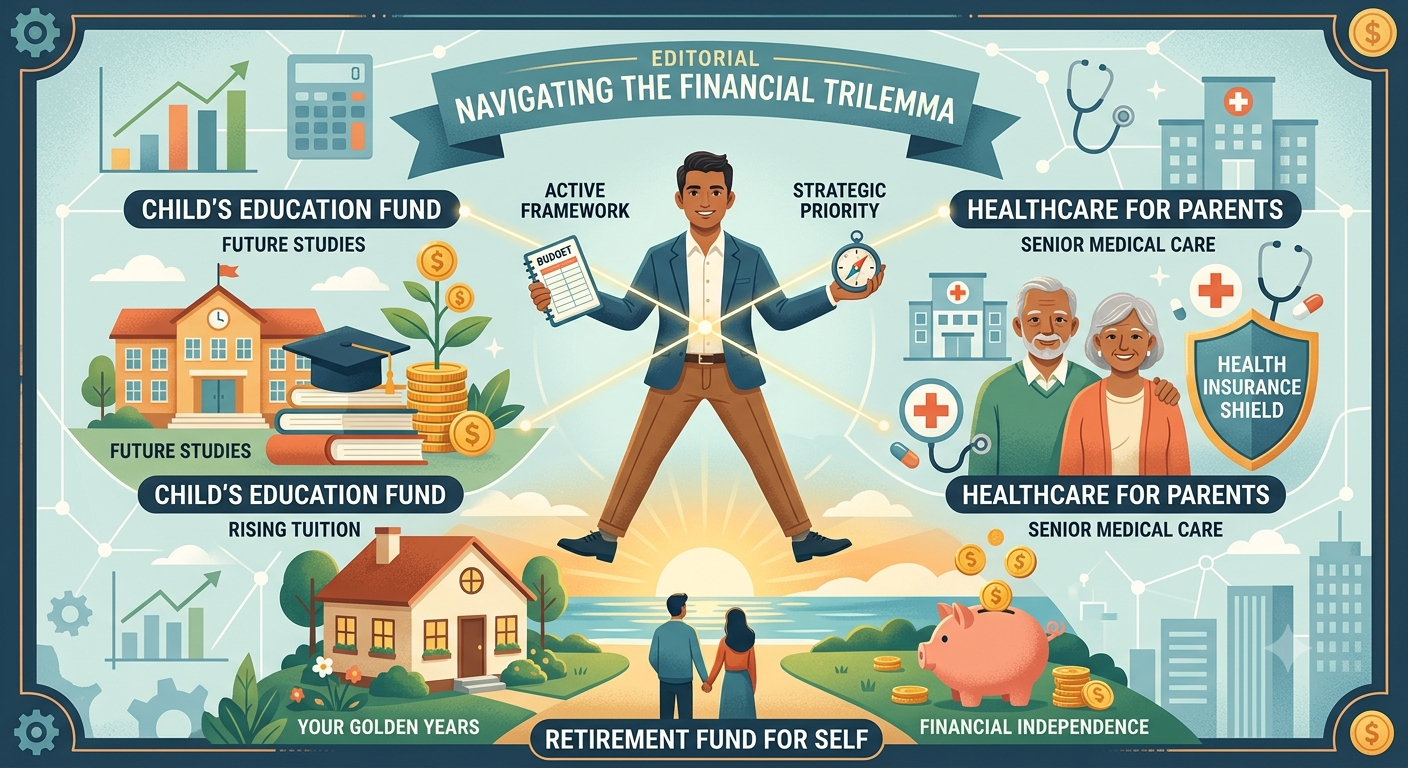
Navigating the mid-career financial stretch often feels like walking a high-wire without a safety net. Millions of working professionals find themselves caught squarely in the “Sandwich Generation”—simultaneously managing the escalating tuition fees for their children, taking care of aging parents facing double-digit medical inflation, and trying to build a bulletproof nest egg for their own retirement. With private higher education costs in India inflating at roughly 10% to 12% annually and healthcare inflation hovering around 11.5%, deferring any single goal can feel catastrophic. However, sacrificing your own retirement to fund immediate expenses is a dangerous trap that leaves you dependent on your children later in life. Balancing these three competing priorities requires an active, structured framework that ruthlessly prioritizes long-term independence while optimizing cash flow and tax efficiency through dedicated financial instruments.
1. The Financial Trilemma: Understanding the Core Conflict
The Sandwich Generation faces three major financial pressures at the same time:
- Children’s Higher Education: Higher education in India and abroad sees compounding cost surges every year. A four-year engineering or professional degree costing ₹15 Lakh today will comfortably cross ₹40–45 Lakh in 12 years.
- Parents’ Healthcare Expenses: As parents enter their 60s and 70s, chronic conditions and hospitalization risks spike. With hospital room tariffs and specialty care inflating rapidly, a single major medical event can wipe out several years of household savings if uncovered.
- Your Retirement Security: Retirement is the only goal on this list for which no financial institution will extend a personal loan. The cost of living in retirement compounds quietly over 25–30 post-work years.
To explore deeper cash flow modeling and long-term asset allocation, read our detailed framework on holistic retirement planning strategies on Greysmiles.
2. The Golden Rule: Why Retirement Must Always Come First
It is natural to put children and parents first, but prioritizing retirement is actually an act of care for your family.
The Oxygen Mask Principle: Just as airlines instruct passengers to put on their own oxygen masks before assisting others, you must secure your financial independence before over-allocating capital to your children or parents.
- Education Has Liquidity Options: Your child can access low-cost education loans subsidized by tax concessions (such as Section 80E under the Indian Income Tax framework) or qualify for merit scholarships.
- Retirement Has No Safety Net: No bank lends money for daily expenses, healthcare, and groceries in your senior years.
- Breaking the Intergenerational Dependency Loop: By building an adequate retirement fund, you prevent your children from becoming part of the next Sandwich Generation.
For a comprehensive breakdown of guaranteed income products to anchor your golden years, check out our guide to the top pension plans in India on Greysmiles.
3. Concrete Case Study: The 35-Year-Old Cash Flow Plan
Consider Rahul (Age 35), a corporate manager in Bengaluru earning a net monthly salary of ₹1,80,000.
Family Profile & Goals:
- Child: Age 3 (Needs an education fund of ₹50 Lakh at Age 18, 15 years away).
- Parents: Ages 63 & 60 (Need healthcare protection and emergency liquidity).
- Retirement Horizon: 20 Years (Target corpus: ₹3.5 Crore at Age 55).
Cash Flow Allocation Framework:
| Goal Bucket | Target Horizon | Monthly SIP / Premium | Primary Investment Vehicle |
|---|---|---|---|
| Emergency & Parents’ Health | Immediate | ₹12,000 | Parent Super Top-Up Health Insurance + Liquid Mutual Funds |
| Personal Retirement | 20 Years | ₹30,000 | Flexi-Cap Equity Mutual Funds + National Pension System (NPS) |
| Child Higher Education | 15 Years | ₹18,000 | Large & Mid-Cap Index Funds + Sukanya Samriddhi Yojana (SSY) (if a daughter) |
| Household Expenses & EMI | Ongoing | ₹1,20,000 | Bank Account / Daily Expenses |
By maintaining a disciplined 60:30:10 rule (60% living costs, 30% investments split across goals, 10% risk coverage and protection), Rahul safeguards his future without shortchanging his family.
4. Managing Parents’ Healthcare Without Draining Capital
Relying purely on out-of-pocket savings for senior citizen medical bills risks depleting your primary wealth-building portfolio. Instead, use a multi-layered risk transfer strategy:
A. Construct a Multi-Tiered Health Insurance Shield
- Base Health Policy: Secure a dedicated senior citizen health insurance policy for parents with a base cover of ₹5 Lakh to ₹10 Lakh.
- Super Top-Up Cover: Layer the base policy with a Super Top-Up Plan offering a ₹25 Lakh to ₹50 Lakh sum insured with a deductible equal to your base plan. This provides high coverage at a fraction of the premium cost.
- Corporate Group Cover: Retain parents on your employer’s group health policy as the first line of defense for pre-existing illness waiting periods.
B. Build a Dedicated Healthcare Contingency Fund
Maintain a buffer of ₹3 Lakh to ₹5 Lakh in high-yield liquid funds or sweep-in fixed deposits. This fund covers out-of-pocket expenses not reimbursed by insurance, such as home care, diagnostic tests, and non-payable surgical consumables.
C. Maximize Tax Efficiency
Leverage statutory tax deductions under Section 80D of the Income Tax Act, which offers deductions up to ₹50,000 for health insurance premiums paid for senior citizen parents, offsetting a portion of your annual risk premiums.
To review how senior-focused financial planning supports aging parents, consult our guide on senior financial wellness strategies on Greysmiles.
5. Funding Child Education Without Ruining Your Portfolio
When planning for your child’s education, focus on long-term capital growth while protecting the principal as the target date approaches.
- Calculate the Inflation-Adjusted Goal: If a course costs ₹20 Lakh today, factor in a 10% annual education inflation rate. In 15 years, that course will require approximately ₹83.5 Lakh.
- Automate Equity-Linked SIPs: Start early using aggressive or moderate equity mutual funds. Over 10–15 years, systematic investment plans (SIPs) in diversified equity funds benefit from market compounding, helping outpace education inflation.
- Execute the Step-Down De-Risking Strategy:
- Years 1 to 10: 80% Equity / 20% Debt.
- Years 11 to 13: Shift to 50% Equity / 50% Debt.
- Years 14 to 15: Systematically transfer 100% of the accumulated corpus into low-volatility Liquid Funds or Arbitrage Funds to protect capital from market downturns right before university fee payments begin.
- Use Education Loans Strategically: If a shortfall occurs, take an education loan. Repaying an education loan builds your child’s credit score while providing tax benefits on interest payments under Section 80E.
6. Step-by-Step Execution Blueprint
Follow this step-by-step roadmap to balance all three commitments without overextending your finances:
- Step 1: Conduct a Financial Risk Audit. Verify that your personal term life insurance covers at least 10–15 times your annual income and that comprehensive health insurance is active for all family members under guidelines regulated by the Insurance Regulatory and Development Authority of India (IRDAI).
- Step 2: Automate Your Retirement Investments. Treat your retirement contribution as a non-negotiable monthly expense. Set auto-debits for the 1st of every month into equity index funds and the National Pension System (NPS).
- Step 3: Establish the Medical Buffer. Put dedicated health coverage and a liquid emergency fund in place for aging parents before making aggressive commitments to secondary financial goals.
- Step 4: Align Child Funds with Target Timelines. Match investment instruments to the exact year your child will enter college, applying a gradual asset-rebalancing strategy as the date approaches.
- Step 5: Conduct an Annual Rebalancing Review. Review your portfolio annually to realign asset allocations, account for salary increments, and update goals for shifts in inflation or health costs.
7. Frequently Asked Questions (FAQs)
Q1. Should I pause my retirement SIPs to cover my child’s immediate college admission fees?
No. Pausing your retirement compounding damages your long-term wealth accumulation due to lost market cycles. Instead, bridge short-term gaps using an education loan, partial withdrawals from targeted child education funds, or liquidating low-yield personal assets.
Q2. How much health insurance coverage is sufficient for senior citizen parents in metro cities?
Given current medical inflation rates, a combined health shield of ₹25 Lakh to ₹30 Lakh (typically structured as a ₹5 Lakh base policy paired with a ₹25 Lakh Super Top-Up) is recommended for senior parents living in metro cities.
Q3. Is the National Pension System (NPS) a good tool for Sandwich Generation investors?
Yes. NPS offers low-cost equity and debt exposure alongside additional tax deductions under Section 80CCD(1B). Its locked-in structure prevents premature withdrawals, ensuring your retirement corpus remains intact while other short-term demands arise.
8. Conclusion: Achieving Complete Financial Harmony
Managing child education, parents’ healthcare, and personal retirement simultaneously is challenging, but it is entirely manageable with a disciplined plan. You do not have to choose between being a dutiful child, a loving parent, or a responsible steward of your own future.
By setting clear boundaries, using high-leverage risk insurance for senior healthcare, leveraging low-cost growth assets for education, and protecting your retirement fund as a non-negotiable priority, you build a sustainable financial strategy. This proactive approach ensures your family stays protected today while securing your independence and comfort for the golden years ahead.




Start the conversation
Share a helpful experience, ask a thoughtful question, or add another perspective for fellow readers.