

By Kartikey Gupta: Kartikey Gupta is a finance professional with 6+ years of experience across capital markets, insurance and financial services.
He is a CMT and CFA Level II qualified professional and writes on retirement planning, investing and financial security.
At a GlanceRetirement planning is not just about knowing how much money you have accumulated. It is also about knowing where that money is, when you can access it, what it is meant for and how it will support your life after salary stops. Your retirement money may be spread across several different savings and investment vehicles, each with its own purpose, access conditions and time horizon.
Your retirement money may not all be equally usable
One of the easiest mistakes to make is to look at your total savings as one large pool of money. In reality, different parts of your retirement savings have different levels of accessibility. Money in a bank account is immediately available, while an FD may be accessible subject to the applicable terms. EPF, PPF and NPS have their own rules around withdrawals and maturity, while property may represent substantial wealth without being readily available for a medical bill or other immediate expense.
This distinction becomes particularly important after retirement because your salary is no longer arriving every month. You need to know not just how much you own, but how much is available when you need it. Our guide to money management for retirees looks at the wider question of managing your finances once regular employment income stops.
Some money may need to stay untouched for years
Retirement savings often include money that you may not want or be able to use immediately. PPF, EPF and NPS are good examples. They can play an important role in building long-term retirement wealth, but their rules and access conditions are different from those of a savings account or short-term FD.
This is not necessarily a disadvantage. Having some money that is effectively set aside for the longer term can provide discipline. The important thing is to understand this before you need the money, particularly if a large part of your retirement wealth is tied up in long-term instruments and you need to know what other resources are available for the first few years of retirement.
For more on using EPF as part of an early-retirement plan, see our guide on retiring early with EPF. You can also explore our article on NPS and mutual funds after EPF if you are thinking about how different retirement savings vehicles fit together.
Short-term money deserves a different approach
The money you may need over the next few months is different from money that you may not touch for ten or fifteen years. This is where basic money-management concepts become important. You may want some money readily accessible for regular expenses and unexpected needs, while another portion may need to remain available over the next few years. Longer-term money can potentially remain invested for longer, depending on your circumstances and objectives.
This does not mean you need to create an elaborate investment strategy. It simply means that time horizon matters. A retirement portfolio becomes easier to understand when you can answer a simple question about each significant amount of money: When might I actually need this?
This is also why it is useful to distinguish your retirement corpus from your overall wealth. Our article on retirement wealth diversification explores this distinction in greater detail.
Why FD laddering can be useful in retirement
Many retirees continue to use bank FDs because they value predictability and familiarity. One common approach is to put a very large amount into a single FD with the same maturity date. Another is to spread the money across FDs with different maturity dates. This is commonly referred to as FD laddering.
For example, instead of putting the entire amount into one long-term FD, you could have FDs maturing at different points in time, depending on your requirements and the prevailing rules and rates. The benefit is not that laddering magically creates higher returns. The benefit is that it can give you greater flexibility over when money becomes available.
We have discussed this in more detail in our article on laddering for retirement.
Do not forget inflation
A retirement plan can look comfortable today and become less comfortable several years later because your expenses are unlikely to remain exactly where they are today. Groceries, domestic help, travel, insurance, healthcare and other regular expenses can all change over time. Healthcare deserves particular attention because some medical costs can rise faster than everyday household expenses.
This is why simply keeping all your retirement money in the most familiar or safest-looking option may not always be the right way to think about the problem. The question is not simply “Where will I get the highest return?” It is also “How should my money support different needs at different points in retirement?”
Our guide to healthcare costs in retirement looks at this issue separately. You can also read about how inflation can affect retirement income over time.
Make a simple retirement money map
You do not need a complicated financial statement to start understanding your retirement money. A simple map can be surprisingly useful because it helps you see which money is readily accessible, which money is intended for the longer term and what role your different assets may play.
| Money | What to know |
|---|---|
| Bank / savings | How much is readily available? |
| FDs | When do they mature and are they spread across different dates? |
| EPF / PPF | What are the applicable withdrawal and maturity rules? |
| NPS | What portion is accessible and what rules apply at retirement? |
| Mutual funds / investments | What is the purpose and time horizon for each major investment? |
| Property | Is it income-generating, potentially usable later, or simply part of your estate? |
This exercise can also reveal something else: you may have considerable wealth but relatively little money that is immediately accessible. That is not necessarily a problem, but it is something you should understand before retirement rather than discovering it when you suddenly need funds.
Your retirement corpus is only part of the picture
People often focus heavily on one question: “Do I have enough money to retire?” That is an important question, but it is not the only one. You also need to understand how that money will support your spending over time.
How much do you expect to spend every month? How much income may continue after retirement? How much might you need to withdraw from your savings? What happens if expenses rise? What happens if retirement lasts longer than expected?
Understand Your Retirement Income Gap
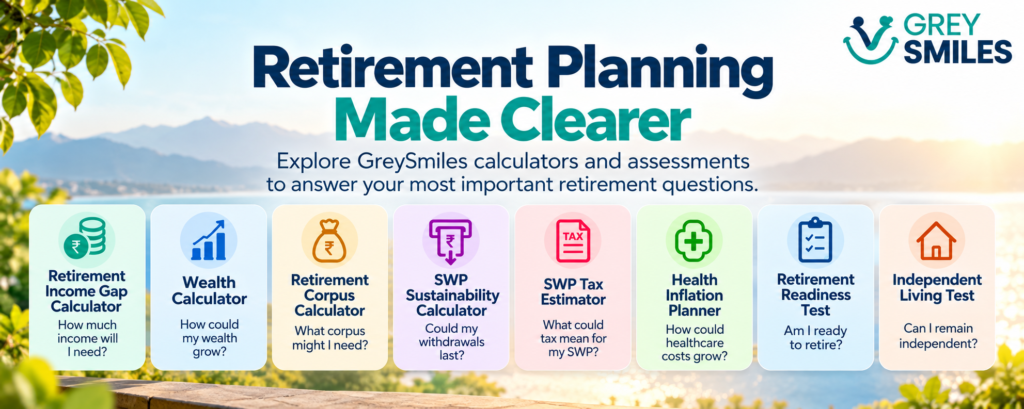
The GreySmiles Retirement Income Gap Calculator helps you compare your expected retirement spending with the income you expect to receive, so you can understand how much your own financial resources may need to cover.
Do You Have Enough for Retirement?
Estimate whether your current savings and expected retirement needs are broadly aligned.
The question of whether you have enough is explored in more detail in our article Do I Have Enough Money to Retire?. If you are already retired and are thinking about drawing regular income from your investments, our SWP Calculator can help you understand the numbers behind withdrawals.
You can also read our guide on how to withdraw from your retirement corpus to understand why retirement income is not simply about choosing a withdrawal amount.
Can your spouse understand the money too?
There is another part of retirement money planning that is often overlooked. Could your spouse find and understand your financial information if you were suddenly unable to manage it? It is not enough for one person in the household to know where the EPF account is, which FDs are due for renewal, where investments are held or what insurance policies exist.
Basic visibility can make a difficult situation considerably easier for the family. A simple list of accounts, investments, nominees, important documents and key contacts can be more valuable than another complicated investment decision. Retirement planning is also a household exercise, as we discuss in Retirement Is Not an Individual Event. It Is a Family Journey.
Five questions worth asking yourself
Before you look at another investment product, take a step back and ask yourself five basic questions:
- How much of my retirement money is immediately accessible?
- How much is intended to remain invested or untouched for the long term?
- When will my major FDs and other investments mature?
- How will I meet regular expenses without a salary?
- Could my spouse or family understand and manage the financial picture if required?
If you cannot answer these questions easily, that does not necessarily mean you are financially unprepared. It may simply mean that your retirement money needs to be organised in a way that makes it easier for you to understand.
GreySmiles TakeYour retirement corpus is a number. Your retirement money is a system.
The real comfort comes from knowing what you have, where it is, when you can access it and what role each part is expected to play. You do not need to make every decision today. Start by making your money visible and understandable.
Frequently Asked Questions
Is having a large retirement corpus enough?
Not necessarily. The size of your corpus matters, but so do your spending needs, time horizon, accessibility of funds, inflation, healthcare costs and how you plan to generate income after retirement. Our retirement FAQs cover several of these questions in more detail.
Should all retirement money be kept in FDs?
There is no single answer that works for everyone. FDs can provide predictability and may be useful for certain needs, but retirement planning also needs to consider inflation, liquidity, taxes, longevity and the role of other assets.
What is FD laddering?
FD laddering means spreading deposits across different maturity dates instead of having all of them mature at the same time. It can provide greater flexibility over when money becomes available.
Should I keep track of EPF, PPF and NPS separately?
Yes. These are different retirement savings vehicles with different rules and access conditions. Understanding each separately can help you know how much of your overall retirement wealth is actually available at different stages.
Sources & References
For official information on retirement savings and withdrawal rules, refer to the EPFO, PFRDA and India Post websites.
GreySmiles provides general information and decision-support tools. This article is not personalised financial, investment, tax or legal advice. Rules and product terms can change, so readers should verify current rules with the relevant institution or a qualified professional.



Start the conversation
Share a helpful experience, ask a thoughtful question, or add another perspective for fellow readers.