
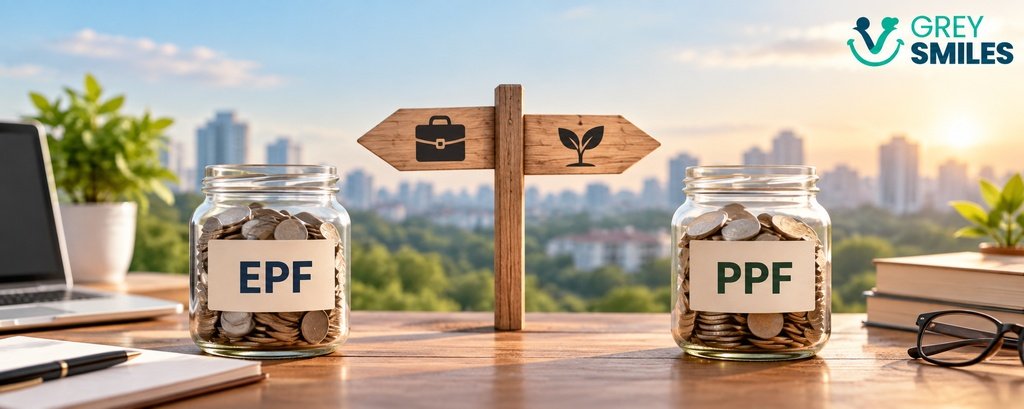
EPF and PPF can play different roles in a retirement portfolio.
By Kartikey Gupta: Kartikey Gupta is a finance professional with 6+ years of experience across capital markets, insurance and financial services.
He is a CMT and CFA Level II qualified professional and writes on retirement planning, investing and financial security.
If you are a salaried employee, EPF may already be quietly building your retirement savings every month. Then you hear about PPF. It is long-term, relatively stable and often recommended as another way to build retirement savings. The obvious question is: if I already have EPF, do I really need PPF?
There is no universal answer. The more useful question is what each one is already doing in your financial life, and whether adding PPF actually fills a gap in your retirement plan.
At a Glance
- EPF and PPF are both long-term savings vehicles, but they enter your financial plan differently.
- EPF is linked to eligible employment and may include employer contributions, while PPF is an individual long-term savings account.
- Having EPF does not automatically mean you need PPF, just as having PPF does not mean you have enough for retirement.
- The right question is whether your overall portfolio has enough stability, growth, liquidity and retirement income potential.
- Before adding more money to PPF, look at your entire retirement portfolio and identify what is actually missing.
Start With What You Already Have
This is the step people often skip. A salaried person may already have EPF accumulating through employment. There may also be NPS, mutual funds, fixed deposits, insurance products, property and bank savings. Adding PPF without looking at the whole picture can simply create another account without solving a particular retirement problem.
Suppose your EPF balance is growing steadily and your other investments already provide a substantial amount of stable, long-term savings. In that situation, the question is not whether PPF is a good product. The question is whether putting your next rupee into another relatively stable, long-term instrument is the best use of that money.
Someone with very little stable long-term savings may look at the same PPF account differently. That is why two people of the same age and earning a similar salary can reach different conclusions.
As GreySmiles explains in its retirement planning guide for salaried employees, EPF can be an important building block, but it should not be mistaken for the entire retirement plan.
EPF and PPF Do Different Jobs
EPF forms part of the employment-linked retirement savings system for eligible employees. Contributions flow through the employment arrangement, and the accumulated balance earns interest according to the applicable EPF provisions. You can check the latest rules and account-related information directly with the Employees’ Provident Fund Organisation (EPFO).
PPF works differently. It is an individual long-term savings scheme that you can build independently of your employer. That can make it useful when you want a separate long-term savings bucket that does not depend on your current employment.
| What matters | EPF | PPF |
|---|---|---|
| How you contribute | Linked to eligible employment and applicable contribution arrangements | You contribute to your own PPF account |
| Employer contribution | Can form part of the employment-linked arrangement | No employer contribution |
| Primary role | Employment-linked retirement savings | Individual long-term savings |
| Investment character | Provident-fund savings with applicable interest | Government-backed long-term savings scheme with notified interest |
| Liquidity | Withdrawal and transfer depend on applicable EPF rules and circumstances | Long-term structure with specific withdrawal and maturity provisions |
Why EPF Can Be Hard to Ignore
For an eligible employee, EPF has one feature that a standalone investment cannot simply reproduce: the employment-linked contribution structure.
If your employer contributes as part of the applicable EPF arrangement, your retirement savings are not coming entirely from money you have to set aside independently. That makes EPF an important foundation for many salaried employees.
This is also why comparing EPF and PPF purely on interest rates can miss the bigger picture. You need to consider what actually goes into the account, how much comes from your own income, what your employer contributes and how the account fits into your wider retirement benefits.
EPF also needs to be distinguished from EPS. They are related within the employment-linked system, but they do not represent the same retirement benefit. Your EPF balance and any pension entitlement under EPS should not be treated as one retirement bucket.
GreySmiles looks at this distinction in Can You Retire Early and Live Off Your EPF?, particularly for people who are tempted to treat an EPF balance as if it were a monthly pension.
Where PPF Can Add Something Different
PPF gives you a way to build long-term savings outside the employer relationship. That can matter if you change jobs, become self-employed, take a career break or simply want another long-term savings bucket that you control independently.
It can also make sense for someone who wants part of the portfolio in a relatively stable, long-term instrument while other investments provide greater growth potential.
The trade-off is that PPF is designed for the long term. That structure can be useful for retirement planning, but it also means you should not put money into PPF simply because it feels safe if you expect to need that money for a near-term goal.
Safety Is Only One Part of Retirement Planning
When people compare EPF and PPF, the conversation often stops at safety. Retirement planning needs a wider lens.
Your retirement portfolio has to balance stability, growth, liquidity, inflation protection and the ability to generate income later. A portfolio made almost entirely of stable savings may feel comfortable today but may not grow enough to support a retirement that could last decades. A portfolio heavily exposed to market-linked assets can create a different problem when markets fall at the wrong time.
Your age, retirement date, existing corpus, expected retirement spending, other income, liabilities and ability to absorb market losses all matter. GreySmiles explores this broader question in Smart Investment Options for Retirement in India.
So, Should You Add PPF If You Already Have EPF?
Sometimes yes. It should, however, be a portfolio decision rather than an automatic next step.
Imagine two people aged 45. The first has a healthy EPF balance, substantial PPF savings, several fixed deposits and very little exposure to growth assets. Adding still more PPF may increase the stable part of the portfolio without addressing the person’s actual retirement gap.
The second has EPF but very little other long-term savings. Most of the family’s financial assets sit in bank accounts, and there is no clearly defined retirement corpus outside EPF. PPF could play a useful role in building another long-term savings bucket.
Same age. Similar product. Very different portfolio problem.
Look at Your Next Rupee, Not Just Your Existing Accounts
A simple way to think about the decision is to stop asking, “Should I invest in PPF?” and ask instead, “Where should my next ₹1 lakh go?”
If your retirement portfolio already contains enough stable assets, your next allocation may need to provide more long-term growth. If you have substantial market exposure but very little stable savings, the answer could be different. If you have a major expense coming up, neither EPF nor PPF may be the right destination for that particular money.
If you have not yet worked out how much retirement may cost, choosing between EPF and PPF is premature. The first step is to understand the size of the retirement gap you are trying to close.
A Simple Check Before You Add More
Before increasing your PPF contribution, ask yourself five questions:
- How much retirement money do I already have? Include EPF, PPF, NPS, mutual funds, deposits and other financial assets genuinely available for retirement.
- How much of it is relatively stable? Look at the entire portfolio rather than judging one account in isolation.
- How much needs long-term growth? A retirement corpus may need to support you for decades, so today’s balance cannot be viewed in isolation.
- How much needs to remain accessible? Emergency money and money required soon should not automatically become retirement money.
- How much will retirement actually cost? Without this number, it is difficult to know whether another ₹5 lakh or ₹10 lakh in PPF meaningfully changes your retirement plan.
What About VPF?
If you are an eligible employee and already have EPF, you may also come across VPF, or Voluntary Provident Fund. VPF allows an employee to voluntarily contribute more towards the provident-fund account, subject to the applicable rules.
That creates a wider question: should additional long-term savings go into VPF, PPF, NPS or another investment? There is no universal answer. The comparison needs to consider your existing EPF balance, tax position, liquidity requirements, asset allocation and retirement target.
GreySmiles already covers the subject in detail in Managing Your Provident Fund Through VPF, so there is little value in repeating that discussion here.
Don’t Confuse a Retirement Corpus With Retirement Income
This distinction is easy to miss. EPF and PPF can help you build a corpus, but neither should automatically be interpreted as the monthly income you will receive in retirement.
At some point, the accumulated money has to support actual spending. You may have pension income, investment withdrawals, annuity income, interest income or a combination of these. The size of your EPF or PPF balance matters, but the bigger question is whether your total assets and income sources can support the life you expect to live.
GreySmiles explores this transition from retirement corpus to monthly retirement income in more detail.
GreySmiles Calculators
Know the Number Before Choosing the Product
Before deciding whether your next investment should go into PPF, VPF, NPS, mutual funds or another option, first understand what your retirement may actually require. Then look at whether your existing corpus can support the income you will need.
Retirement Corpus Calculator
Estimate the retirement corpus you may need based on your expenses, inflation, retirement age and expected returns.
SWP Calculator
Once you have a corpus, see how a systematic withdrawal approach could translate that money into regular retirement income.
These are illustrative planning tools. Actual investment outcomes will vary.
EPF vs PPF: What Should You Prioritise?
For an eligible salaried employee, EPF will often be the natural starting point because it is linked to employment and may include employer contributions. PPF can complement that foundation when you want to build additional long-term savings independently of your employer.
The important point is not to turn “EPF versus PPF” into a permanent rule such as “EPF first” or “PPF first”. If your retirement portfolio already contains substantial stable assets, putting every additional rupee into another stable instrument may leave a different part of the plan underfunded. If your overall retirement corpus remains well below what you need, the answer may involve increasing your savings rate, changing your asset allocation, delaying retirement or finding a better balance between stability and growth.
The right decision therefore depends less on which product sounds better and more on what your retirement portfolio needs next.
GreySmiles Take
EPF and PPF are not really competing for the same trophy. For an eligible employee, EPF can form an important retirement foundation because it is linked to employment and may include employer contributions. PPF can provide a separate long-term savings bucket outside that employment relationship.
The mistake is choosing between them without looking at everything else you own.
Before putting more money into either one, look at your entire retirement portfolio and ask what is missing. The right investment is the one that helps close that gap.
Frequently Asked Questions
Is EPF better than PPF for retirement?
For an eligible salaried employee, EPF has an important advantage because it is part of the employment-linked retirement savings arrangement and may include employer contributions. PPF can complement EPF by providing a separate long-term savings account. Whether you need more PPF depends on your overall portfolio rather than on one product in isolation.
Can I invest in both EPF and PPF?
Yes. They can coexist in a retirement plan. The more useful question is whether the combination gives you the balance of stability, growth, liquidity and long-term savings that your particular retirement plan requires.
If I already have EPF, do I need PPF?
No, not automatically. If your EPF and other assets already provide enough stable long-term savings, additional PPF may not be your highest priority. If you need another long-term savings bucket outside your employment-linked EPF, PPF may have a useful role.
Is PPF safer than EPF?
It is better not to frame the decision simply as one being “safer”. They are different schemes with different rules, contribution structures and withdrawal provisions. The more useful question is what role each one plays in your financial plan.
Should I choose PPF or mutual funds for retirement?
They serve different portfolio needs. PPF can provide a relatively stable long-term savings component, while mutual funds can provide different types of market exposure and potentially greater long-term growth, depending on the fund and investment strategy.
What if my EPF balance is already large?
A large EPF balance does not automatically mean you have enough for retirement. Look at your expected retirement spending, other income, inflation, healthcare needs and the rest of your assets before deciding what to do with additional savings.
Sources & References
For current information on EPF rules, account provisions and applicable processes, refer to the Employees’ Provident Fund Organisation. For current tax provisions and related rules, refer to the Income Tax Department.
EPF and PPF rules, interest rates, tax provisions, contribution limits and withdrawal conditions can change. Check the latest official information before making a financial decision.
This article is intended for general information and does not constitute financial, investment, tax or other professional advice.




Start the conversation
Share a helpful experience, ask a thoughtful question, or add another perspective for fellow readers.