
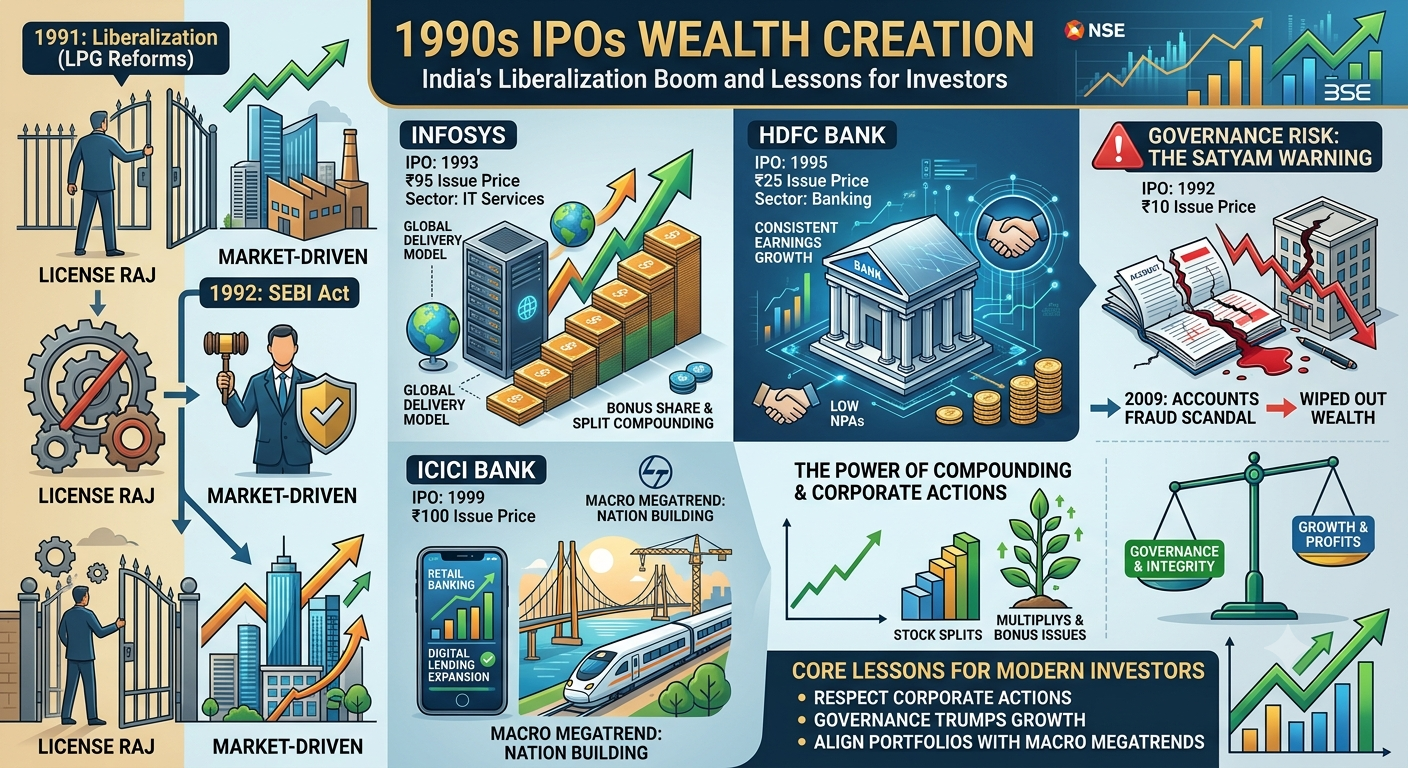
Architects of wealth: How landmark 1990s IPOs, market reforms, and corporate compounding shaped modern Dalal Street.Analyzing the legacy of 1990s IPOs wealth creation reveals how India’s economic liberalization reshaped capital markets and generated unprecedented generational wealth. Driven by the 1991 Liberalization, Privatization, and Globalization (LPG) reforms, India transitioned from a heavily regulated “License Raj” economy toward an open, market-driven financial system. The statutory establishment of market regulators provided transparency, prompting pioneering firms in technology, banking, and infrastructure to go public. In this detailed analysis, we evaluate the growth engines of the 1990s IPO boom, examine corporate governance risk lessons, review multi-decade compounding performance, and unpack key strategies for modern equity investors.
Article Navigation
1. The Growth Engines: Landmark 1990s Public Debuts
To evaluate the true scope of 1990s IPOs wealth creation, investors must look beyond simple stock price appreciation and account for continuous corporate actions—such as bonus share issuances, stock splits, and reinvested dividend income—that drastically multiplied long-term share counts.Infosys Technologies (IPO: 1993)
When Infosys launched its public offering in 1993 at an issue price of ₹95 per share, market skepticism surrounding India’s software export sector left the IPO initially undersubscribed. Bailed out by institutional underwriters, Infosys went on to pioneer the global IT delivery model. Repeated 1:1 bonus issues and splits over thirty years turned a single lot into massive capital wealth, proving how early exposure to high-margin export sectors fuels long-term portfolios.To learn how to harness similar multi-decade compounding power in modern equity markets, read our comprehensive guide on small-cap mutual funds compounding on Greysmiles.HDFC Bank (IPO: 1995)
Debuting at ₹25 per share during the early deregulation of private banking, HDFC Bank prioritized prudent asset quality control, low non-performing assets (NPAs), and aggressive digital technology adoption. Over three decades, it compounded earnings at over 20% annually, evolving into one of India’s largest private financial institutions.ICICI Bank (IPO: 1999)
Listing at ₹100 per share, ICICI Bank marked the transition of a developmental financial institution into a universal banking power. Despite surviving cyclical credit downturns, its strategic focus on retail asset expansion and digital banking enabled a multi-year balance sheet re-rating.Larsen & Toubro (L&T) (IPO Restructuring: 1992)
Following major capital restructuring in the early 1990s (priced around ₹75), L&T became the definitive proxy for India’s national infrastructure and capital expenditure (capex) story, benefiting directly from state-led construction of highways, power grids, and transit networks.Investors seeking to structure their portfolios to survive broader macroeconomic cycles can explore our breakdown of optimal portfolio asset allocation strategies on Greysmiles.2. Corporate Governance & Risks: The Satyam Warning
The story of 1990s IPOs wealth creation is incomplete without addressing systemic governance risks. Satyam Computer Services, which listed in 1992 at ₹10, was long celebrated as an IT export pioneer before collapsing in 2009 due to a ₹7,000+ crore accounting fraud involving falsified balance sheets and fictitious cash reserves.The subsequent crash wiped out thousands of crores in retail wealth before government intervention facilitated an auction to Tech Mahindra. The Satyam scandal remains an enduring reminder that revenue growth cannot compensate for compromised management integrity. Official regulatory frameworks established by the Securities and Exchange Board of India (SEBI) continue to enforce strict governance norms to prevent similar systemic failures.3. Historical Performance & Corporate Actions Overview
The table below summarizes the trajectories of major 1990s public debuts and their long-term wealth creation drivers across Indian exchanges like the National Stock Exchange (NSE) and the BSE.| Company Name | IPO Year | Issue Price (₹) | Sector | Primary Long-Term Value Driver |
|---|---|---|---|---|
| Infosys | 1993 | ₹95 | IT Services | Global delivery model; heavy bonus & split compounding. |
| HDFC Bank | 1995 | ₹25 | Banking | Consistent 20%+ earnings growth; pristine credit quality. |
| ICICI Bank | 1999 | ₹100 | Banking | Systemic scale; digital retail lending expansion. |
| Larsen & Toubro | 1992 | ₹75 | Infrastructure | Direct macro play on national infrastructure capex. |
| Satyam Computers | 1992 | ₹10 | IT Services | Erased by 2009 fraud scandal; acquired by Tech Mahindra. |
4. Core Lessons for GenZ and Millennial Investors
- Respect the Power of Corporate Actions: Evaluating historical IPOs solely by absolute share price changes ignores the multiplication of shares via splits and bonuses. Long-term wealth lies in expanding total share counts while earnings compound.
- Governance Trumps Growth: Accounting integrity, board independence, and transparent auditor reports are far more vital than top-line growth rates.
- Align Portfolios with Macro Megatrends: The most successful companies from the 1990s IPO era rode secular tailwinds—IT globalization and middle-class financialization.




Start the conversation
Share a helpful experience, ask a thoughtful question, or add another perspective for fellow readers.