
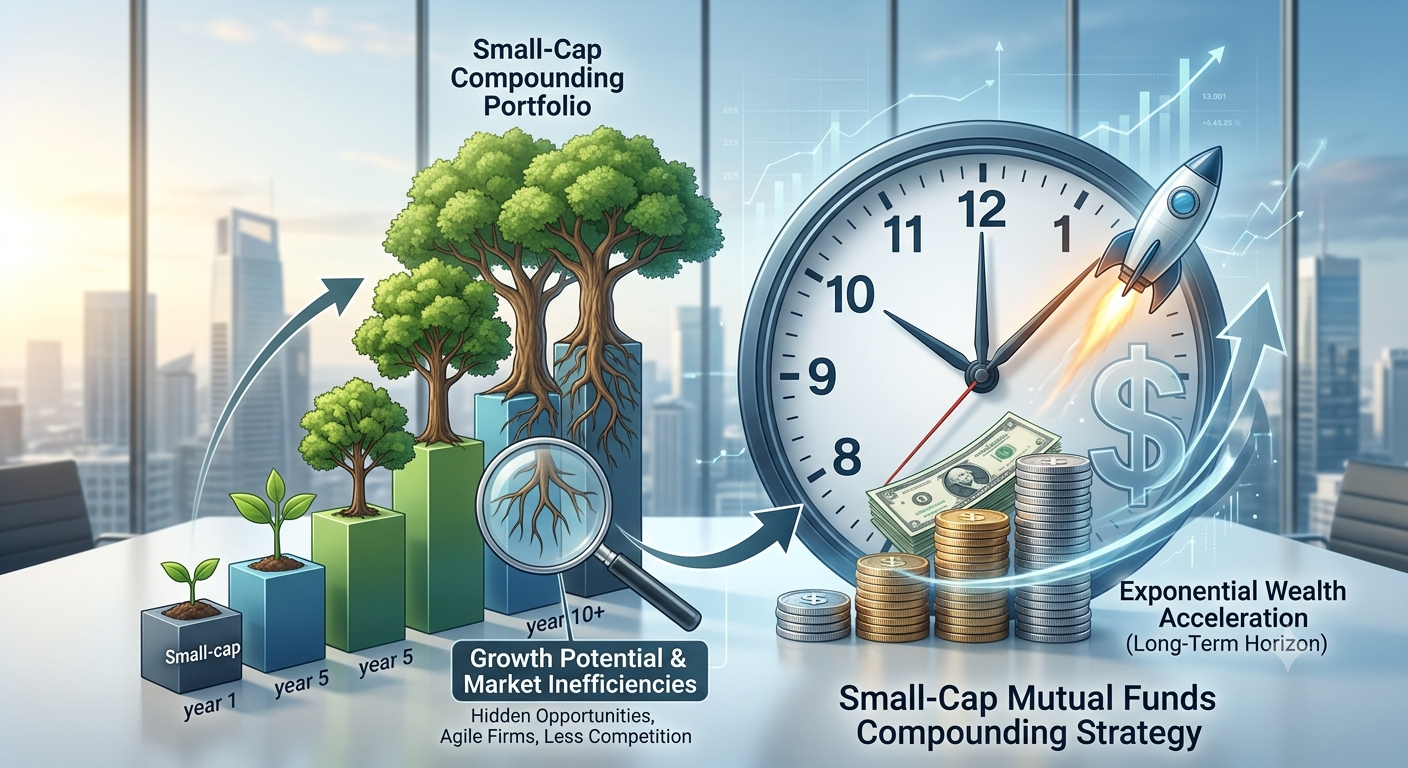
Unlocking the power of small-cap mutual funds compounding allows ambitious investors to accelerate portfolio growth far beyond traditional large-cap returns. While mature blue-chip corporations provide baseline stability, smaller enterprises operate with high agility and massive runaway for market expansion. By capturing emerging market trends, exploiting institutional pricing inefficiencies, and systematically reinvesting capital, these dynamic funds dramatically alter portfolio growth curves over extended time horizons. In this guide, we explore how higher growth velocity and return potential combine with under-researched market inefficiencies to create superior diversification and compounding benefits—along with the tactical risk-management framework you need to execute safely.
Article Navigation
1. Explosive Growth Velocity and Superior Historical Returns
Mid-cap and small-cap companies occupy a unique growth sweet spot within the corporate life cycle. Unlike mature mega-cap corporations that face structural revenue plateaus, smaller enterprises operate with high agility and significant runway for market expansion.
- Accelerated Earnings Trajectory: Emerging companies typically reinvest a larger share of operational profits back into research, talent, and expansion. This continuous reinvestment cycle enables exponential percentage jumps in top-line revenue during economic expansion phases.
- Market Share Acquisition: Nimble mid-cap and small-cap firms frequently disrupt legacy industry players by adopting modern technology stacks and customer-centric models faster than bureaucratic large-cap competitors.
- High Risk-Reward Premium: Industry data published by authorities such as the Association of Mutual Funds in India (AMFI) demonstrates that while small- and mid-cap indices experience higher short-term volatility, their rolling 7-to-10-year returns consistently outperform broader market benchmarks.
To learn how to structure your foundational savings before entering high-growth equities, read our detailed guide on building a secure financial foundation on Greysmiles.
2. Institutional Inefficiencies and Niche Market Dominance
The structural layout of public equity markets creates distinct informational advantages for active fund managers who specialize in small-cap mutual funds compounding over time.
Under-Researched Valuation Gaps
Large-cap stocks are heavily covered by hundreds of institutional analysts, leaving little room for mispricing. Conversely, many mid-cap and small-cap companies receive limited coverage from mainstream brokerages. This lack of institutional scrutiny creates pricing inefficiencies—allowing skilled mutual fund managers to identify undervalued, high-quality businesses before the broader market recognizes their intrinsic value.
Niche Dominance and Acquisition Upside
Smaller companies often lead specialized, high-margin niche industries—such as green energy components, specialized pharmaceuticals, or niche SaaS applications—that large conglomerates cannot enter efficiently. Furthermore, these high-growth firms frequently become strategic acquisition targets for industry giants, delivering substantial buy-out premiums to equity shareholders.
3. The Mathematics of Long-Term Compounding & Diversification
Compounding is fundamentally driven by time and rate of return. A modest increase in annualized return (CAGR) yields an exponentially larger final portfolio balance over a multi-decade horizon.
| Feature | Large-Cap Funds | Mid-Cap Funds | Small-Cap Funds |
|---|---|---|---|
| Growth Velocity | Moderate / Stable | High Growth | Very High / Explosive |
| Volatility Level | Low to Moderate | Moderate to High | High to Extreme |
| Ideal Investment Horizon | 3 to 5 Years | 5 to 7 Years | 7 to 10+ Years |
| Market Liquidity | Very High | Moderate | Varies / Moderate |
When investors systematically reinvest capital gains through automated Systematic Investment Plans (SIPs), the compounding effect multiplies. Navigating these volatile asset classes requires a disciplined rebalancing strategy. Explore our comprehensive breakdown on optimal portfolio diversification and asset allocation on Greysmiles to balance risk across market capitalizations.
For additional strategies on multi-income streams and early financial exit math, check out our guide on the career-bifurcation side-hustle model on Greysmiles. For third-party market research and historical fund performance analytics, consult platforms like Morningstar or regulatory framework updates from the Securities and Exchange Board of India (SEBI).
4. Managing Volatility: Tactical Allocation Framework
While small-cap and mid-cap funds offer outsized returns, they are susceptible to sharp cyclical drawdowns during market corrections. To harness their growth potential without exposing your wealth to catastrophic risk, follow these risk-mitigation rules:
- Maintain a 7+ Year Time Horizon: Never allocate short-term liquidity or emergency funds to volatile equity funds. Extended time horizons smooth out market corrections and allow small-cap mutual funds compounding mechanics to function uninterrupted.
- Use Systematic Dollar-Cost Averaging (SIP): Investing lump sums during market peaks can result in prolonged recovery periods. Systematic monthly allocations help average out purchase costs across bull and bear cycles.
- Implement a Core-Satellite Strategy: Keep large-cap index funds or defensive assets as your “core” portfolio (50%–60%) for stability, while utilizing mid-cap and small-cap funds as “satellite” holdings (30%–40%) to drive portfolio alpha.
Frequently Asked Questions
Why do small-cap mutual funds compounding trajectories outperform large-caps over 10 years?
Smaller companies have greater operational headroom to expand revenue and market share compared to mature mega-cap firms. When managed actively, these higher underlying business growth rates translate directly into superior long-term compounded investment returns.
What is the minimum recommended holding period for small-cap funds?
Investors should commit to a minimum investment horizon of 7 to 10 years when allocating capital to small-cap funds. This extended timeline allows funds to recover from short-term market cycles and capture the full growth cycle of underlying businesses.
How much of my portfolio should be allocated to mid-cap and small-cap funds?
An ideal allocation depends on your personal risk tolerance and age. Generally, moderate-to-aggressive growth portfolios allocate between 20% and 40% of their total equity investment across mid-cap and small-cap funds, with the remainder anchored in stable large-cap or flexi-cap funds.
Are small-cap funds safe during economic recessions?
Small-cap stocks experience higher volatility and larger drawdowns during economic downturns due to liquidity constraints and smaller balance sheets. However, they historically rebound sharply during early economic recoveries.
Final Thoughts: Balancing Acceleration with Discipline
Mid-cap and small-cap mutual funds represent the high-performance engines of long-term wealth accumulation. By combining patient holding periods with automated systematic investing, smart investors tap into the early stages of enterprise growth while maintaining a balanced, resilient portfolio.




Start the conversation
Share a helpful experience, ask a thoughtful question, or add another perspective for fellow readers.