
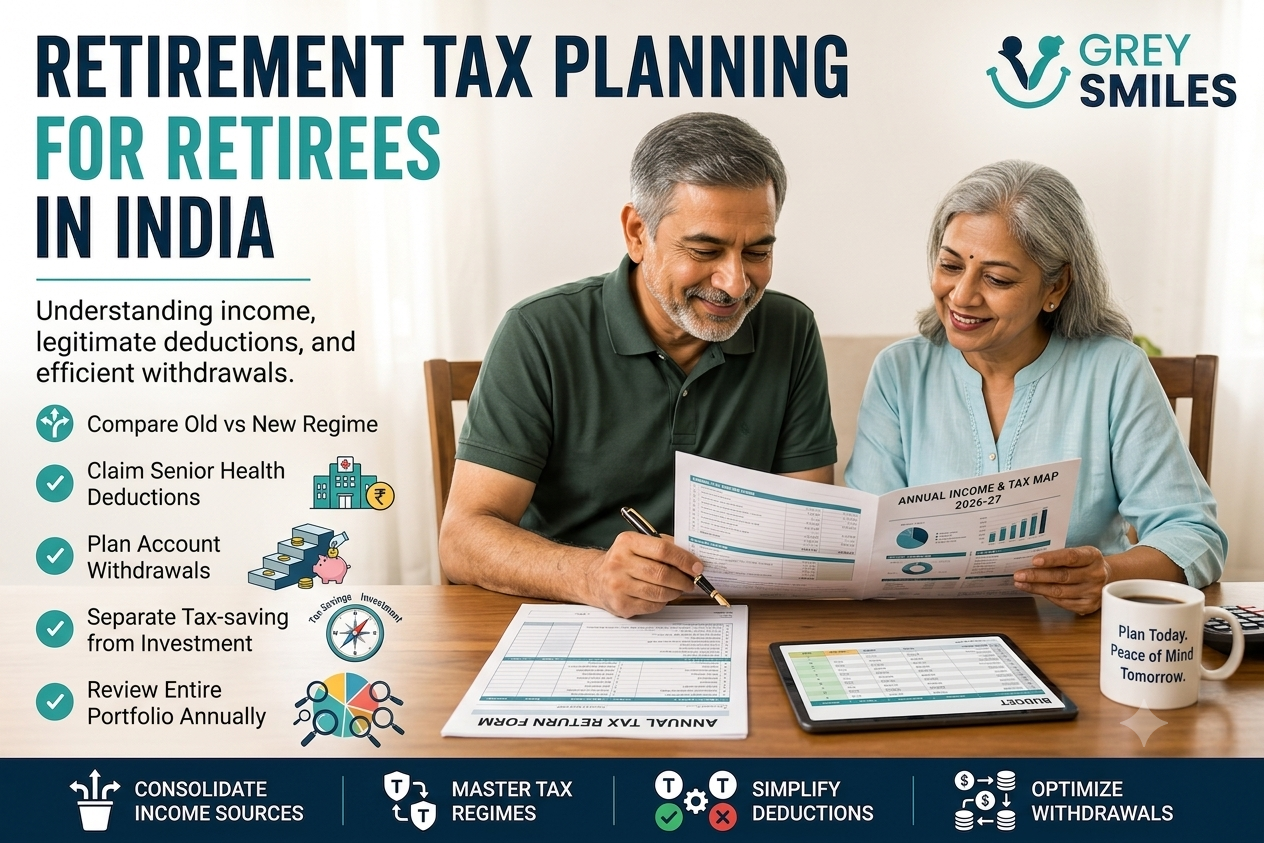
A comprehensive guide to understanding income regimes, senior citizen tax deductions, and withdrawal strategies for retirees in India.
By CA Garvit Maheshwari · Chartered Accountant
Retirement changes more than your daily routine. It can change the way your income is taxed too. Salary may give way to pension, bank interest, dividends, rental income and capital gains, often coming from several accounts and investments at the same time.
That makes tax planning an important part of retirement planning. The objective is not to avoid tax or chase complicated products. It is to understand which income is taxable, which deductions you can legitimately claim, which tax regime suits your situation and, importantly, when and how you withdraw your money.
At a Glance: The 5 Tax Moves Retirees Should Review Every Year
- Compare the old and new tax regimes. The new regime is the default, but eligible taxpayers can opt for the old regime. The better choice depends on your income and eligible deductions.
- Check senior-citizen deductions. Health insurance, specified medical treatment and deposit interest can receive tax benefits under the old regime when the relevant conditions are met.
- Plan withdrawals. Selling investments or withdrawing large amounts in one year can create a very different tax outcome from spreading transactions across financial years.
- Separate tax-saving from investment decisions. A product should not be bought merely because it offers a deduction.
- Review the entire portfolio once a year. Pension, interest, dividends, rent and capital gains should be looked at together rather than account by account.
Important: Tax rules change. This article reflects the framework applicable to Tax Year 2026–27 and the current official guidance available at the time of publication. Always verify the rules applicable to your specific tax year before filing.
First, Understand the Tax Regime You Are Actually Using
For many retirees, the first tax decision is not about a deduction. It is about choosing between the old tax regime and the new tax regime.
The new regime is the default regime for individuals and HUFs, but eligible taxpayers can opt out and choose the old regime. For taxpayers without business or professional income, the regime choice can generally be made each year in the return.
The important point is that there is no universal answer to “Which regime is better for senior citizens?” A retiree with substantial eligible deductions may find the old regime more attractive, while another retiree with relatively simple income and few deductions may prefer the new regime.
| What to compare | Old regime | New regime |
|---|---|---|
| Default? | No | Yes |
| Most Chapter VI-A deductions | Generally available if conditions are met | Generally not available, subject to specified exceptions |
| Senior-citizen slab benefit | Yes | No separate senior-citizen slab; slabs are age-neutral |
| Best starting point | Add up your eligible deductions and exemptions | Start with taxable income under the simpler slab structure |
The Income Tax Department provides an official tax calculator and e-filing portal that can be used to compare tax under the two regimes.
Do not make this mistake
Do not choose a regime simply because someone tells you “the new regime is better” or “senior citizens should always use the old regime.” Run the numbers using your actual income, deductions and capital gains for that tax year.
2. Don’t Leave Senior-Citizen Tax Benefits Unchecked
The old regime continues to offer several provisions that can matter to retirees. These are not automatic tax discounts; you have to satisfy the relevant conditions and claim them correctly.
Section 80D: Health Insurance and Certain Medical Expenses
For eligible taxpayers under the old regime, Section 80D can provide a deduction for health insurance premiums. The limit can be higher where a senior citizen is involved, and eligible medical expenditure on a senior citizen may also qualify where the prescribed conditions are met and no health insurance premium is paid for that person. The Income Tax Department currently lists a ₹50,000 limit for the senior-citizen component.
This is particularly relevant during retirement because healthcare expenses can become a significant part of annual spending. Tax planning should therefore sit alongside your broader healthcare and retirement-income planning rather than being treated as a separate exercise.
If healthcare costs are already a concern, GreySmiles’ guide on home ICU and nursing-care costs in India provides useful context on another major retirement expense.
Section 80DDB: Specified Diseases
Section 80DDB can provide a deduction for eligible expenditure on treatment of specified diseases. The current Income Tax Department guidance states that the deduction limit for a senior citizen can be up to ₹1 lakh, subject to the applicable conditions and documentation.
Section 80TTB: Interest on Deposits
Resident senior citizens can claim a deduction of up to ₹50,000 on eligible interest from deposits under Section 80TTB under the old regime. This can be relevant for retirees who rely heavily on fixed deposits, savings accounts or other qualifying deposits for regular income.
Remember that the deduction is not the same thing as “₹50,000 of interest is tax-free.” It is a deduction from eligible income, and the eventual tax benefit depends on the person’s overall taxable income and applicable tax rate.
3. Pension Income Needs to Be Looked at Differently From Investment Income
Retirees often receive several types of income in the same year, and each can have different tax treatment. Pension, bank interest, rental income, dividends and capital gains should therefore not be mentally grouped together as “retirement income.”
For example, a pension may be treated differently from capital gains arising from the sale of mutual funds. Interest from deposits is another category, while rental income has its own computation rules.
This is why a simple annual income map is so useful:
| Income source | What to review |
|---|---|
| Pension | Gross pension, standard deduction and applicable regime |
| Bank/Post Office interest | Total interest across institutions and eligible deductions |
| Mutual funds/shares | Short- and long-term gains, transaction timing and applicable exemptions/rates |
| Rental income | Rental receipts, eligible deductions and ownership structure |
| Dividends | Aggregate income and TDS reported by different institutions |
4. The Biggest Opportunity May Be How You Withdraw Your Money
Retirees often focus heavily on finding the “best investment.” But once you are retired, another question becomes equally important: How and when should I take money out?
Suppose you need ₹12 lakh for a major expense. The tax outcome may be different if you sell investments or realise gains in one year compared with a carefully planned withdrawal spread across different tax years, where the nature of the income and applicable rules allow it.
This does not mean every withdrawal should be delayed. It means the withdrawal should be treated as a financial decision rather than simply an ATM transaction from your investment portfolio.
Consider Staggering Large Redemptions
Where appropriate, large redemptions can sometimes be planned across tax years. This needs to be assessed based on the investment, the type of gain, holding period, applicable capital-gains rules and your wider income for each year.
The objective is not to manipulate transactions artificially. It is to avoid creating an unnecessarily large taxable event simply because a withdrawal happened at an inconvenient time.
Review SWPs Carefully
A Systematic Withdrawal Plan can provide regular cash flow from mutual funds, but an SWP is not automatically “tax-free” or inherently more tax-efficient. Each withdrawal has tax implications based on the underlying units redeemed and the applicable capital-gains rules.
For retirees, the value of an SWP is often its ability to create a disciplined cash-flow system. The tax treatment should then be analysed alongside the investment strategy.
This is closely connected to a larger retirement question: how much should you withdraw each year without compromising the sustainability of your retirement corpus? GreySmiles’ Retirement Readiness Test can help readers think more broadly about whether their retirement finances are ready for the years ahead.
5. Capital Gains Need Their Own Retirement Tax Strategy
Capital gains can become particularly important after retirement because retirees may gradually rebalance equity, mutual funds, property or other investments accumulated during their working years.
Do not assume that selling an investment means the entire sale value is taxable. Generally, tax is concerned with the applicable gain, not simply the gross amount received. But the exact calculation depends on the asset, acquisition date, holding period and applicable capital-gains provisions.
For listed equity and equity-oriented investments covered by Section 112A, the current framework includes an annual threshold for long-term capital gains before tax applies. The Income Tax Department’s current filing guidance reflects a ₹1.25 lakh threshold for eligible Section 112A gains.
Because capital-gains rules can change and different assets are taxed differently, retirees should avoid applying a single “capital gains rule” to shares, mutual funds and property.
6. Be Careful With Property Sales and Reinvestment
Retirement is often the point at which people right-size their homes. A large family house may no longer make sense, or a second property may become difficult to manage.
Selling property can create capital gains, but there are circumstances in which reinvestment into eligible residential property or other qualifying avenues can provide tax relief. These provisions come with specific conditions, timelines and restrictions.
That means “I’ll just reinvest it and avoid tax” is not a strategy. Before selling, calculate the likely gain and discuss the available exemptions with a qualified tax professional before the transaction is completed.
7. Don’t Create an HUF Just Because Someone Promises Tax Savings
Hindu Undivided Families can have legitimate tax and estate-planning roles in appropriate circumstances, particularly where genuine HUF assets and family arrangements already exist. But an HUF is not simply a second PAN that can be created to split any income a family chooses.
Whether an HUF makes sense depends on the source and ownership of assets, the family’s circumstances, documentation and the applicable tax rules.
If ancestral property, rental income or family assets are involved, this is an area where a CA should review the facts before any restructuring is undertaken.
Don’t confuse tax planning with tax engineering.
A structure that exists only on paper to create a deduction or split income can create compliance problems later. Legitimate tax planning begins with the actual ownership and purpose of the assets.
8. One Useful Senior-Citizen Relief: Advance Tax
Resident senior citizens who do not have income from a business or profession can receive relief from the advance-tax requirement under the applicable provisions. The Income Tax Department specifically lists this benefit for resident senior citizens without business or professional income.
This does not mean tax disappears. It means the timing and manner of paying the tax can be different. Retirees should still estimate their annual liability and ensure that sufficient tax is ultimately paid.
9. A Special Filing Relief for Some Seniors Aged 75+
There is a specific provision that can reduce the return-filing burden for certain resident senior citizens aged 75 years or above.
Section 194P applies where the senior citizen receives pension and interest income only, the interest is from the same specified bank where the pension is received, and the other prescribed conditions are satisfied. The required declaration is submitted to the specified bank, which calculates the tax and deducts it. Where the conditions are met, the senior citizen does not have to furnish an income-tax return.
This is quite different from saying that “people above 75 do not have to file returns.” The exemption is conditional, not automatic.
10. The New Income Tax Act Changes the Language You Will See
There is an important reason retirees may see different terminology in tax documents going forward. The Income Tax Act, 2025 came into effect from 1 April 2026 and repealed the Income Tax Act, 1961 for the new tax framework. The new system uses the term “tax year” rather than the old “previous year” and “assessment year” terminology for the new framework.
However, this transition does not mean older tax years suddenly become governed by the new Act. The Income Tax Department has clarified that earlier tax years and pending proceedings continue under the relevant provisions of the repealed Act.
For readers, the practical lesson is simple: always identify which tax year you are dealing with before applying a tax rule found online.
11. Build a Once-a-Year Retirement Tax Checklist
You do not need to think about tax every day. A structured annual review is usually far more useful.
Your Annual Retirement Tax Checklist
- List every source of income: pension, interest, rent, dividends, mutual funds, shares and other investments.
- Compare the old and new regimes using your actual numbers for the relevant tax year.
- Check senior-specific deductions such as eligible health insurance, medical treatment and deposit-interest deductions under the old regime.
- Review planned withdrawals before selling a large investment or property.
- Check capital gains separately rather than treating all investment income as ordinary income.
- Reconcile TDS and Form 26AS/AIS information so that income reported by banks, brokers and other institutions has not been missed.
- Review property and HUF structures if they form part of your retirement finances.
- Keep documentation: interest certificates, capital-gains statements, medical documents, insurance receipts and investment records.
- Run the numbers before making a major transaction. Tax planning done before a sale or withdrawal is generally more useful than trying to fix the outcome afterwards.
Tax Planning Should Follow Your Retirement Plan — Not Replace It
There is a temptation in retirement to chase every available deduction. But saving ₹10,000 in tax is not useful if it requires locking away ₹1 lakh into an unsuitable product. Similarly, avoiding a taxable capital gain should not automatically mean holding an investment you no longer want.
The correct sequence is: decide what you need your retirement money to do, choose investments that fit that purpose, and then structure the withdrawals and tax treatment efficiently.
This is why tax planning works best when it is part of the wider retirement conversation. GreySmiles’ Indian Wealth Journey: Retirement Planning from 30s to 60s looks at how financial decisions evolve across different stages of life and can be a useful companion piece for readers reviewing their retirement finances.
What Retirees Should Not Do
- Do not choose a tax regime based solely on what worked for a friend.
- Do not buy an investment product simply because someone says it is “tax-saving.”
- Do not assume all capital gains are taxed in the same way.
- Do not ignore small interest amounts across multiple bank accounts.
- Do not wait until after selling property or investments to ask about tax implications.
- Do not assume TDS means your tax return is automatically correct.
- Do not rely on a tax rule from an old article without checking the relevant tax year.
The Bottom Line
For retirees, maximizing post-tax returns is rarely about finding one clever loophole. It is about making a series of ordinary decisions well: choosing the appropriate tax regime, claiming legitimate deductions, understanding how different income sources are taxed and planning withdrawals before they happen.
The biggest improvement may come from simply bringing everything onto one page once a year. How much pension did I receive? How much interest did I earn across all banks? Did I realise capital gains? Did I sell property? Which deductions am I eligible for? What large withdrawals are coming next year?
Once you can see the entire picture, tax planning becomes much less intimidating.
The GreySmiles Takeaway
Retirement tax planning is not about paying the least tax at any cost. It is about keeping more of the money you are legitimately entitled to keep while making decisions that still serve your long-term retirement needs.
Frequently Asked Questions
Is the new tax regime better for senior citizens?
Not automatically. The new regime is the default, but eligible taxpayers can opt for the old regime. The right choice depends on income, deductions, investments and other individual circumstances. :contentReference
Can senior citizens claim Section 80TTB?
Resident senior citizens can claim a deduction of up to ₹50,000 on eligible interest from deposits under Section 80TTB, subject to the applicable conditions and regime. :contentReference
Can senior citizens claim a higher health-insurance deduction?
Under the old regime, Section 80D provides higher limits where a senior citizen is involved. The current Income Tax Department guidance lists ₹50,000 for the senior-citizen limit, subject to the applicable conditions.
Do people above 75 automatically avoid filing an income-tax return?
No. The special Section 194P relief applies only when specific conditions are satisfied, including age of 75 or above, resident status, pension and interest as the specified income sources, and interest being from the same specified bank where the pension is received. :contentReference
Should retirees spread investment withdrawals across years?
Sometimes, but not automatically. The decision depends on the type of investment, the nature of the gain, applicable capital-gains rules and your total income in each tax year. A planned withdrawal can be more tax-efficient than an unnecessarily large one-time transaction, but it should be assessed before selling.
Where can retirees check their current tax position?
The official Income Tax Department e-filing portal provides tax calculators, return-filing information and current guidance. Because tax rules change, it should be one of the first places to check before relying on an older tax article or calculation.
About the Author: CA Garvit Maheshwari is a Chartered Accountant who writes on retirement taxation, personal finance and practical tax planning.
Disclaimer: This article is for general educational and informational purposes only and does not constitute tax, investment or financial advice. Tax treatment depends on individual circumstances and the relevant tax year. The Income Tax Act, 2025 applies from 1 April 2026 for the new tax framework, while earlier tax years remain subject to the applicable transitional provisions. Tax rules, thresholds, exemptions and filing requirements can change. Readers should verify the current position with the Income Tax Department and consult a qualified Chartered Accountant or tax professional before making a significant financial or tax decision.




Start the conversation
Share a helpful experience, ask a thoughtful question, or add another perspective for fellow readers.