
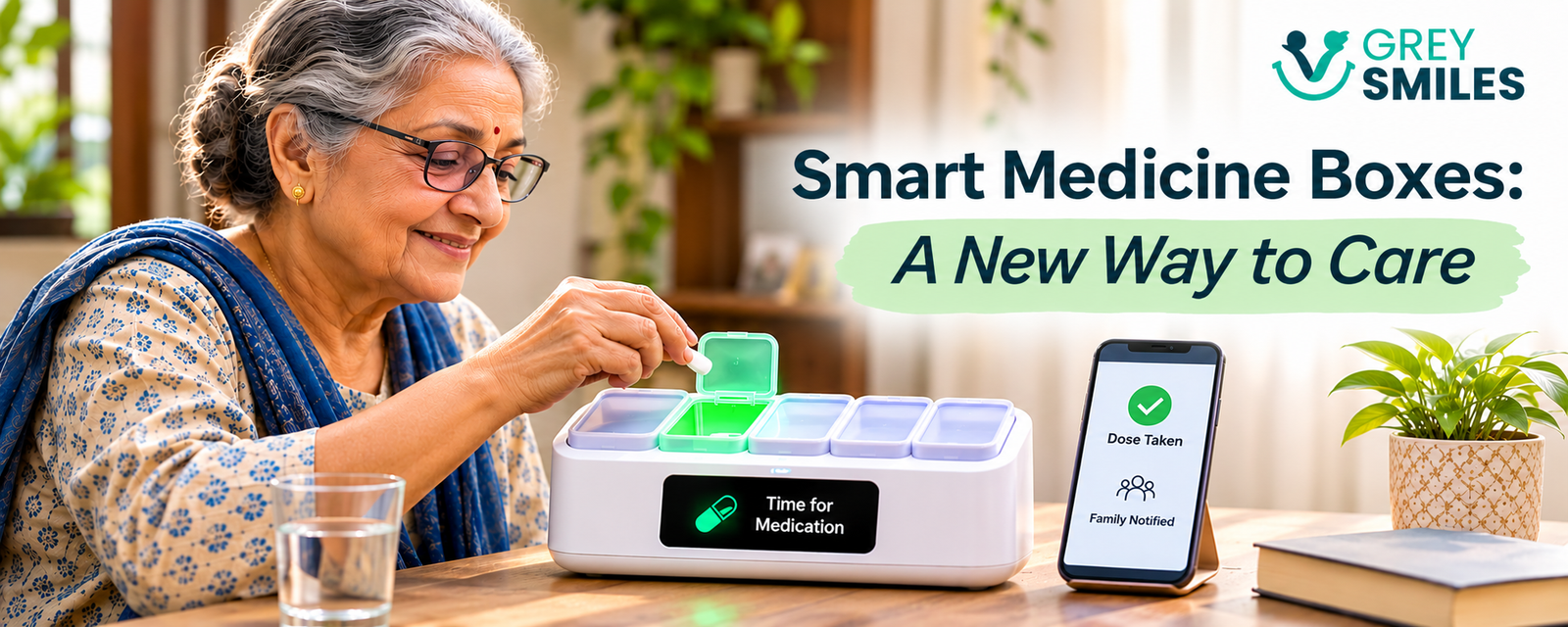
Smart medicine boxes can help older adults manage medication reminders while giving families greater peace of mind.
At a Glance
- Managing multiple medicines can become difficult for older adults, particularly when medicines need to be taken at different times.
- Smart medication devices combine organised storage, reminders, alerts and, in some cases, remote notifications for family members.
- These products can reduce dependence on repeated phone calls and reminders while supporting independence.
- Technology cannot replace medical advice, supervision where needed or human caregiving.
- Families should evaluate ease of use, reliability, safety, privacy and suitability before adopting one.
“Did Maa Take Her Medicines Today?”
For many Indian families, this is a familiar question.
A son living in Bengaluru calls his parents in another city. A daughter living overseas checks in every evening. Somewhere between asking about lunch, the weather and the day’s activities, comes the familiar question: “Papa, did you take your medicines?”
The response is usually reassuring. “Yes, I have.”
Most days, that may well be true. However, managing several medicines at different times can become confusing. A dose may be forgotten, the wrong medicine may be taken, or a prescription may run out without anyone realising it. Sometimes, older parents may not mention a missed dose because they do not want their children to worry.
For families living away, these small uncertainties can become a persistent source of anxiety. They want their parents to remain independent, but they also want to know that essential daily routines are being followed.
Medication management is only one part of the larger picture of eldercare in India. As parents grow older, families may have to coordinate medicines, appointments, household support, emergencies and professional care, often from a distance. Solutions that simplify everyday routines can help make this responsibility more manageable.
Why Managing Medicines Can Become Challenging With Age
Many older adults take medicines for more than one health condition. Their routine may involve several tablets, different timings, medicines that must be taken before or after food, periodic dosage changes and regular refills.
Even someone who has managed medicines independently for years may find the routine increasingly difficult when eyesight, memory, dexterity or mobility changes. The problem is not always forgetfulness. Medicines may look similar, prescriptions may change, packaging may be difficult to open, or the person may simply be tired of managing a complicated daily routine.
Family members often become part of the medication-management system without realising it. They call to remind their parents, arrange refills, check prescriptions, coordinate with doctors and sometimes physically organise medicines during visits.
For families living apart, these responsibilities can become difficult to manage consistently. This is one reason healthcare is increasingly moving beyond hospitals and into homes, using technology and support services to make everyday healthcare easier to manage.
How Smart Medication Management Devices Work
Smart medication-management devices attempt to simplify the process through a combination of physical organisation, timed reminders and connected technology. The exact functionality varies considerably across products, but the common objective is to reduce confusion around medication schedules.
- Organising medicines: Separate compartments help organise tablets according to medicines, doses or timings.
- Timed reminders: Lights, sounds, displays or mobile notifications remind the user when a dose is due.
- Family alerts: Connected devices may notify a family member when a scheduled compartment is accessed or when a dose appears to have been missed.
- Wrong-compartment warnings: Some devices provide alerts when the user accesses an incorrect compartment.
- Refill alerts: Notifications can help families identify when medicines may be running low.
These features can help reduce some medication-management difficulties. However, a notification that a compartment has been opened does not establish with certainty that the medicine has actually been swallowed.
MedCase: An Indian Innovation in Smart Medication Management
One example of this emerging category is MedCase, a smart medicine-management product developed by Priorities Made Easy Technology Pvt. Ltd., an Indian technology startup.
MedCase was reportedly developed out of a personal need within the founders’ family. The idea was to create a simple system to help an older parent manage several medicines taken at different times of the day, while allowing family members to remain informed without repeatedly calling to check.
The product combines a physical medicine box with six compartments and a connected mobile application through which a family member can configure medicines, dosages and timings. The device connects through the home’s Wi-Fi, with the company providing assistance during setup.
The product is designed so that the older person does not have to learn or operate a complicated mobile application. The box communicates through visual and audible reminders.
MedCase has won the Emerging Startup Award by AIIMS, Bhubaneswar.
Features Described by the Company
- Six medicine compartments: Each compartment is designed to hold up to 30 pills, subject to the size and shape of the medicines.
- Timed reminders: The designated compartment lights up green and a buzzer sounds when it is time for a scheduled dose.
- Family notifications: The connected application can notify family members when the scheduled compartment is opened, with alerts for missed doses.
- Wrong-compartment warning: A red light and display indication warn the user when an incorrect compartment is opened.
- Medicine supply alerts: An orange indicator is designed to alert the family when medicines are running low.
- SOS button: A button on the device is intended to alert a caretaker.
- Battery backup: The company reports backup operation of up to six hours during a power outage.
- Additional medication logging: Dedicated buttons have been added to log injections and insulin, according to the company.
MedCase is an example of how a relatively simple everyday healthcare task can be approached through product design and connected technology. It is not the only possible solution, and its usefulness will depend on the individual’s medication routine, needs, abilities and comfort with the device.
Technology That Supports Independence Rather Than Supervision
One of the most important aspects of eldercare technology is how it makes the older person feel.
Many seniors value their independence deeply. They want to continue managing their own home, making their own decisions and living according to their routines. Constant reminders from family members, even when motivated by love, can sometimes feel like supervision.
There is a fine balance between ensuring safety and preserving dignity.
Smart medication devices can approach this problem differently. Instead of a family member repeatedly calling to check whether a medicine has been taken, the device provides a reminder directly to the user. The family receives information in the background.
This can change the nature of the interaction between parents and their children. The evening call no longer has to begin with a checklist of medicines, appointments and health-related questions. It can simply be a conversation about the day.
That may appear to be a small change, but for families managing care across distances, it can help preserve a more natural relationship.
As we explored in What Piku Teaches Us About Ageing and Caregiving, care is not simply about doing everything for an older parent. It is about understanding what they can continue doing independently, where help is needed, and how to support them without unnecessarily taking away control of their lives.
When Children Live in Another City or Country
India’s changing family structures mean that many older adults live alone or with a spouse, while their children live in different cities or countries for work.
Remote caregiving is becoming a reality for a growing number of families. Children may be financially supporting their parents, coordinating doctors and hospital visits, arranging home care and checking in regularly, all while balancing careers and their own families.
The challenge is that care cannot be delivered through phone calls alone. Families need practical ways to understand whether important daily routines are being followed and when intervention may be required.
Smart medication systems can help bridge some of this gap. They cannot replace a family member, a doctor or a trained caregiver. However, they can reduce the burden of remembering, checking and coordinating one part of everyday care.
Medication reminders are only one part of the support that may be required. Families living away may also need to arrange help with meals, mobility, household tasks, doctor visits, emergency support or companionship. Our guide on when to consider care at home for an ageing parent explores how support can be introduced without automatically compromising independence.
Medication Management Is Only One Part of Independent Living
An older person may manage medicines perfectly well but find stairs difficult. Another may be comfortable moving around the home but struggle with shopping, cooking, bathing or getting to medical appointments. Someone else may be living independently but have no reliable person nearby to help during an emergency.
Ageing does not affect everyone in the same way, and independence cannot be measured by one activity alone.
Families often focus on the immediate problem they notice first. A missed dose leads to reminders. Difficulty climbing stairs leads to avoiding the upper floor. A fall leads to greater supervision. Over time, these individual adjustments can become a pattern, but the family may not stop to consider whether the person’s overall living arrangement and support system still work.
GreySmiles Independent Living Test (ILT)Medication management, mobility, daily activities, safety and the ability to manage everyday life are all part of living independently. The GreySmiles Independent Living Test helps individuals and families think beyond isolated difficulties, identify where challenges are emerging and consider what kind of support or changes may be appropriate.
Take the Independent Living Test →
For example, difficulty with medicines may be addressed through better organisation, a reminder system or assistance from a family member. Where more complex healthcare needs arise, professional support may be required.
These solutions may look very different, but they share a common purpose: identifying the difficulty and finding a proportionate way to address it, while preserving as much independence as possible.
Families can also explore the guide to choosing eldercare services in India to think more systematically about the support available when everyday needs change.
When an Alert Is Only the Beginning
A useful healthcare product should not only identify a problem. It should also help the user or family understand what to do next.
A missed-dose notification, for instance, raises an immediate question: What should the family do now?
MedCase has described plans to extend its connected ecosystem through its mobile app, with proposed services including access to a doctor-supported AI health assistant, doctor consultations, trained caretakers at home, medicine delivery, emergency response and home ICU support.
These are planned extensions, rather than all being established features of the current medicine box. The broader vision is to connect the initial alert with access to assistance when a family actually needs it.
The distinction is important. Technology can help flag a situation, but medical advice and treatment decisions must remain with qualified healthcare professionals. A medication reminder device is not a substitute for a doctor, nor can an alert system guarantee that a medicine has been swallowed or that a medical emergency will be detected.
Its value lies in helping families stay informed and making support easier to coordinate.
What Families Should Consider Before Adopting a Smart Medicine Device
Products such as smart medication dispensers could be useful for seniors managing multiple medications, particularly when family members are not physically present every day. However, a device should be selected based on the individual’s actual needs and capabilities.
- Medication compatibility: Is the medicine schedule compatible with the device’s compartments and functionality?
- Ease of use: Can the older person comfortably access, open and refill the device, or will someone need to assist?
- Reliability: What happens if Wi-Fi, power, the app or the device stops working?
- Alert management: How are alerts handled when family members are asleep, travelling or unavailable?
- Privacy: What information is collected, who can access it and how is it protected?
- Medical oversight: How are prescription changes, new medicines and discontinued medicines handled?
- Emergency limitations: What can the SOS function actually do, who receives the alert and what response can reasonably be expected?
- User comfort: Does the older person feel comfortable with the system and feel that it supports, rather than restricts, their independence?
The best technology is not necessarily the one with the most features. It is the one the older person is comfortable using consistently and which solves a genuine problem for the family.
There is also a wider financial consideration. Medicines, consultations, diagnostics, hospitalisation and home-based care can all become recurring expenses as people age. Families should consider healthcare needs alongside retirement finances and plan for expenses that may change over time.
The GreySmiles guide to planning healthcare costs in retirement explores why healthcare deserves a separate place in retirement planning.
Healthcare Inflation PlannerHealthcare costs may change significantly over a long retirement. The GreySmiles Health Inflation Planner lets you explore how your current out-of-pocket healthcare spending could grow over time using your own assumptions.
Explore the Health Inflation Planner →
What Is the Evidence Behind These Products?
Smart medication devices are promising, but families should distinguish between a product’s features and evidence that it improves medication adherence or health outcomes.
A reminder being generated, a compartment being opened or a notification being delivered is not the same as confirming that the correct medicine was taken in the prescribed quantity. Similarly, the number of units deployed or reminders recorded does not, by itself, establish clinical effectiveness.
Before adopting any product, it is reasonable to ask the manufacturer about testing, reliability, technical limitations, data protection, support arrangements and evidence behind any claims of improved adherence or reduced medication errors.
These questions are especially important when the device is being used by someone with multiple medical conditions, cognitive impairment, a complex medication regimen or a history of medication-related problems. The treating doctor or pharmacist should be involved where the device affects how medicines are organised or administered.
For broader context, the World Health Organization’s Medication Without Harm initiative highlights the importance of reducing medication-related harm as part of safer healthcare.
GreySmiles TakeHealthcare innovation does not always need to be complex to make a meaningful difference. Sometimes, it begins by addressing one everyday problem that quietly affects millions of families.
Medication management is one such problem. For an older person, remembering multiple medicines can become a daily responsibility. For a son or daughter living away, it can become a daily worry. A thoughtfully designed device that makes this routine easier and keeps family members informed can bring value to both sides.
Smart medication management is not about placing another digital device in the home or monitoring our parents more closely. Its real value should be in making a routine easier, reducing avoidable stress and helping an older person remain in control of their own life.
Products such as MedCase represent one approach to this challenge. The broader opportunity lies in developing healthcare innovations that understand the realities of ageing: the need for simplicity, dignity, reliability, affordability and support that is available without being intrusive.
As India’s eldercare ecosystem evolves, the most meaningful innovations will not necessarily be those with the most sophisticated technology. They will be the ones that solve real problems, fit naturally into people’s lives and help older adults live better for longer, with the right support available when they need it.
Important Disclaimer
This article is intended solely for general information, educational and awareness purposes. It is not medical advice, a product recommendation, an endorsement, or a substitute for consultation with a qualified doctor, pharmacist or other healthcare professional. Medication schedules, dosage, storage, administration and treatment decisions must always be determined and reviewed by appropriately qualified healthcare professionals. Readers should not change, discontinue, rearrange or rely on a medication regimen based solely on information in this article or the use of a reminder device.
MedCase is mentioned solely as an illustrative example of a product in the smart medication-management category. GreySmiles has not independently tested, inspected, clinically evaluated or validated MedCase or its performance. Product features, specifications, functionality, availability, deployment numbers, pilot results, reminder statistics, awards, performance claims and proposed future services described in this article are based on information supplied by the company and have not been independently verified. Their inclusion should not be interpreted as confirmation of accuracy, effectiveness, safety, regulatory status or suitability for any individual.
Smart medication-management devices may have limitations, including technical failure, connectivity issues, incorrect configuration, user error, missed alerts or inability to confirm that medication has actually been taken. Such devices should not be relied upon as the sole safeguard for medication use, emergencies or the care of an older adult. Families should independently evaluate any product, its privacy and data practices, safety features, support arrangements, limitations and suitability for the intended user before making a purchase or use decision.
GreySmiles does not receive or provide medical services through this article and does not endorse any particular product, company or service provider. Any decision to use a healthcare product or technology should be made independently, taking into account the individual’s medical needs, preferences and circumstances, and with professional guidance where appropriate.




Start the conversation
Share a helpful experience, ask a thoughtful question, or add another perspective for fellow readers.