
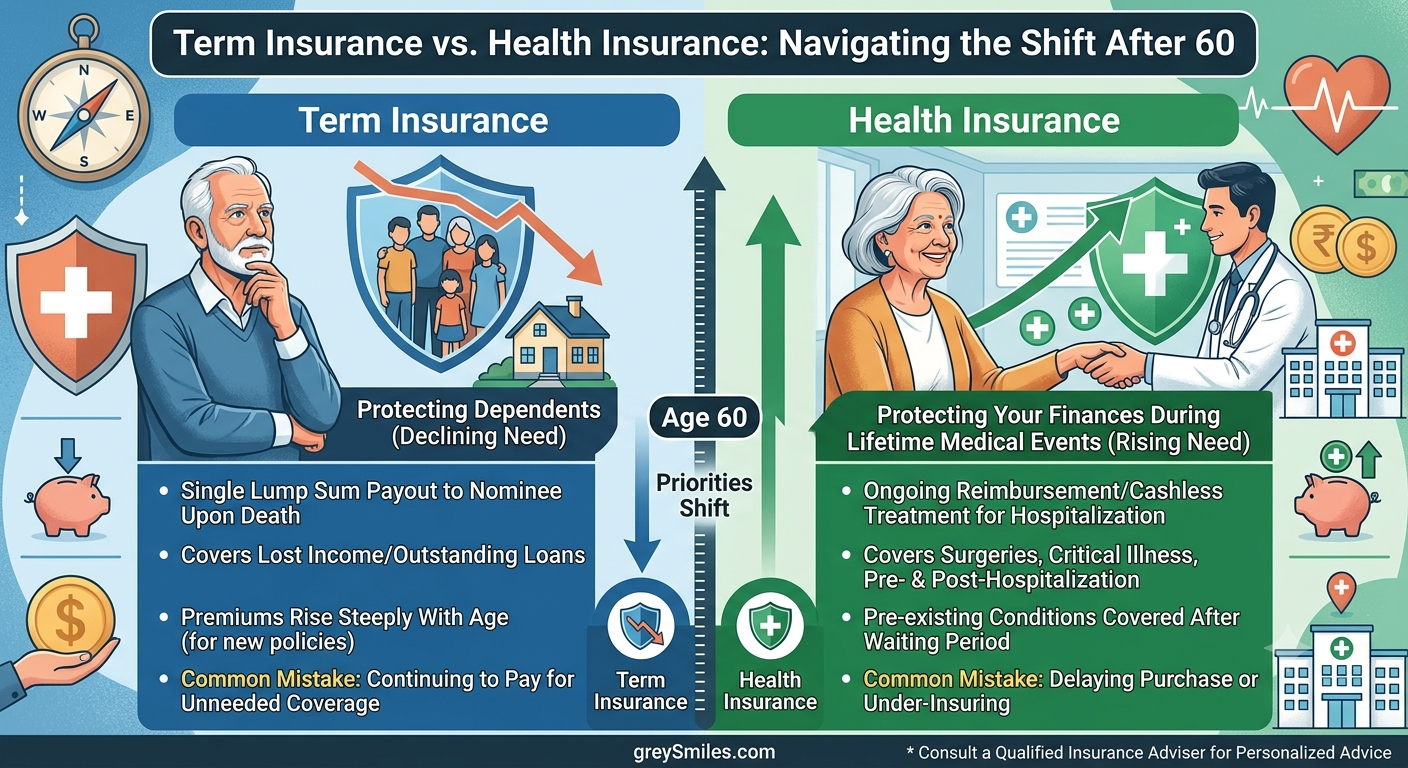
Understanding how your insurance priorities flip after age 60: Term Insurance protects dependents, while Health Insurance guards your retirement savings against rising medical costs.
⚡ Quick Takeaways: Term vs Health Insurance After 60
- The Core Priority Flip: In your 30s, premature death is the biggest financial risk. After 60, rising hospitalization costs pose a far greater threat to your nest egg.
- Term Cover Needs Shrink: Unless you still carry active debts, a late mortgage, or financially dependent children, continuing heavy term insurance past 60 is often redundant.
- Health Cover is Essential: Retail health insurance acts as a non-negotiable shield around your liquid mutual funds and senior savings schemes.
- Regulatory Safety Net: IRDAI guidelines mandate lifelong renewability and restrict arbitrary age caps for senior citizen health plans.
Two distinct financial products often get conflated at the exact stage of life where choosing the wrong one can quietly drain your hard-earned retirement savings.
Somewhere around age 60, a quiet shift happens in an Indian family’s balance sheet. Most retirees do not notice it until an annual premium renewal notice arrives or a sudden hospital admission forces the issue. During your peak earning years, term insurance takes center stage—and rightly so. Its sole purpose is to replace your salary for your family if you are no longer there to earn it.
By 60, that core logic weakens significantly. Meanwhile, the argument for comprehensive health coverage becomes overwhelming. This guide cuts through insurance marketing to explain what each product actually delivers, why the financial equation flips so sharply past 60, and how to structure your coverage around your real-world retirement needs.
In This Guide
- 1. Why This Priority Flip Happens at 60
- 2. What Term Insurance Delivers (and Misses) After 60
- 3. What Health Insurance Actually Secures Post-Retirement
- 4. Key Differences at a Glance
- 5. Do You Need Both, Just One, or Neither?
- 6. Costly Mistakes Indian Retirees Make
- 7. Frequently Asked Questions
- 8. The Final Verdict
1. Why This Priority Flip Happens at 60
Term insurance and health insurance were never designed to compete. They handle completely different risks at different phases of your financial lifecycle.
When you are 35, the primary catastrophic financial risk is premature death. If your income suddenly vanishes while you are funding school fees and servicing a 20-year home loan, your family faces immediate financial distress. Term insurance solves that exact vulnerability.
By age 60, the landscape looks fundamentally different for most urban Indian households:
- Children have generally completed their higher education and earned their financial independence.
- Home loans and major liabilities are either fully cleared or nearing final settlement.
- The primary risk is no longer lost future income—it is a single prolonged hospitalization consuming a fixed retirement corpus in India that can no longer be replenished with a monthly paycheck.
Crucially, this transition coincides with the abrupt ending of corporate group mediclaim policies. Relying purely on employer cover until the day you retire is one of the classic habits that erode a retirement corpus. A single ICU stay or complex cardiac procedure in your late 60s without adequate health insurance can alter an otherwise bulletproof retirement blueprint.
2. What Term Insurance Delivers (and Misses) After 60
Term insurance operates on a straightforward mechanism: it pays a fixed, tax-free sum to your nominee if you pass away during the policy tenure. It carries no cash value, offers no maturity survival payouts, and is priced almost exclusively on mortality probability.
Because mortality risk accelerates sharply past 60, buying a fresh term policy at this stage is notoriously expensive. Medical underwriting becomes stringent, and premiums jump exponentially. For an individual who no longer has financial dependents, paying heavy premiums for a term policy essentially solves a problem that no longer exists.
However, specific edge cases do remain valid:
- Active Financial Liabilities: You are still servicing a business loan, property mortgage, or personal liability that would fall on your spouse.
- Late Dependents: You have an adult child with special needs or a spouse without independent pension cashflows.
- Legacy Creation: You intentionally want to pass a tax-advantaged lump sum to a grandchild or a trust.
If none of these apply, continuing to pump money into a heavy term policy is often an unnecessary drain on your monthly cashflows.
3. What Health Insurance Actually Secures Post-Retirement
Health insurance reimburses or directly settles (cashless) in-patient treatment, surgeries, day-care procedures, and advanced therapies while you are alive. Unlike term insurance, it can be claimed multiple times across your lifetime.
Medical inflation in India consistently outpaces general CPI inflation, frequently hovering in the 11% to 14% range. Room rents, doctor fees, and surgical technology costs double at a rapid pace. A sum insured that felt generous at age 50 often falls short a decade into retirement.
The biggest hurdle seniors face is timing. Waiting for a major medical diagnosis before buying a dedicated retail health plan is the most expensive path available. While guidelines from the Insurance Regulatory and Development Authority of India (IRDAI) ensure lifelong renewability and restrict arbitrary age limits, pre-existing conditions like hypertension or diabetes trigger mandatory waiting periods (typically 12 to 36 months). Securing a personal retail policy—or porting away from a corporate cover—well before formal retirement locks in coverage before major health parameters shift.
4. Key Differences at a Glance
| Factor | Term Insurance | Health Insurance |
|---|---|---|
| Primary Purpose | Protects dependents against income loss after death. | Protects existing savings against medical bills during your life. |
| Payout Structure | One-time lump sum to nominee upon death during policy term. | Repeated claims (up to sum insured) across lifetime. |
| Relevance at 60+ | Declines sharply, unless specific debt or dependents remain. | Increases dramatically due to age-related healthcare needs. |
| Cost Trajectory | Fresh policies at 60+ carry prohibitively high premiums. | Premiums rise with age slabs, but continuous renewals maintain cover. |
| Pre-Existing Conditions | Can lead to outright rejection during medical screening. | Triggers waiting periods, after which coverage applies. |
5. Do You Need Both, Just One, or Neither?
For an individual stepping into their 60s with financially settled children and no pending home loans, the decision framework simplifies quickly:
- Health Insurance is Non-Negotiable: A robust health policy (ideally a base sum insured of ₹15–25 Lakhs paired with a high-deductible Super Top-Up policy for cost-efficient scale) is essential. It acts as a shield around your equity mutual funds, senior savings schemes, and liquid fixed deposits.
- Term Insurance is Optional: If your surviving spouse can live comfortably on existing rental income, systematic withdrawal plans (SWPs), or pension annuity income in India without relying on your salary, continuing a massive term cover is often redundant. The capital used for those high premiums can instead boost your health insurance coverage or sit in liquid investments.
The exception? If you still support a family member who cannot earn independently, or carry a co-signed mortgage, retain a targeted, right-sized term cover. Match the policy duration precisely to the timeline of that specific obligation rather than signing up for an unnecessarily long contract.
6. Costly Mistakes Indian Retirees Make
Navigating insurance in retirement requires avoiding a few common traps:
- Assuming Corporate Conversion is Automatic: Relying on your company’s retiree continuation plan without reviewing the underlying co-pay clauses or sub-limits on room rents often causes surprises during hospitalization.
- Ignoring Room Rent Capping: Many older individual policies feature room rent caps (e.g., 1% of sum insured per day). If you select a room above that limit, insurers apply proportionate deductions across the entire hospital bill—including doctor fees and surgery costs. Upgrading to a policy without room-rent restrictions is vital.
- Failing to Audit Nominees and Legal Estate Structures: Incorrectly documented nominations on financial assets create paperwork hurdles during stressful moments. Having a clear legal structure, as highlighted in our guide on nominees vs. wills in India, ensures seamless claims processing.
- Ignoring Alternative Cashflow Tools: If health insurance becomes completely unviable due to severe pre-existing illnesses, asset-rich but cash-poor seniors can evaluate legal instruments like Reverse Mortgages to build a dedicated emergency healthcare reserve. Detailed guidelines on reverse mortgage structures are maintained by the Reserve Bank of India (RBI).
7. Frequently Asked Questions
Do I need term insurance after 60?
Usually not, provided your financial dependents are settled and your retirement portfolio can support your spouse’s living costs. Term insurance replaces lost monthly earnings. Once you transition into passive income or corpus withdrawals, the corpus itself takes over that protective role.
What is the maximum entry age for health insurance in India?
While insurers previously imposed hard limits around age 65, recent IRDAI regulatory updates require health insurers to offer products without rigid entry age caps and guarantee lifelong renewability. That said, underwriting rules for senior citizen plans still apply, so applying earlier reduces friction.
Can I buy health insurance with pre-existing conditions after 60?
Yes. Insurers regularly issue senior citizen policies to applicants with hypertension, type-2 diabetes, or past surgeries. However, expect a mandatory waiting period (ranging between 12 and 36 months) for those specific conditions, along with possible co-pay terms or premium adjustments.
How does a term insurance claim differ from a health insurance claim?
A term insurance claim is a one-off lump-sum payout delivered to your beneficiary after your death to settle debts or fund living costs. A health insurance claim pays out during your life, covering hospital stays, surgeries, and treatments, and can be used across multiple events during the policy year.
8. The Final Verdict
At 60+, health insurance acts as your primary defense, while term insurance becomes a legacy tool to re-evaluate rather than blindly renew. Reviewing your policies with a fee-only, qualified financial adviser can help tailor these choices to your family’s exact needs.
Read next on GreySmiles: Why You Should Target a ₹4 Crore Retirement Corpus · What Are Pension Plans and How Do They Work in India?




Start the conversation
Share a helpful experience, ask a thoughtful question, or add another perspective for fellow readers.