
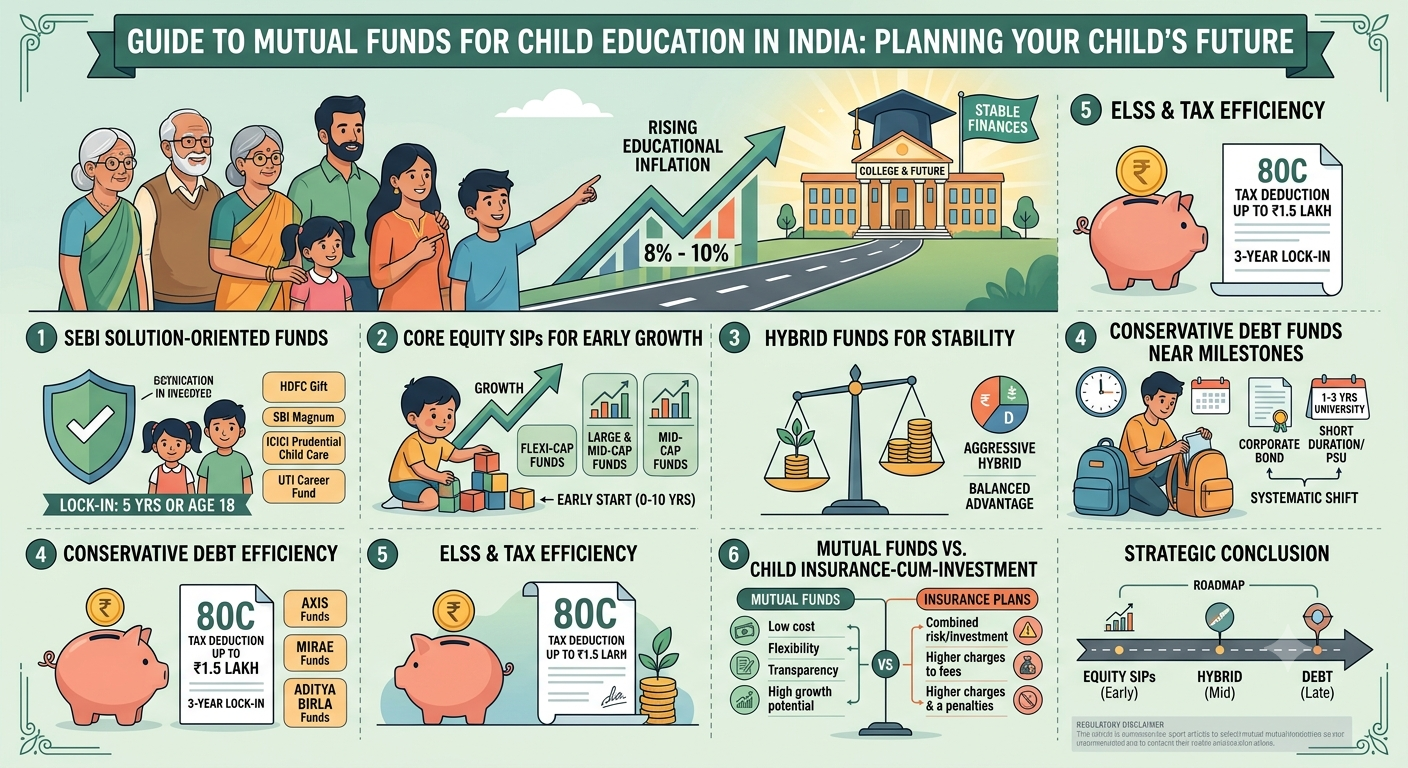
Selecting the best mutual funds for child education is one of the most effective steps parents can take to beat rising university costs and build long-term wealth. Securing a child’s future financial needs—from quality higher education to milestone life events—demands a proactive, inflation-adjusted investment roadmap. In India, soaring educational inflation, which often outpaces general CPI inflation at rates exceeding 8% to 10% annually, makes traditional savings accounts and fixed deposits insufficient for long-term real wealth accumulation. While many parents search for specialized “Child Care Gift Plans,” the modern Indian financial landscape offers a nuanced mix of formal Solution-Oriented Children’s Funds under Securities and Exchange Board of India (SEBI) regulations, broad-market equity SIPs, hybrid strategies, and tax-efficient structures. Navigating these avenues requires balancing risk tolerance, compounding horizons, and liquidity constraints. In this comprehensive guide, we unpack the mechanics of solution-oriented schemes, compare core equity and hybrid strategies, examine tax-saving ELSS options.
1. SEBI Solution-Oriented Mutual Funds for Child Education
Under the categorization norms defined by AMFI (Association of Mutual Funds in India) and SEBI, “Solution-Oriented Schemes – Children’s Funds” are specifically structured to help parents save for major milestones like higher education and marriage. When evaluating mutual funds for child education, these schemes typically feature a mandatory lock-in period of 5 years or until the child reaches adulthood (age 18), whichever comes earlier. This built-in lock-in enforces behavioral discipline, preventing parents from prematurely liquidating capital during market volatility.
- HDFC Children’s Gift Fund: Focuses on long-term capital creation through an equity-oriented hybrid asset allocation, ideal for long-term horizons exceeding 5 to 7 years.
- SBI Magnum Children’s Benefit Fund (Investment Plan / Savings Plan): Offers distinct options ranging from equity-heavy aggressive wealth growth strategies to conservative debt-oriented asset mixes depending on the time left before college admission.
- ICICI Prudential Child Care Fund (Gift Plan): A strategic mix of equities and fixed-income securities designed to navigate market cycles while maintaining capital growth.
- UTI Children’s Career Fund (Equity / Savings Option): Built around customized goal tracking, allowing parents to build a dedicated corpus starting from early childhood.
To learn more about structuring your portfolio for multi-decade timelines, check out our detailed guide on small-cap mutual funds compounding on Greysmiles.
2. Core Equity Mutual Funds for Child Education Growth
For parents starting early (when the child is 0–5 years old), standard diversified mutual funds for child education via Systematic Investment Plans (SIPs) often offer higher growth potential than solution-oriented funds without tying up liquidity with lock-in clauses.
- Flexi-Cap & Large & Mid-Cap Funds: Schemes like HDFC Flexi Cap Fund or ICICI Prudential Large & Mid Cap Fund allow fund managers to dynamically alter market-cap exposure according to prevailing valuation cycles.
- Small-Cap / Mid-Cap Funds: High-beta funds such as SBI Small Cap Fund or Axis Midcap Fund offer multi-fold compounding over 10 to 15-year time horizons, though they experience sharper short-term volatility.
Systematic monthly investments help dollar-cost average (rupee-cost average) the purchase price, insulating parents from market timing anxiety.
3. Hybrid Funds: Balancing Growth and Stability
When a child reaches ages 10 to 14, capital preservation begins to share equal importance with equity growth. Hybrid mutual funds for child education automatically rebalance portfolios between equities and debt instruments to limit drawdowns during equity market corrections.
- Aggressive Hybrid Funds (e.g., HDFC Hybrid Equity Fund): Maintain a 65%–80% equity exposure for wealth growth, with the remainder in high-grade fixed income for cash-flow stability.
- Balanced Advantage Funds (e.g., ICICI Prudential Balanced Advantage Fund): Use dynamic asset allocation models to automatically increase debt allocation when stock markets become expensive and increase equity exposure during market sell-offs.
Parents can balance risk across different life stages by reviewing our guide on optimal portfolio asset allocation strategies on Greysmiles.
4. Conservative Debt Funds for Near-Term Milestones
When the child is 1 to 3 years away from needing funds for university tuition or vocational training, accumulated savings in mutual funds for child education should be gradually shifted out of equities into low-risk debt mutual funds to protect the accumulated wealth from sudden market downturns.
- Corporate Bond Funds (e.g., HDFC Corporate Bond Fund): Invest predominantly in high-rated AA+ and AAA corporate debt instruments, offering steady predictability.
- Short Duration & Banking/PSU Debt Funds: Suitable for parking capital close to the target withdrawal date with minimal interest rate sensitivity.
5. Equity Linked Savings Schemes (ELSS) for Dual Benefits
Parents looking to integrate their child’s education savings with annual tax planning can consider Equity Linked Savings Schemes (ELSS).
- Tax Deductions: Investments up to ₹1.5 lakh per financial year qualify for deductions under Section 80C of the Income Tax Act (under the Old Tax Regime).
- Shortest Lock-In: ELSS funds come with a 3-year mandatory lock-in—the shortest among Section 80C instruments (compared to 15 years for PPF).
- Examples: Axis Long Term Equity Fund, Mirae Asset ELSS Tax Saver Fund, and Aditya Birla Sun Life Tax Plan.
6. Mutual Funds vs. Child Insurance-Cum-Investment Plans
Many parents evaluate traditional insurance child plans (such as SBI Life Smart Child Plan or HDFC Life Young Star Super Premium Plan) alongside mutual funds.
Key Difference: Insurance-cum-investment products bundle risk cover with capital growth, but typically carry higher mortality charges, surrender penalties, and administrative fee structures that can drag down long-term net returns compared to pure mutual funds. A widely recommended financial approach is to separate risk protection from wealth creation by holding a pure Term Life Insurance policy to secure the child’s financial future, while directing investment capital into low-cost, transparent equity and debt mutual funds.
If you are looking to build additional personal reserves to support your family’s long-term financial goals, read our guide on the career-bifurcation side-hustle model on Greysmiles.
7. Frequently Asked Questions (FAQs)
Can I open a mutual fund account directly in the name of a minor child?
Yes. Mutual fund investments can be made in the name of a minor child with the parent or legal guardian designated as the legal operator of the account. Upon reaching age 18 (adulthood), the status of the account must be updated to a regular adult account following standard KYC procedures.
What is the benefit of a Solution-Oriented Children’s Fund over a regular equity fund?
Solution-oriented children’s funds carry a mandatory 5-year lock-in period (or until the child reaches age 18). This prevents impulsive early redemptions during market panics and helps align long-term family financial goals with disciplined holding periods.
How are mutual fund returns taxed when investing for a child?
Income or capital gains realized from a minor child’s mutual fund investment are clubbed with the income of the parent who earns a higher total income, as per Indian Income Tax regulations. Once the child turns 18, capital gains are taxed separately in the individual child’s hands based on prevailing holding periods and capital gains tax brackets.
When should parents start shifting child goal investments from equity to debt?
A de-risking phase should typically begin 3 to 5 years before the target educational milestone. Parents can systematically transfer equity capital into short-term debt funds or liquid instruments via a Systematic Transfer Plan (STP) to lock in gains and prevent market shocks right before tuition payments are due.
8. Strategic Conclusion & Portfolio Roadmap
While the Indian mutual fund industry offers targeted solution-oriented children’s funds, parents are not restricted solely to labeled products. Selecting effective mutual funds for child education comes down to matching your asset mix with your timeline: utilizing aggressive equity SIPs in the child’s early years (0–10 years old), transitioning toward balanced hybrid strategies during middle school years (11–14 years old), and systematically shifting funds into low-volatility debt instruments as university enrollment approaches (15–18 years old). By combining disciplined monthly SIP investing, clear asset allocation rules, and periodic portfolio rebalancing, parents can build a robust financial cushion tailored to their child’s aspirations.




Start the conversation
Share a helpful experience, ask a thoughtful question, or add another perspective for fellow readers.